



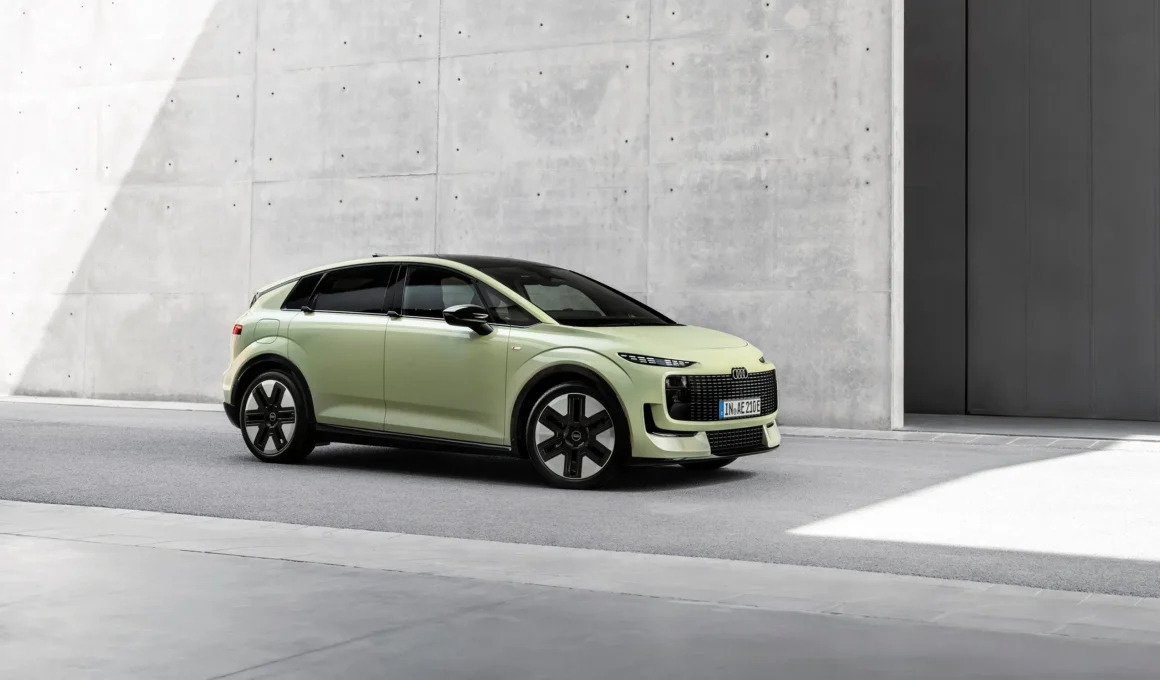
The original Audi A2 lost money on every car it built, and the reason was the aluminium. Presented today in Ingolstadt, the Audi A2 e-tron revives a nameplate that ended production in 2005 after 176,377 units, and it inherits the silhouette almost intact while inverting the logic underneath it. Where the first car chased efficiency through a bespoke material, this one chases it through a production line that already existed.
The 1999 A2 made a case disguised as a supermini. Its Audi Space Frame was built entirely from aluminium, producing a bodyshell of just 153 kg (337 lbs) — around 60 percent of the weight of a comparable steel structure — and the original Audi A2 aluminium space frame made it the first compact car of its era with an all-aluminium body. Exterior design came from Belgian designer Luc Donckerwolke, with Stefan Sielaff leading the interior, and the shape they arrived at was a monospace teardrop nobody in the segment had asked for.

Efficiency was the whole point then, as now. The 1.2 TDI variant, sold from 2001, returned 2.99 liters per 100 km (78 mpg US) and reached a drag coefficient of 0.25, figures that made it the world’s first four-door production car under the three-liter threshold. The most efficient Audi ever built is now the A2 e-tron 140 kW, at 12.8 kWh per 100 km (20.6 kWh per 100 miles) under WLTP — a different unit of measurement for the same obsession.

Proportions carry the reference most directly. The new car stands 1.55 m (61 in) tall, within millimetres of its predecessor’s 1,553 mm, but the wheelbase has grown from 2,405 mm (94.7 in) to 2.77 m (109.1 in), stretching the same basic volume over a longer footprint. The Audi A2 e-tron design reads as the older car’s monospace profile pulled taut: short overhangs, a heavily raked windscreen, a roofline that descends gradually before terminating in a defined spoiler that manages airflow separation at the tail.

Aerodynamics replaced weight as the primary lever, and the numbers show where the effort went. A drag coefficient of 0.24 makes this the slipperiest car in Audi’s compact range, achieved through a controllable cooling-air intake that stays shut during normal highway running, a largely enclosed underbody, and gap reducers integrated into the wheel-arch trims that narrow the space between tire and arch. Electric car aerodynamics now do the work that the aluminium space frame did in 1999, at a fraction of the manufacturing cost.

The front is a black panel rather than a grille, with sensors and main headlights recessed into it and slim daytime running lights sitting above — four digital signatures are available, three static and one with a moving light effect. Fully electric door handles with haptic sensors sit flush in the side profile, opening to a light pull and locking to a press, with an energy store built into the door so they still function if the vehicle’s electrical system fails. It is the first entry-level application of the Audi design language that Massimo Frascella, the brand’s Chief Creative Officer since 2024, has been steering since the Nuvolari supercar took it to production — Frascella himself counts the original A2 among the Audi models that, in his words, “redefined car design.”

Inside, the Softwrap does the talking: a soft, fabric-covered surface running from the instrument panel across the doors and into the rear, rising to the window ledge trim. An optional panoramic glass roof adds 1.6 m² (17.2 sq ft) of glass with a UV and heat coating, and the Audi A2 e-tron interior holds 396 liters (14 cu ft) of luggage, expanding to 1,336 liters (47.2 cu ft) with the rear seatbacks down. Audi is the first premium manufacturer to fit the patented Fidlock magnetic fastening system as standard, three modular adapters in the center console holding cupholders, cable bags, and lashing straps in place with one click.

Materials carry the circular brief. Depending on configuration, the car uses more than 300 components made from recycled steel, aluminium, and plastics, with over 100 containing post-consumer recycled content drawn from sources including end-of-life vehicles. The rear door module combines steel, plastics, and glass with post-consumer content for the first time, and the optional Softwrap and sports seat fabrics are made from 100 percent recycled polyester — recycled materials in car interiors being the hardest place to use them convincingly, which is precisely why they appear here.

Production is the actual innovation. Audi built the A2 e-tron at its Ingolstadt home plant across roughly 110,000 m² (1.18 million sq ft), reusing more than 1,200 existing manufacturing assets and around 250 robots already deployed on other models, with bodies produced on the same flexible lines as the A3. The car reached market 21 months faster than comparable predecessors, and compact electric car efficiency here refers as much to development time and capital expenditure as to kilowatt-hours.

Four power levels and three batteries cover the range: from 125 kW and 350 Nm (258 lb-ft) to 240 kW and 545 Nm (402 lb-ft), across 52, 61, and 84 kWh gross capacities, with rear-wheel drive throughout and WLTP range peaking at 646 km (401 miles). “It shows how we are rethinking premium for Europe: using resources more intelligently without compromising on quality, technology, or customer experience,” says Audi CEO Gernot Döllner. The Audi A2 e-tron price starts at €38,200 in Germany — which, adjusted for twenty-six years, is roughly where the original sat when buyers decided it cost too much.