



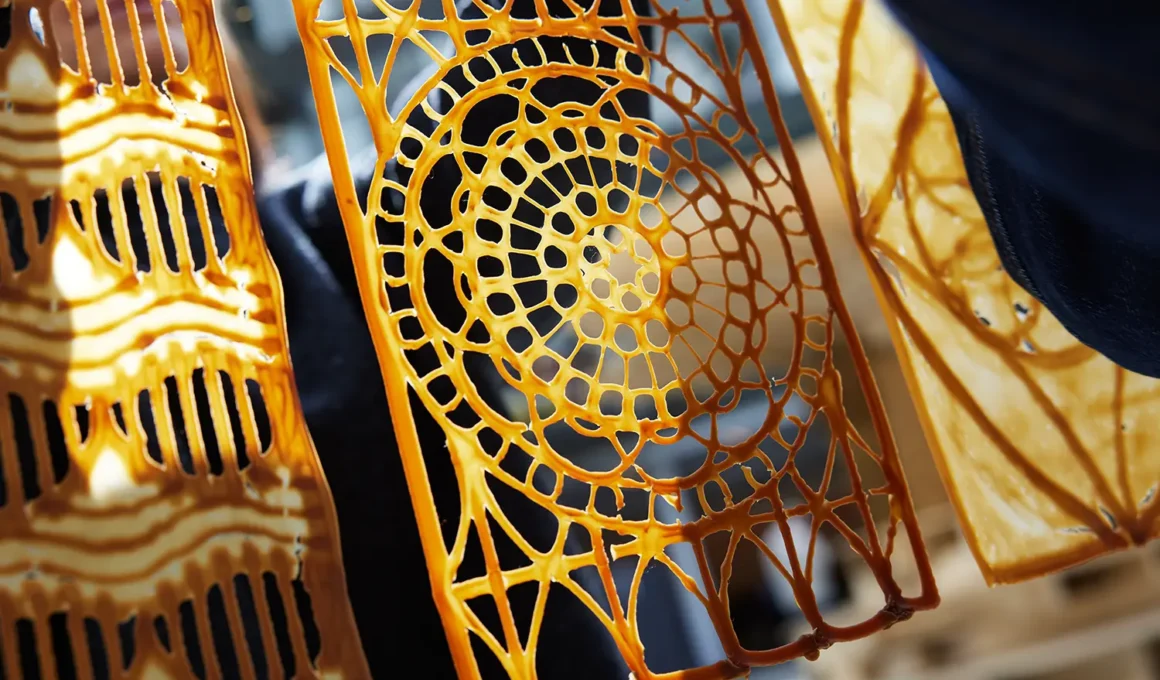
Researchers at Chalmers University of Technology in Gothenburg have developed a fully bio-based architectural material made from baker’s yeast, cellulose fibres, algae-derived alginate, plant-based glycerol, and water — a combination that produces a hydrogel printable at room temperature into screens, partitions, and wall panels with no waste, no fossil inputs, and a built-in end-of-life. The study, published in Frontiers of Architectural Research in early 2026, is the first to use yeast not as a fermenting agent but as structural biomass — a binder that gives the mixture its volume, viscosity, and mechanical strength. The provocative implication is stated plainly by the research team: a material designed to degrade is not a compromise. It is a design position.

The construction sector is responsible for a disproportionate share of global emissions and resource consumption, and the pressure to find renewable alternatives to plaster, synthetic textiles, and petroleum-based plastics has produced a growing field of bio-material research. What makes the Chalmers formula distinctive is not the ambition — engineered living materials, or ELMs, are an active frontier — but the ingredient. Yeast is ubiquitous, inexpensive, industrially produced at scale, and generates significant residual biomass through brewing and agriculture that currently has no secondary use. “Residue that cannot be used as food or animal feed could therefore be used in architecture,” said Professor Malgorzata Zboinska, who led the study.

The production process is deliberately low-tech. The yeast is first heat-deactivated — stabilised, rather than activated — and then combined with the other ingredients to form a smooth hydrogel. The mixture is then 3D printed using air pressure at room temperature, requiring neither energy-intensive heating nor support structures. It dries into its final shape without additional intervention. “3D printing makes it possible to create complex shapes without producing waste. We can design and manufacture the material directly — with a high degree of control over its shape, texture and material distribution,” said doctoral student Yagmur Bektas, co-author of the study. The entire process, from mixing to finished panel, operates on a logic closer to baking than to industrial manufacturing.

The material’s visual range is one of its less-discussed but architecturally significant properties. Depending on formulation, the dried hydrogel produces natural hues ranging from pale cream through amber to deep brown — the colour palette visible in the research photographs is not the result of pigmentation but of the material’s own organic composition. Transparency, surface texture, and porosity can all be adjusted through minor formula changes, making the material suitable for daylight-modulating screens and light-filtering partitions where both visual and thermal performance matter. Natural pigments or pigment-producing yeast strains can shift the colour further without introducing synthetic additives.

The formula’s structural logic distributes specific functions across each ingredient. Glycerol acts as a plasticiser, providing flexibility. Alginate contributes dimensional stability during printing. Cellulose fibres from wood add tensile strength under load. The yeast — deactivated, acting as biomass rather than organism — binds the mixture and controls viscosity. The result is a sustainable building material that behaves as a gel-like viscoelastic solid during printing, retaining its deposited shape before drying to a rigid, handleable panel. Current prototypes demonstrate application as room dividers, wall systems, and sunlight-protecting screens — interior elements that in conventional construction would be made from plaster, plastic, or fossil-derived composites.

The most provocative claim in the research is not technical but philosophical. Unlike every conventional building material in history — designed for maximum durability, tested for longevity, specified precisely because it will not change — the yeast-based material is explicitly biodegradable. It is designed to return to nature after use. “This challenges the traditional notion that materials must last forever,” said Zboinska. “Instead, we can think in terms of shorter life cycles and even view the ageing or degradation of the material as part of the design.” This reframing positions circular design in architecture not as a waste-management problem to be solved after the fact, but as an intention encoded into the material from the outset. For a broader map of where bio-based thinking is reshaping construction choices, the Low-Carbon Material Guide on bio-homes and sustainable infrastructure on urdesign provides useful context.

Further research is needed before the material enters widespread use. Fire safety, moisture performance, structural strength at scale, and the logistics of robotic 3D printing for architecture at building scale all remain open questions. The team at Chalmers — Yagmur Bektas, Malgorzata Zboinska, Cecilia Geijer, Tiina Nypelö, and Zeinab Hefny, working across Chalmers and Aalto University in Finland — frames the current work as a foundation rather than a conclusion. The horizon they describe is more ambitious: self-healing panels, air-purifying wall systems, materials that neutralise pollutants through embedded biological activity. “What we have achieved so far is an important first step,” said Zboinska. “You could say that we are laying the foundations for future developments that combine sustainability, functionality and design in entirely new ways.”

What the Chalmers yeast material ultimately challenges is a foundational assumption that the construction industry has never seriously questioned: that permanence is the correct measure of quality. Every specification sheet, every durability standard, every material warranty in the built environment is premised on the idea that longer life equals better performance. The yeast-based panels propose the opposite — that a biodegradable architectural panel designed for a defined, finite life cycle, made entirely from organic residues, printed without waste, and returnable to nature, might represent a more honest response to the planetary conditions under which buildings are now being made. Whether that argument survives contact with fire codes and procurement committees is a different question. That it is being made at all, at a major technical university, in a peer-reviewed journal, is the news.