



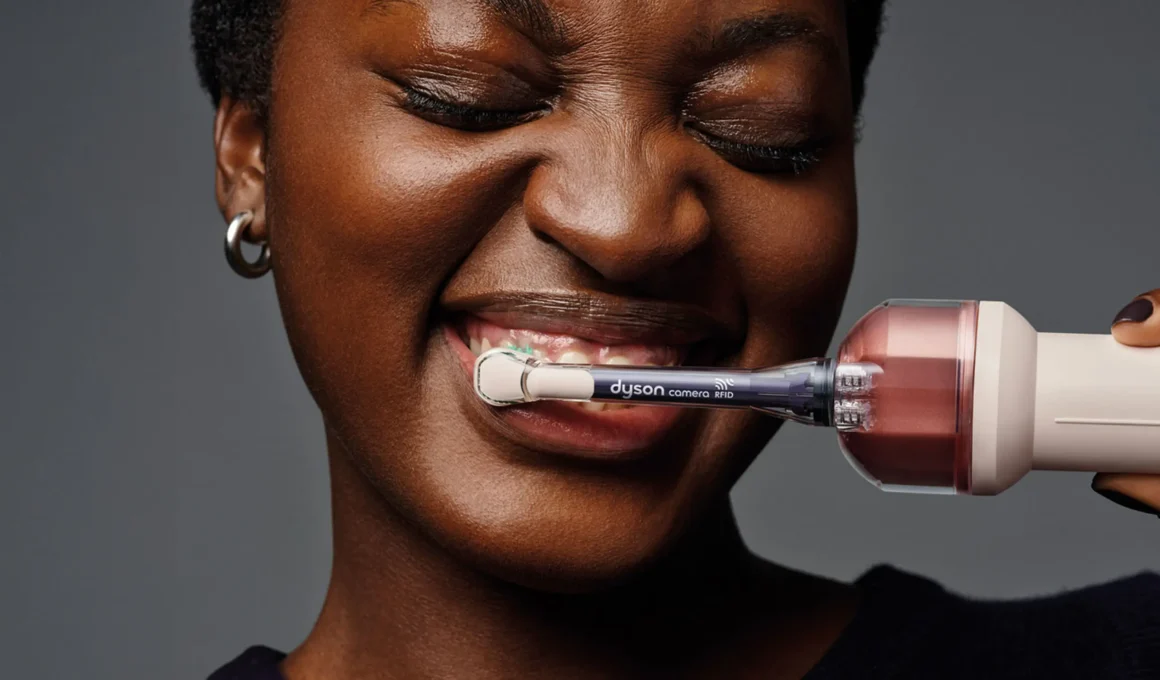
The toothbrush has kept the same basic shape for two and a half centuries, and the reason has less to do with the object than with the one step people quietly skip. On September 1, technology company Dyson launched the CameraJet, a $499.99 (€480) electric toothbrush with a 100,000-pixel macro camera set near the head that locates the gaps between teeth and fires mouthrinse into them. Six years and 661 engineers went into removing a second gesture from the bathroom sink, which makes this a question about behavior before it is a question about hardware.

The archetype barely moved across the centuries that followed its arrival in Europe: the bristle toothbrush appeared in China around 1498, William Addis industrialized it in England around 1780 with a carved cattle-bone handle and boar bristles, and DuPont replaced those bristles with nylon in 1938. Everything else in the history of the toothbrush has been material substitution — bone to celluloid to plastic, animal hair to polymer — applied to the same two parts, a handle and a tuft.

Electrification arrived late and changed the motor rather than the method. Swiss dentist Philippe-Guy Woog developed the Broxodent in 1954, and the first electric toothbrush was aimed at patients with limited motor skills rather than at the general market; General Electric added cordless rechargeable models in the early 1960s, and sonic oscillation followed in the 1990s. Each step made the same gesture faster, or easier to perform correctly. None of them removed a gesture.

The gap Dyson identified sits in the routine rather than in the mouth. The brand says the device answers reports that nine out of ten people do not floss regularly enough, and its own figures put average brushing time at 45 seconds against the two minutes dentists recommend. “Flossing is an awkward and time-consuming chore,” said company founder James Dyson, which places flossing compliance on the engineering side of the problem rather than on the side of discipline.

A camera in the head carries the actual novelty. Set near the bristles, a 100,000-pixel macro lens captures 28 images per second and runs them through an algorithm trained on 470,000 dental images to recognize, track and predict the spaces between teeth. Dyson says those images are processed on the device and are neither stored nor uploaded, which puts AI-powered oral care in the unusual position of watching continuously while recording nothing.

Fluid dynamics do the rest. Where a conventional water flosser produces a needle-like stream, the CameraJet releases a conical spray of up to 0.15 ml (0.005 fl oz) at lower pressure, drawn from a transparent 12.5 ml (0.4 fl oz) tank that a pump keeps pressurized so the jet continues when the brush is held upside down. Dyson reports external testing showing up to 69 percent more plaque removal between teeth and other hard-to-reach areas than market-leading premium electric brushes, measured against a proxy plaque developed with the dentistry faculty at the National University of Singapore.

The evidence sits further back. A 2019 Cochrane review of home interdental devices, covering 35 studies and 3,929 adults, found the available evidence weak and inconsistent, with oral irrigators among the least well supported, and the wider dental literature is consistent on a narrower point: a rinse is an adjunct to mechanical cleaning rather than a replacement for it, because biofilm has to be physically disrupted. What interdental cleaning research cannot yet say is whether a jet aimed by optics rather than by hand behaves like a rinse or like an instrument.

Category entry follows a pattern at Dyson, which has moved from vacuum cleaners into hand dryers, fans, heaters, hair styling tools and, more recently, the OnTrac headphones. “Every Dyson technology begins with identifying a problem that people have largely accepted,” said Niamh Turney, senior commercial manager at the company. Oral care qualified on exactly those terms: a routine unchanged for decades, performed daily by billions, with a well-documented failure point.

The object reads as a Dyson before it reads as a toothbrush. The exposed copper motor bulb below the brush head echoes the engineering logic of the Dyson PencilVac, the brand’s slimmest vacuum, where the entire mechanism has to compress into the smallest possible diameter; the tank is transparent so the fluid stays visible, and the two colorways — Ceramic Ultra Blue and Ceramic Pink — carry the finish logic of the hair tools. Dyson’s industrial design language has always treated visible machinery as the case for the price, and nothing here is hidden.
The toothpaste had to change for the camera to work. Foam clouds the lens, so the brand developed a non-foaming toothpaste without SLS, in Ginger Mint and Spearmint, sold with the mouthrinse and the dock as a single dental system. A device built to see inside the mouth ended up specifying what goes into it first: the lens set the terms, and the foam — the part of brushing that most people would describe as the sensation of it working — had to go.
Dyson CameraJet | Available at: dyson.com — Price: $499.99 USD / €480 EUR