



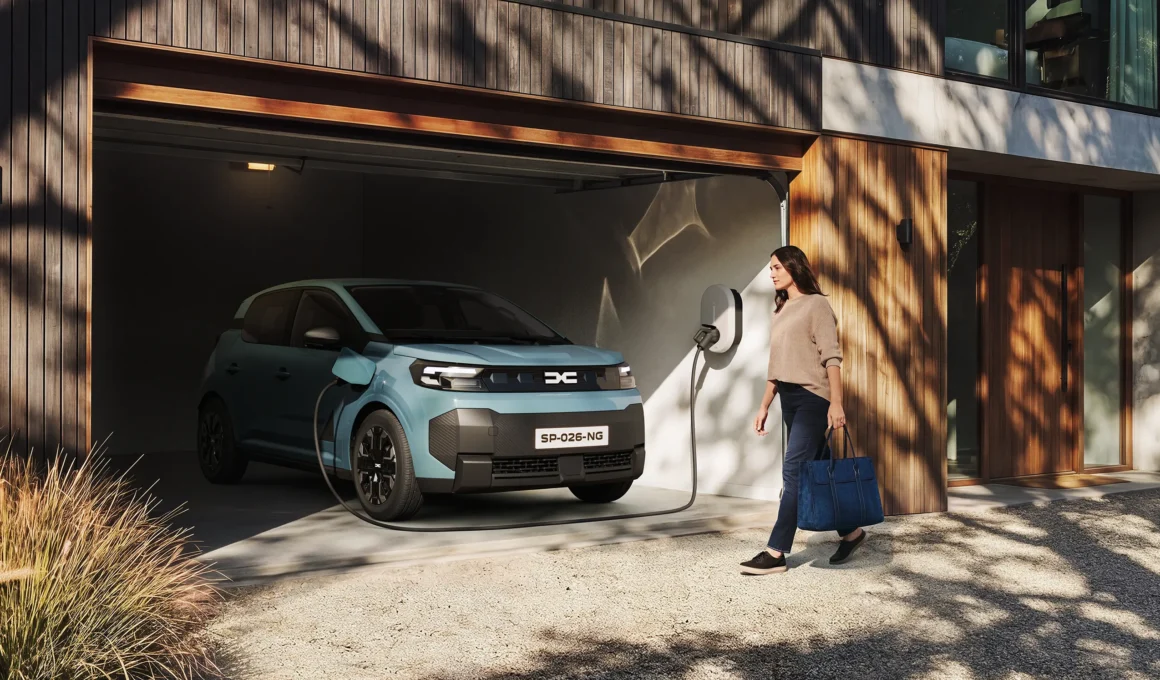
Half of the light signature on the new Dacia Spring doesn’t light up at all. The lower section of each lamp is a plain surface angled at 45 degrees, reflecting the LED strip above it to double the visual signature using half the components. On a car priced under €20,000, that is not a shortcut — it is the design method itself, made visible.

Revealed today, the second-generation New Dacia Spring is the first of four all-electric models Renault Group-owned Dacia has confirmed by 2030. Built on the RG-EV small platform, it replaces a car that sold over 210,000 units across more than forty countries since 2021, and keeps almost nothing but the name: 15 cm (5.9 in) longer, 18 cm (7.1 in) wider, and now assembled in Europe at the Novo Mesto plant in Slovenia.

The reflector solution is the clearest example of what the brand is doing. Drawing on the Dacia Link emblem, the light signature reaches its full shape using a limited number of illuminated parts: only the upper section carries LED diffusers, while the angled surface below does the rest optically, adding depth and a floating effect. Premium brands solve the same problem by adding light sources. Here the cheaper answer and the better-looking one turn out to be identical.

The same logic runs to the rear badge. Rather than attaching separate letters to the tailgate, the DACIA name is formed out of the trim strip itself, its surfaces angled to catch light and generate contrast without a second material or a second assembly step. It reads as understated instead of absent, and it removes a part count, a fixing operation, and a few grams — which on an electric car is never a neutral saving.

Frugal engineering is not a new idea inside this group; the term was coined at Renault in 2006 to describe designing under a hard cost ceiling rather than trimming down from a premium product. What makes the Spring worth a second look is how far that method has migrated into surface detail, the same territory Dacia has been testing publicly with its Hipster concept for affordable urban mobility. Development took under two years, a target the brand treats as a design constraint rather than a schedule.

Durability is designed in rather than repaired later. The protective panels in both bumpers use self-coloured black plastic with a linear textured finish, chosen because it registers scratches and scuffing far less visibly than paint. The gloss black trim strips get a laser-grained surface for the same reason. It is a decision aimed at how these cars actually live: parked tight, used daily, scuffed by strangers.

Weight is the payoff for all that subtraction. At 1,212 kg (2,672 lbs) the Spring is among the lightest A-segment EV offerings on sale, and consumption falls to 12.7 kWh per 100 km (62 miles), one of the lowest figures on the market. The LFP battery carries 27.5 kWh of usable capacity for up to 250 km (155 miles) WLTP, built around iron and phosphate instead of nickel and cobalt — cheaper metals, and more available ones.

Not every decision is this elegant. The rear windows pop outward on a hinge instead of winding down, saving the cost of a full regulator mechanism, and most reviewers have filed the result under compromise rather than cleverness. The criticism is fair, and it is the useful part of the story: the same method produces the reflector trick and the hinged window with equal ease, and what separates them is judgment, not process.

Packaging is where the savings return to the owner. Within 3.85 m (12.6 ft) of length, the Spring carries 337 litres (11.9 cu ft) of boot space, rising to 1,283 litres (45.3 cu ft) with the bench folded — more than some cars a full segment above it. It also remains the only A-segment electric car offered with a frunk, an optional 18-litre (0.6 cu ft) compartment under the bonnet, sized for precisely one object: the charging cable that would otherwise spend its life rolling loose around the boot.