



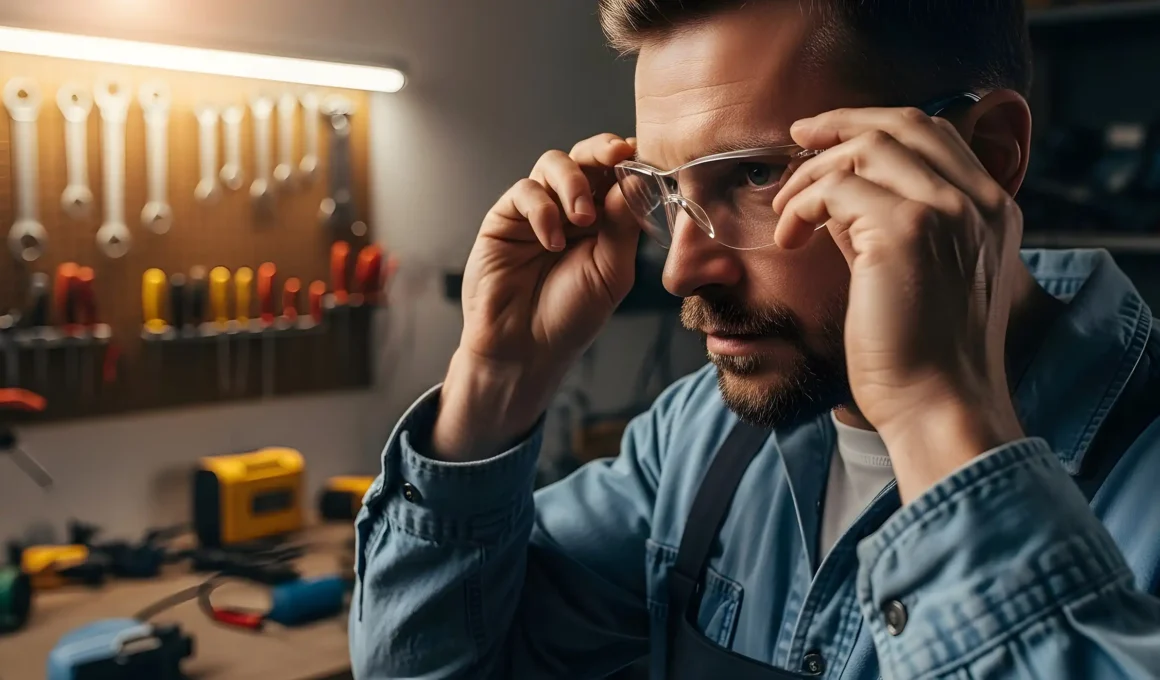
Weekend projects can be unpredictable. Firstly, one might be trimming hedges in their backyard, and seconds later you may find them in the garage fixing a leaking pipe; just to relocate back outside to build a deck. For eyeglass wearers, these transitions between activities usually results in continuous deliberating about if they want to take the risk of wearing their everyday eyeglasses. Many, just choose to struggle through blurry vision.
Now, the truth is that most active people will spend the majority of their time partaking in potentially hazardous activity at home, versus any work environment. Only few to no people ever consider what kind of protective eyewear to wear until something goes wrong for them. Animals shoes off dirt in the garage, wood chips flying during a DIY project, chemical splashes during cleaning or debris being kicked up during yard work all add up very quickly to the possibilities of threats to your vision.
Par for the course, ordinary prescription eyeglasses were never manufactured to handle these conditions. Ordinary glasses have some degree of style and comfort while seeing clearly doing simple, regular daily life tasks. This leaves eyeglass wearers in an extremely awkward place when they try to tackle projects around the house or anywhere else that involves an hard effort, or force is needed.
The Issue with Protective Solutions
The majority of the time people will try to answer this dilemma with improvisatory fixes that are creative but ultimately unsatisfactory. Some will try to wear an incorrect set of safety glasses over their prescription frames, which creates a clumsy pair of glasses often does not fit or seal correctly against the face. Others will take off their eyeglasses completely and work with diminished vision which actually increases the chance for an injury, not decrease it. Contact lens solution may be helpful for some people, but introduces its own complications. Contact lenses often trap particles against the eye, and many people find them uncomfortable with dusty or dirty work. Additionally, not everyone can comfortably tolerate wearing contact lenses for long periods of time, especially when engaged in physical activities that may cause sweating.
These makeshift approaches often discourage people from taking on new projects they may have otherwise enjoyed. When the equipment isn’t working, the activity becomes frustrating rather than fulfilling. Some eyeglass wearers, for example, have reported avoiding certain hobbies or maintenance tasks around the house simply because they couldn’t find a reasonable way to see clearly while remaining protected.
The Right Gear for Multi Tasking
The question of versatility becomes important when considering that most people do not want to buy special eyewear for every new activity. If the eyewear worked great for woodworking but did not function as good for gardening, this wouldn’t serve someone who enjoys both hobbies.
Many people have discovered that well-designed prescription safety glasses provide the flexibility one is looking for when performing a variety of activities because they protect against multiple hazards and are comfortable for those who need to use the eyewear for long periods of time. Again, the emphasis is finding stylish safety eyewear that provides enough protection without being so specialized that it lose efficacy for a different type of work.
The type of activities that provide the most benefit from this approach involve hazards associated with projectiles, chemicals, and/or bright light. As we previously mentioned, woodworking most certainly would fall into the projectile hazard as it includes flying chips and splinters in addition to sharp tools. Other types of activities that fall into the projectile scenarios can be related to metal work, automotive repair, or even preparing certain foods in the kitchen. Gardening and cleaning may involve the risk of chemical exposure from fertilizers, pesticides, and cleaning products. Time spent outside may involve prolonged exposure to the sun’s intensity which, over time, adds to eye strain.
Outdoor Projects and Weather
Weather brings additional complexity to the protective eyewear dilemma. Everyday glasses struggle with temperature transitions leading to fogging, they can also collect raindrops that obscure vision, or even sweat on the lenses due to hot, sweaty work. These frustrations can be exacerbated when working on outdoor projects as conditions can change throughout the day.
Many of us find exits that our everyday prescription glasses simply aren’t sufficient enough to keep up with prolonged outdoor work exposure. Sweat causes the glasses to slide down the nose; wind carries debris that scratches the lenses; and changes in temperature leads to fogging that disrupts work flow.
The fogging issue deserves specific attention because it impacts comfort and safety. Once the glasses fog up while trying to work on a project; people are bound to want to remove the glasses in frustration to regain clear vision. This will often be the moment when you have compromised protection and continue to work, which results in the perfect combination for an injury.
The Garage Workshop Dilemma
Garage workshops create challenges for glasses wearers as garage workshops combine many types of hazards in one area. Power tools create flying debris; automotive fluids often splash; welding or soldering creates intense light and sparks.
Many home workshop hobbyists report frustration while trying to utilize a combination of glasses to complete different aspects of any one project. Switching between prescription glasses and safety glasses during a project is an interruption to the flow of work, and if safety is not adhered to, you may forget to put the glasses on at the critical moment.
The issue becomes amplified in many garages. Fluorescent lights and work lights produce glare that becomes difficult for the eyes, all while there are shadows that make seeing finer detail near impossible. A pair of prescription glasses designed to see well under typical indoor lighting may not provide the best vision in a space where the lighting is less than ideal.
Long-term Comfort and Functionality
Comfort is critical when you are performing for hours rather than minutes. An entire weekend project often lasts longer than you anticipated it would be to complete, and it is uncomfortable and potentially painful to wear glasses and have those glasses make the hobby you began with an exciting endeavor seem more like a challenge to finish the project than a fun activity.
Weight distribution is very important for long-term wear. A pair of glasses that seem fine after only 30 minutes of wear, may cause headaches or discomfort on the bridge of the nose after having worn them for a few hours. The material used for frames varies. Some frames will out last others or feel more comfortable during physical activity.
The treatment on lenses, of course, comes into play with functionality of the protective eyewear. Anti-scratch coatings on lenses allow for clearer and longer vision, whilst an anti-reflective treatment reduces strain on the eyes when making detailed cuts. What starts out as a small addition becomes the primary reason you wear your protective eyewear when it begins to shed light on how those features are important in either keeping your eye protection in use or store it after each activity or work week.
Return on Investment
Many people feel that it is pretty expensive to get quality prescription safety glasses that ultimately enhance projects and activities, which makes sense in comparison to buying specialized eyewear for every other different hobby or type of project. The eye protection is one pair of eyewear that can perform for numerous activities or projects.
The durability component should factor in the value portion as well. As the value equation comes into play, anything built to take the abuse in any domain, glaucoma frames appear to hold up significantly better than regular eyewear. Good designated safety glasses last a significantly longer time than regular eyewear in anything physical, and in particular, if enjoyed at one point in time…and that goes for both types of eyewear, the longer they last calms anxiety about replacing the regular eyeglasses which continue to fail before any safety glasses.
People, who are more active, in particular, begin to learn work safety and enjoy the new projects and activities, which in part act to make sight protection and safety glasses acceptable for continued projects. If equipment and protection works properly, then the excitement of trying to carry out new projects or activities becomes more of a fun challenge than managing comfort with eyeglasses that do not serve the person at the end of the day.