



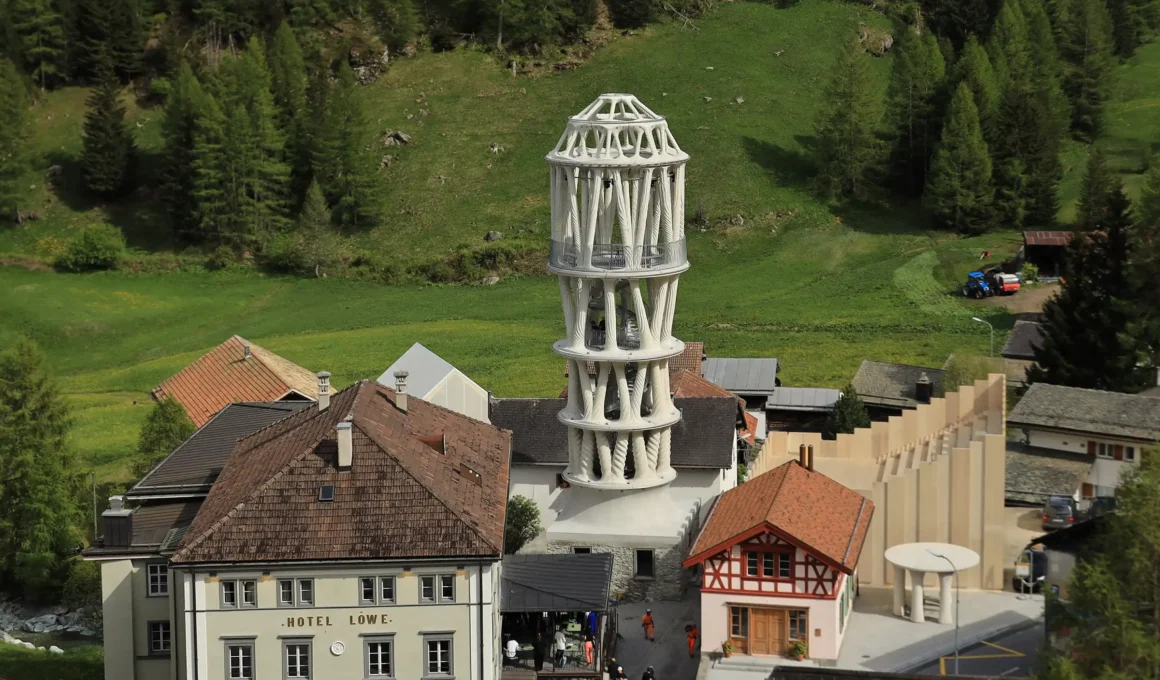
Rising gracefully against the Swiss alpine landscape, Tor Alva in Mulegns stands as a testament to the future of 3D-printed architecture. Designed by Michael Hansmeyer and Benjamin Dillenburger of ETH Zurich, this striking white concrete tower is now the world’s tallest 3D-printed structure, pushing the boundaries of computational design and robotic fabrication.

The 12-meter-high tower is a mesmerizing fusion of Gothic intricacy and cutting-edge technology, featuring an elaborate lattice-like facade that could only be achieved through algorithmic modeling. Unlike traditional construction methods, Tor Alva was built using a large-scale 3D printer, layering fast-hardening concrete to create its delicate, organic forms without the need for molds or manual sculpting. This sustainable construction approach minimizes material waste while maximizing structural efficiency.

Originally commissioned as part of the Swiss Historic Hotels initiative, the tower serves as a landmark pavilion for the historic Hotel Walserhof in Mulegns. Its name, Tor Alva—meaning “white gate”—reflects its role as both an architectural marvel and a symbolic portal between past and future. The design draws inspiration from historical confectionery molds, reinterpreting their intricate patterns at an architectural scale.

Beyond its aesthetic allure, Tor Alva represents a breakthrough in digital fabrication. The ETH Zurichteam utilized parametric design tools to optimize the structure’s geometry, ensuring stability despite its seemingly fragile appearance. Each component was 3D printed off-site and assembled in Mulegns, demonstrating the potential for prefabricated architectural elements in remote locations.

As the latest milestone in 3D-printed construction, Tor Alva challenges conventional notions of what buildings can look like—and how they are made. Its success paves the way for more complex, sustainable, and customizable architecture, proving that robotic construction is no longer a futuristic concept but a tangible reality.

For those visiting Switzerland, Tor Alva is more than just a structure; it’s a glimpse into the next era of design innovation, where technology and artistry merge to redefine our built environment.