


Within the walls of Turin‘s Ex Mulini Feyles, a 19th-century industrial complex steeped in history, a transformation is underway. ecoLogicStudio, the architecture and research firm known for its pioneering work in bio-design, has unveiled its latest project – the Design Apothecary. This ambitious endeavor reimagines the former industrial space as a vibrant center for creativity and sustainable living.

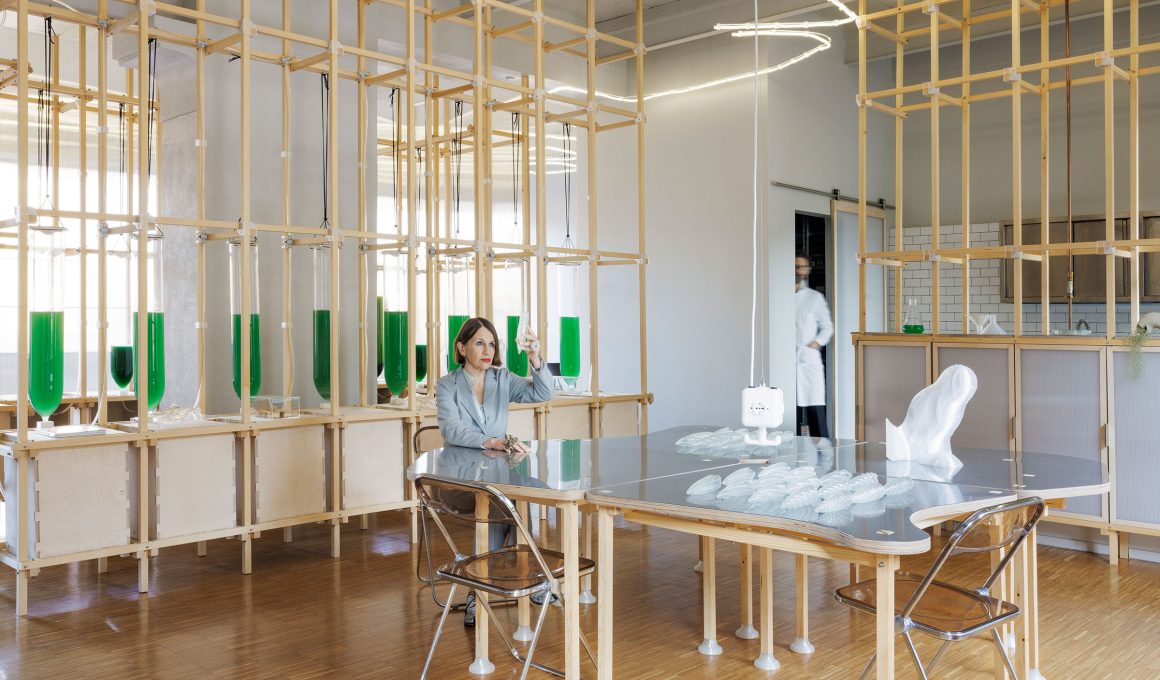
The Design Apothecary is a testament to ecoLogicStudio’s philosophy of integrating nature and technology. The heart of the project is a striking algae garden, a network of 17 photobioreactors that form a living air purification system. These bioreactors, filled with Spirulina, Chlorella, and Cyanidium cultures, not only capture CO2 at a rate equivalent to four mature trees but also metabolize pollutants, contributing to a healthier indoor environment.

The algae cultivated within this living laboratory serve multiple purposes. The harvested biomass is used to create fertilizer for the on-site medicinal plant garden, provides a protein-rich ingredient for culinary experiments, and acts as a raw material for 3D-printed bioplastics used in the creation of design objects and furniture. This closed-loop system exemplifies a commitment to circular economy principles, minimizing waste and maximizing resource utilization.

The architectural design of the Design Apothecary complements its bio-centric focus. The algae garden, constructed from a modular fir wood lattice with stainless steel hardware and 3D-printed joints, creates a visually engaging and adaptable structure. The space also features a living lab room for research and experimentation, a balcony housing a library of medicinal plants, and a drawing room that serves as an exhibition space for bio-art and design products.

The Design Apothecary transcends its function as a design studio and exhibition space. It serves as a prototype for a new kind of ecologic domesticity, where living systems are seamlessly integrated into the built environment. By harnessing the power of photosynthesis and embracing circular economy principles, ecoLogicStudio has created a space that fosters well-being, promotes sustainability, and reconnects inhabitants with the natural world.

This project signals a new direction for adaptive reuse, demonstrating how historic industrial spaces can be transformed into vibrant hubs for innovation and sustainable living. The Design Apothecary is a powerful example of how design can address pressing environmental challenges and create a more harmonious relationship between humans and nature.