



The evolution of the modern hotel room has long been tethered to a rigid duality: the sterile efficiency of business travel or the literal, often gaudy, symbolism of themed “kid suites.” However, as the hospitality sector undergoes a radical transformation, we are seeing a shift toward hyper-specialization. From the ultra-efficient modularity of self-service concepts in Ningbo to the extraterrestrial luxury of stainless-steel villas in the Red Sea, the industry is finally embracing specific human narratives. Within this landscape, ARCHSTUDIO has unveiled the Mountain Journey Family Suite in Shenzhen, a project that eschews flat surface-level aesthetics in favor of a three-dimensional, topographical exploration of domestic space.

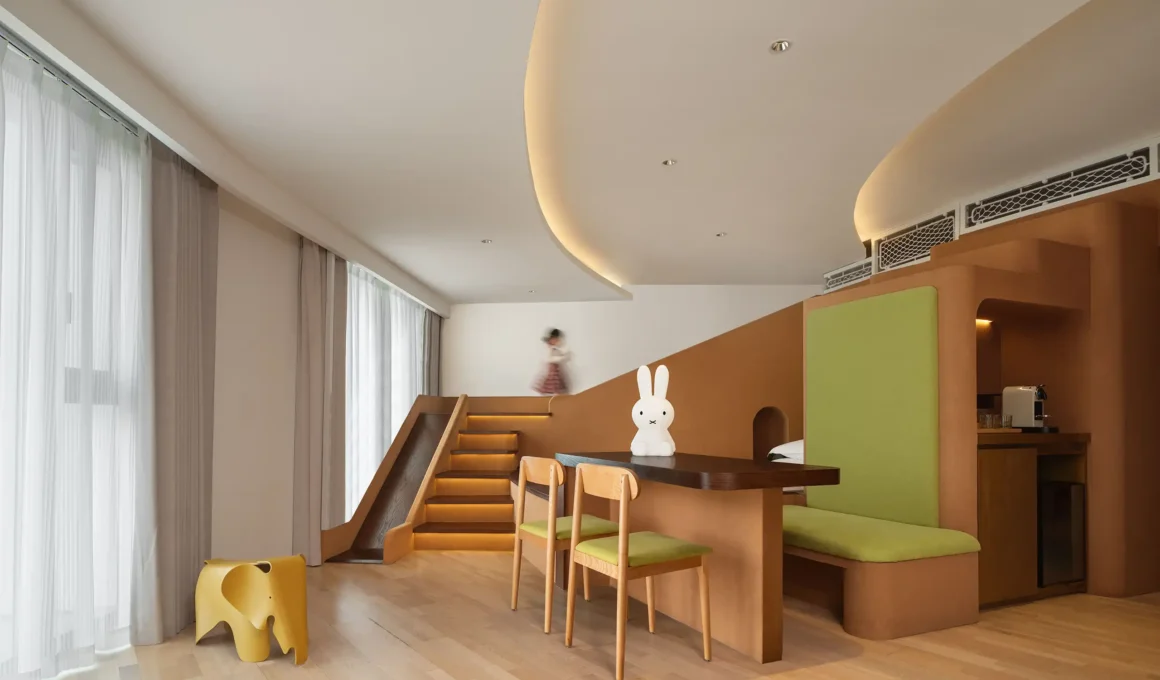
A conceptual vision of “spatial wandering” defines the 130-square-meter footprint within the Shenzhen Women and Children’s Center. Commissioned as a public-interest initiative, the designers were faced with an irregular, rhombus-shaped layout that defied traditional compartmentalization. Rather than fighting the geometry, ARCHSTUDIO transformed the suite into a miniature landscape. The design philosophy moves beyond the “urban jungle” tropes we’ve seen in reimagined boutique hotels, opting instead for an abstract “mountain” that serves as both furniture and infrastructure. It is a space where the act of “staying” is replaced by the act of “discovering.”
The technical core of the project is governed by a rigorous 35-centimeter height module. This specific increment dictates the terraced slopes of the mountain, creating a rhythmic ascent that accommodates every essential hotel function. Living, dining, and sleeping areas are not separate rooms but plateau-like destinations within a continuous vertical journey. By utilizing this mathematical logic, the architects have successfully integrated play zones—slides, tunnels, and rope nets—into the structural fabric of the suite. It is a sophisticated exercise in human-centric spatial organization, ensuring that while children find a playground, adults find a cohesive, sculptural environment that feels intentional rather than cluttered.

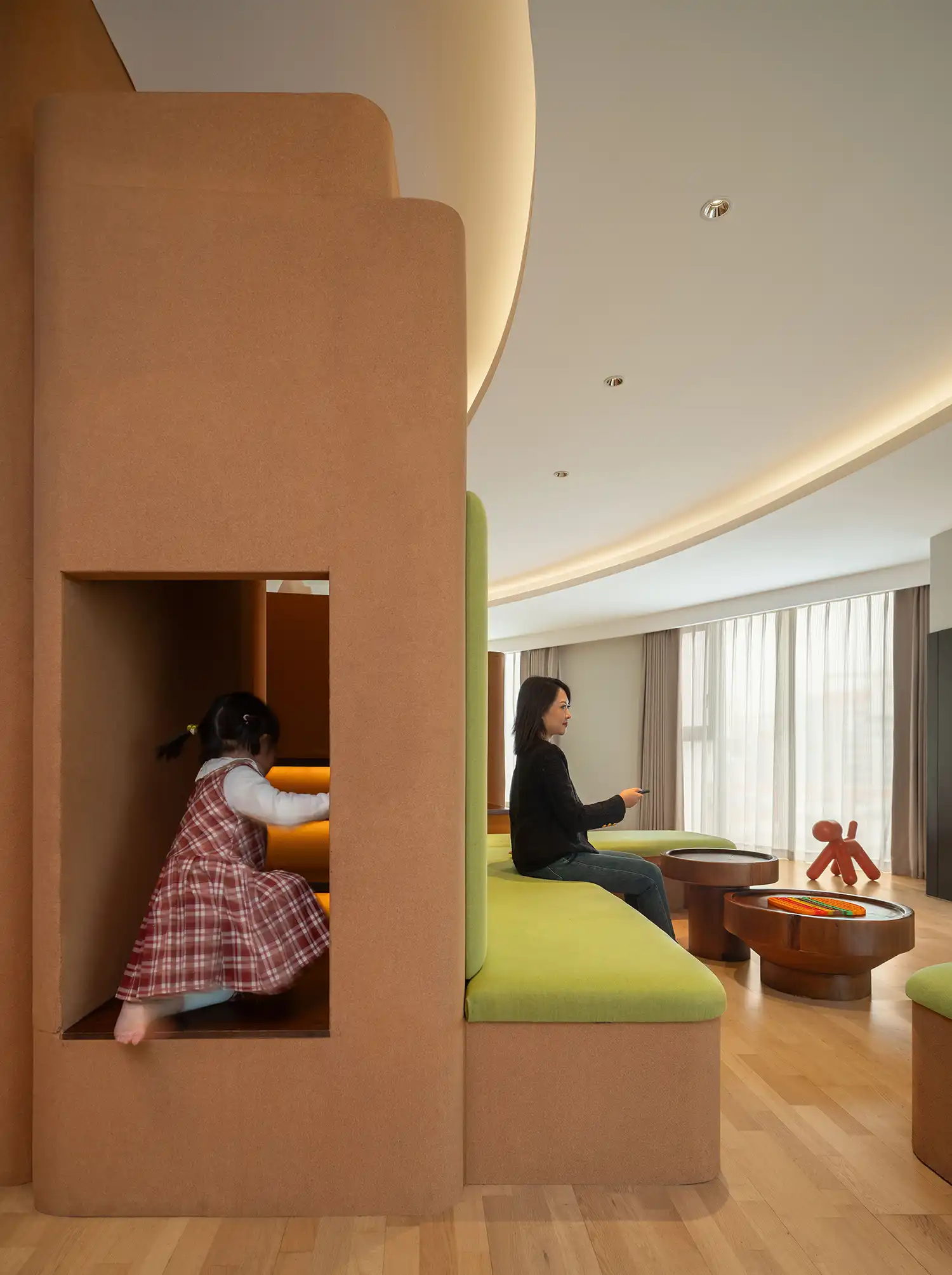
Sensory engagement is prioritized through a tactile material palette that evokes the quietude of a forest floor. The entire “mountain” structure is wrapped in soft, earthy cork, inlaid with walnut accents that provide a grounding warmth. The edges of every platform are meticulously rounded, balancing the ruggedness of the mountain concept with the safety requirements of a high-end family residence. This softness extends to the pine-green upholstery and animal-shaped lighting fixtures, which subtly reinforce the alpine narrative without resorting to cartoonish clichés. Underfoot, the cork offers a dampening acoustic quality, transforming the typical echoes of a hotel corridor into the muffled, serene atmosphere of a wilderness retreat.

Hidden within the “caves” of the mountain, the suite’s logistical requirements are handled with clever discretion. Two independent bathrooms are tucked into the lower recesses of the topography, utilizing glass partitions to maintain a sense of visual openness while providing necessary wet-dry separation. This “cave” metaphor extends to the sleeping arrangements; three platforms at varying elevations allow for a flexible, multi-generational configuration. Whether it is a child tucked into a cozy niche or a grandparent resting on a higher plateau, the suite provides a sense of enclosure and privacy without sacrificing the communal spirit of the journey.

The contextual impact of the Mountain Journey Family Suite suggests a new path for urban hospitality in China. By moving away from static furniture and toward an integrated architectural landscape, ARCHSTUDIO has created a vessel for shared family memories. In a city as fast-paced as Shenzhen, this suite offers more than just a place to sleep; it provides a choreographed “mountain adventure” that reconnects the family unit through physical movement and sensory discovery. It stands as a compelling argument that the future of family-oriented design lies not in more digital distractions, but in the timeless, tactile joy of exploring a physical landscape together.