




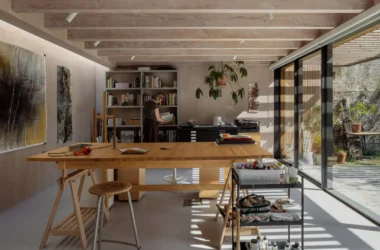

When homeowners think about furnace replacement, the focus is usually on equipment size, efficiency ratings, or fuel type. But the materials that make up the home itself quietly shape how that new furnace will actually feel in daily use. Walls, floors, and finishes determine whether heat lingers or disappears, whether rooms feel stable or drafty, and whether comfort is effortless or constantly adjusted.
Material choice determines how heat behaves once it’s produced, not just how it’s generated. Two homes can use the same heating system and still feel radically different because materials decide whether heat is absorbed, stored, reflected, or lost. In home heating design, materials play an active role in shaping comfort rather than acting as a passive backdrop to mechanical systems. Heating design isn’t only about equipment efficiency; it’s about how long warmth lingers, how evenly it spreads, and how stable the indoor temperature feels hour to hour. Materials turn heat from a momentary output into an experience.
Heating comfort is driven less by air temperature than most people think; it’s driven by how your body exchanges heat with the room. Mean radiant temperature (MRT) matters because your body “sees” surrounding surface temperatures; cold walls or windows can make 21°C air feel chilly as your body radiates heat toward colder surfaces. Thermal effusivity shapes how a surface feels to the touch, which is why two rooms at the same temperature can feel completely different when materials pull heat from your skin at different speeds. Material assemblies also influence system behavior and cycling: some create fast but fragile comfort with quick warm-up and cool-down, while others create slow but stable comfort with fewer swings and fewer on/off cycles—a difference that becomes obvious during equipment changes, troubleshooting, or mini split repair, when material-driven behavior is often mistaken for system failure.
Materials aren’t just about insulating better. In thoughtful home heating design, they determine whether a home feels calm, stable, and evenly warm, or like it’s constantly chasing comfort.
The Thermal mass of materials
The thermal mass of materials describes their ability to absorb heat, store it, and release it slowly over time. It’s heat capacity in context, not just “stores heat.” High-thermal-mass materials act like a thermal buffer, reducing sharp temperature swings by soaking up excess heat when the home is warm and releasing it when temperatures drop. This creates steadier comfort, fewer cold mornings, less overheating in the afternoon, and a home that feels calm rather than reactive to the thermostat.
The thermal mass of materials affects phase timing in your home. It shifts when heat shows up, so indoor temperatures lag behind outdoor changes. That lag reduces early-morning cold soak, late-afternoon overheating from sun or internal gains, and sharp temperature drops after the system turns off.
The thermal mass of materials only improves comfort when it’s thermally coupled to the room and exposed, and when the building envelope is good enough that stored heat isn’t simply leaking away. Mass doesn’t magically create warmth; it buffers warmth you already have access to from the sun, occupants, appliances, or the heating system.
Building Materials with High Thermal Mass in Residential Architecture
The strongest performers are building materials with high thermal mass that combine density, thickness, and exposure to the living space, but “best” isn’t a simple list. Performance depends on where the mass sits and what charges it. These materials work best when they’re inside the thermal envelope, not hidden behind layers of insulation or finishes, because interior-side mass stabilizes the living zone instead of battling outdoor losses.
Concrete slabs, walls, and polished floors are classic building materials with high thermal mass and offer exceptional heat storage, making them ideal for radiant systems. Brick and masonry provide strong thermal buffering with architectural flexibility, while stone such as limestone, slate, or tile releases heat more slowly for long-lasting warmth. Rammed earth delivers outstanding thermal stability along with natural moisture regulation. When properly deployed, slab concrete floors paired with radiant heat or winter solar gain, and thick masonry feature walls located centrally rather than as exterior veneer, tend to outperform decorative or perimeter applications.
Mass performs best when it is exposed and connected to a heat source, sunlight patches, radiant floors, or warm-air delivery paths, and when it has enough thickness to matter. Thin tile on plywood is mostly a conductive finish, not meaningful thermal storage. High-density plaster is often overlooked; while not as massive as concrete, spread across large interior surfaces it can behave similarly to building materials with high thermal mass by damping temperature swings and offering architectural flexibility. Masonry heaters and tiled stoves are purpose-built thermal mass devices with controlled release and are extremely relevant in residential comfort.
Surface area can compete with density. A moderately massive material distributed across large interior surfaces can outperform a heavier material confined to a small accent zone.
Material Heat Conductivity vs Thermal Mass
Thermal mass is about how much heat a material can store. Material heat conductivity is about how quickly heat moves through it. A material can conduct heat well but store very little of it, or store a lot of heat while releasing it slowly. In interiors, material heat conductivity affects how quickly systems “show up” and how quickly a surface feels warm to the touch, while thermal mass affects how long that warmth lasts, how evenly it’s distributed over time, and how resistant a space is to temperature change.
The real comfort differentiator is effusivity, which blends conductivity and heat capacity and predicts surface feel. That’s why tile or stone can feel cold even when room air is warm—high effusivity pulls heat quickly from skin—while wood feels warmer underfoot at the same air temperature because of lower effusivity.
In interiors, material heat conductivity shapes heat transfer speed, mass shapes heat inertia, and effusivity shapes the immediate human sensation people interpret as warm or cold.
When a Material That Conducts Heat Well Improves Radiant Heating
A material that conducts heat well shines when paired with radiant heating systems, especially floor heating. Stone, tile, and polished concrete transfer heat efficiently from embedded pipes or cables into the room, delivering fast, even warmth across the space. Conductivity enhances responsiveness, while the material’s thermal mass ensures the heat doesn’t disappear the moment the system cycles off.
A material that conducts heat well improves radiant heating when uniform surface temperatures are needed, when lower water temperatures are desired—which is critical for heat pumps—and when stable operation reduces cycling stress that can otherwise show up during heat pump repair.
Most non-metal finishes such as tile, wood, and plaster have high emissivity and radiate effectively. Bare metals can be highly conductive but radiate poorly unless coated or finished. The best radiant surfaces combine good conductivity, high emissivity, and enough mass to behave like a material that conducts heat well while still supporting stable, long-duration comfort.
Aesthetic Warmth and Thermal Comfort Through Materials
Visual warmth and thermal comfort often overlap, but not always. Natural textures like wood, stone, and brick signal warmth psychologically, even before heat is felt. Physically, materials that maintain stable surface temperatures reduce the “cold wall” effect and radiant heat loss from the body. When visual cues align with thermal performance, spaces feel intuitively comfortable, not just heated, but welcoming.
Aesthetic warmth and physical warmth interact through expectation and sensation. Aesthetic warmth comes from texture, grain, matte finishes, warm undertones, and visual softness, while physical comfort is driven by MRT, surface temperature, draft perception, and contact sensation. Mismatches create discomfort: a space can look warm with dark wood and cozy lighting but feel cold if surfaces are cold or drafts dominate.
Materials that create “quiet comfort” reduce cold radiant surfaces, reduce sharp tactile coldness by limiting heat loss on contact, and reduce stratification and drafts by allowing systems to run gentler and longer, all core goals of effective home heating design.
Climate and Building Materials with High Thermal Mass
Building materials with high thermal mass are most effective in climates with large day–night temperature swings, such as desert, Mediterranean, and temperate regions. They absorb daytime heat and release it overnight, reducing heating demand. The biggest impact is in climates where heat availability and heat need are out of phase—available at one time, needed at another—like sunny days followed by cold nights or volatile shoulder seasons where mass dampens indoor swings. Time-of-use electricity further amplifies the benefit, allowing mass to “charge” off-peak and coast during peak hours.
In colder climates, building materials with high thermal mass still offer benefits, but only when paired with proper insulation and airtight construction to prevent stored heat from escaping too quickly. Without a strong envelope, mass is often oversold, especially in persistently cold, low-sun climates where it can’t compensate for continuous heat loss. In humid climates, where overheating control dominates, mass can help with stability but must be paired with shading and ventilation strategies.
Thermal mass is less about “hot vs cold climate” and more about daily temperature amplitude, solar timing, and energy pricing patterns.
Future-Focused Home Heating Design
Smarter material selection shifts home heating design from energy consumption to energy behavior. Instead of relying solely on mechanical systems, homes can passively regulate temperature through structure and finishes. As energy costs rise and electrification expands, materials that stabilize indoor comfort will reduce peak loads, improve heat pump performance, and make homes more resilient, turning the building itself into part of the heating system.
Future-ready home heating design is about lower temperatures, longer runtimes, and load smoothing, especially with heat pumps and more renewable electricity. Smarter material selection can enable low-temp hydronic systems (better heat pump COP, less stress on equipment), reduce peak demand (important for grid constraints and pricing), and improve comfort at lower thermostat settings by raising MRT.
Material choices should consider embodied carbon vs operational carbon tradeoffs. Some high-mass materials like concrete can cut operational energy but have high embodied impact. Design is moving toward “right-sized mass”, using the thermal mass of materials strategically with low-carbon mixes and hybrid assemblies, placing mass where it matters, not everywhere.
Phase-change materials (PCMs) integrated into plasters or panels don’t add mass in the conventional sense; they add latent heat storage, smoothing temperature swings with less thickness. It’s one of the few genuinely new material strategies in this space that’s not just marketing.