

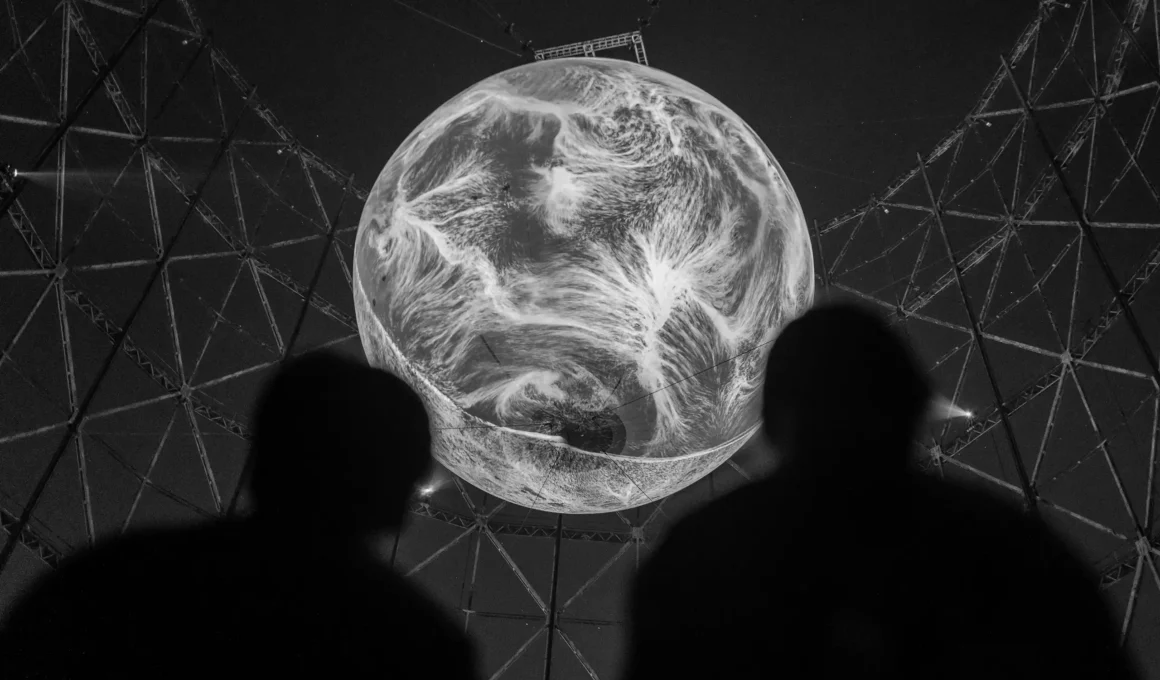
In the ever-evolving landscape of digital art, the Italian multidisciplinary studio fuse* has consistently pushed the boundaries of how we perceive the invisible threads between science and emotion. Their latest magnum opus, Luna Somnium, is not merely an installation but a profound celestial inquiry that transcends the limits of traditional media. Inspired by Johannes Kepler’s 1608 short story Somnium—often cited as the first work of science fiction—the piece invites the viewer to adopt a Copernican shift in perspective. Just as Kepler used a fictional dream of a lunar voyage to argue for a heliocentric universe, fuse* utilizes the vast, industrial canvas of the Gasometer in Rome, Italy to challenge our earthly certainties, urging a transition into a new way of experiencing the world through the lens of the cosmos.
The conceptual vision of the work serves as a departure from the studio’s previous technical explorations, pivoting instead toward a deeply human-centric narrative of emotional participation. The installation reimagines the moon as a vantage point from which to observe “reality” from a distance, reflecting the same intellectual curiosity that once drove Kepler to defy the geocentric dogmas of his time. By situating this ethereal narrative within the skeletal, iron framework of an iconic industrial relic in Rome, fuse* transforms a site of historical labor into a cathedral of contemporary thought, proving that the most resonant art often emerges from the friction between rigid architectural history and fluid digital innovation.

Technical mastery meets sensory storytelling in a ten-minute temporal journey structured like a cinematic storyboard. The narrative arc of Luna Somnium is meticulously calibrated to build emotional tension, moving through cycles that mirror the lunar phases—from the void of the New Moon to the overwhelming radiance of the Full Moon. This isn’t a static projection; it is a living simulation. Using openFrameworks and Houdini, the studio developed a custom pipeline where sound-reactive elements dictate the formation of realistic rocky structures and “crack” formations. As the experience reaches its zenith, these solid forms undergo a metaphorical “change of state,” dissolving into fluid, organic geometries driven by noise-based functions and steering forces that respond to the sonic intensity of the space.

The auditory landscape of the installation was the foundational “Formal Drawing” upon which the visual world was built. Eschewing traditional composition, the sound design is a tactile exploration of timbre, utilizing recordings of unconventional objects like aluminum tubes, rubber balls, and double basses played with extended techniques. This research into contrast—moving from “rough” to “smooth” and “dark” to “light”—allows the audience to feel the lunar cycle as much as see it. Processed through custom Max MSP patches and delivered via an octophonic multichannel system, the spatialization of sound becomes a sculptural element, enveloping visitors in a 360-degree environment where the boundaries between the physical and the virtual are effectively erased.
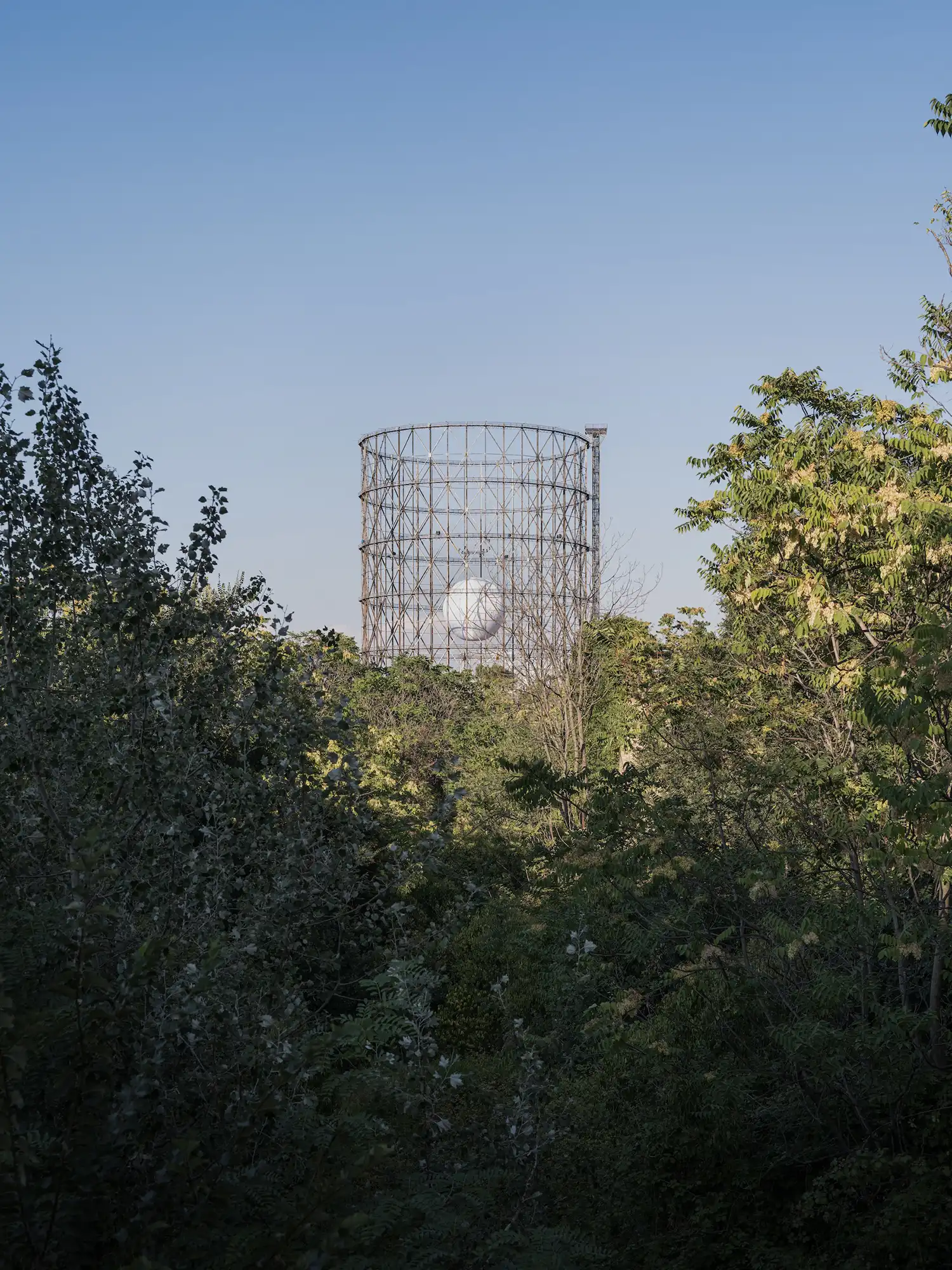
This philosophy of adaptive reuse and “spatial hacking” aligns Luna Somnium with a growing global movement of monumental public art that injects celestial wonder into non-traditional urban environments. We have seen similar dialogues between art and the colossal in SpY’s “Ovoid” installation in Riyadh, which challenged the scale of public space, or the ethereal “Oura” by Jun Ong, which brought a glowing comet to the streets of AlUla. Much like the gravity-defying presence of KAWS’ “Companion” in Abu Dhabi, these works share a common goal: to repurpose the urban fabric as a stage for collective dreaming. By occupying the Gasometer, fuse* doesn’t just display art; they activate an architectural ghost, inviting the public to rediscover a forgotten landmark through the lens of a lunar dream.
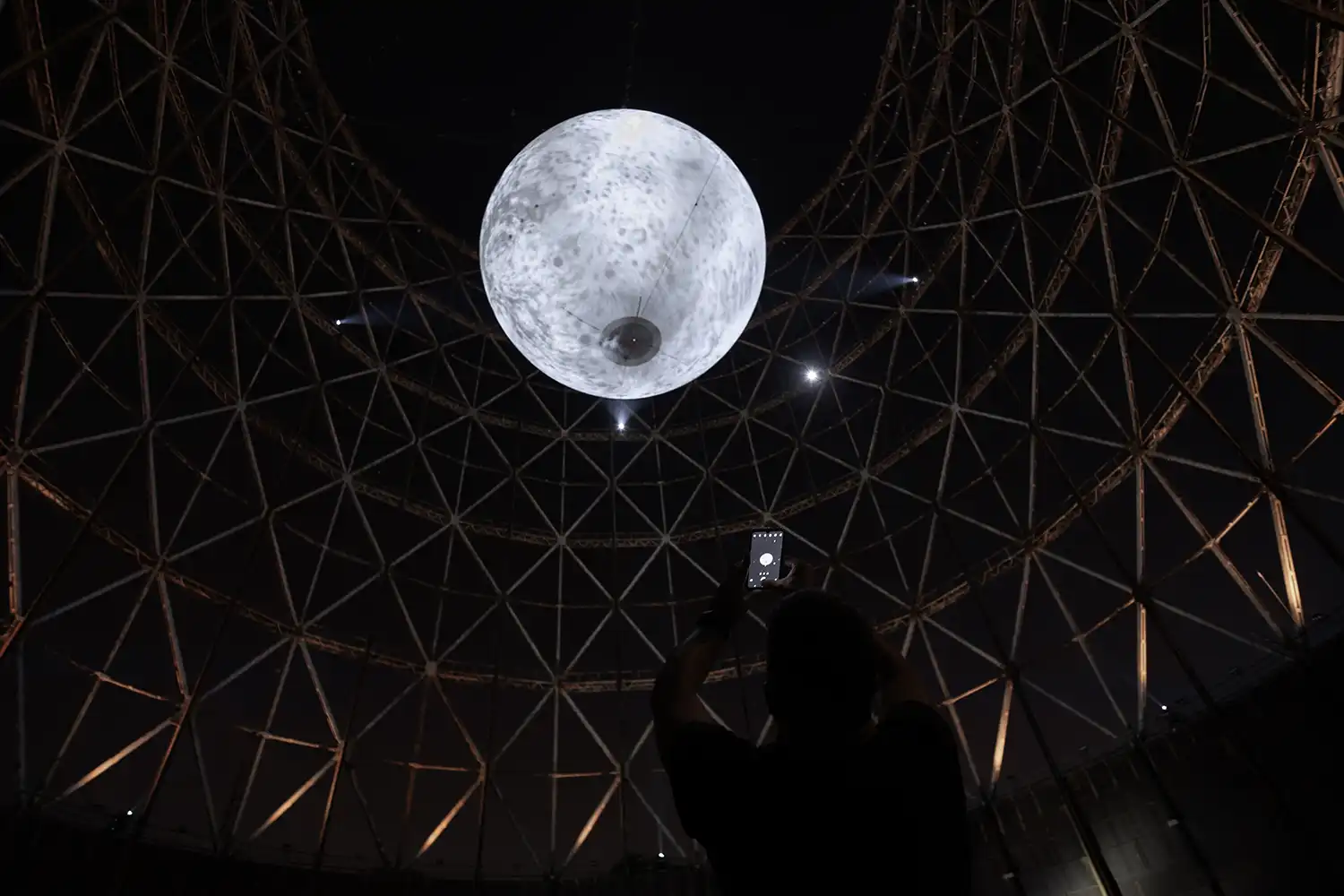
Beyond its physical manifestation in Rome, the project has evolved into a versatile ecosystem of experiences, adapting its complex simulations to different formats and global stages. In 2023, the work was reimagined for the immersive dome of the Zeiss-Großplanetarium in Berlin, Germany, where the technical challenge of translating 3D particle simulations into equirectangular maps allowed for an even deeper sense of immersion. This evolution from a site-specific installation to a planetarium experience and even tangible fine-art prints demonstrates the work’s inherent flexibility. It serves as a testament to the studio’s ability to scale their vision without losing the poignant, human core of the narrative.
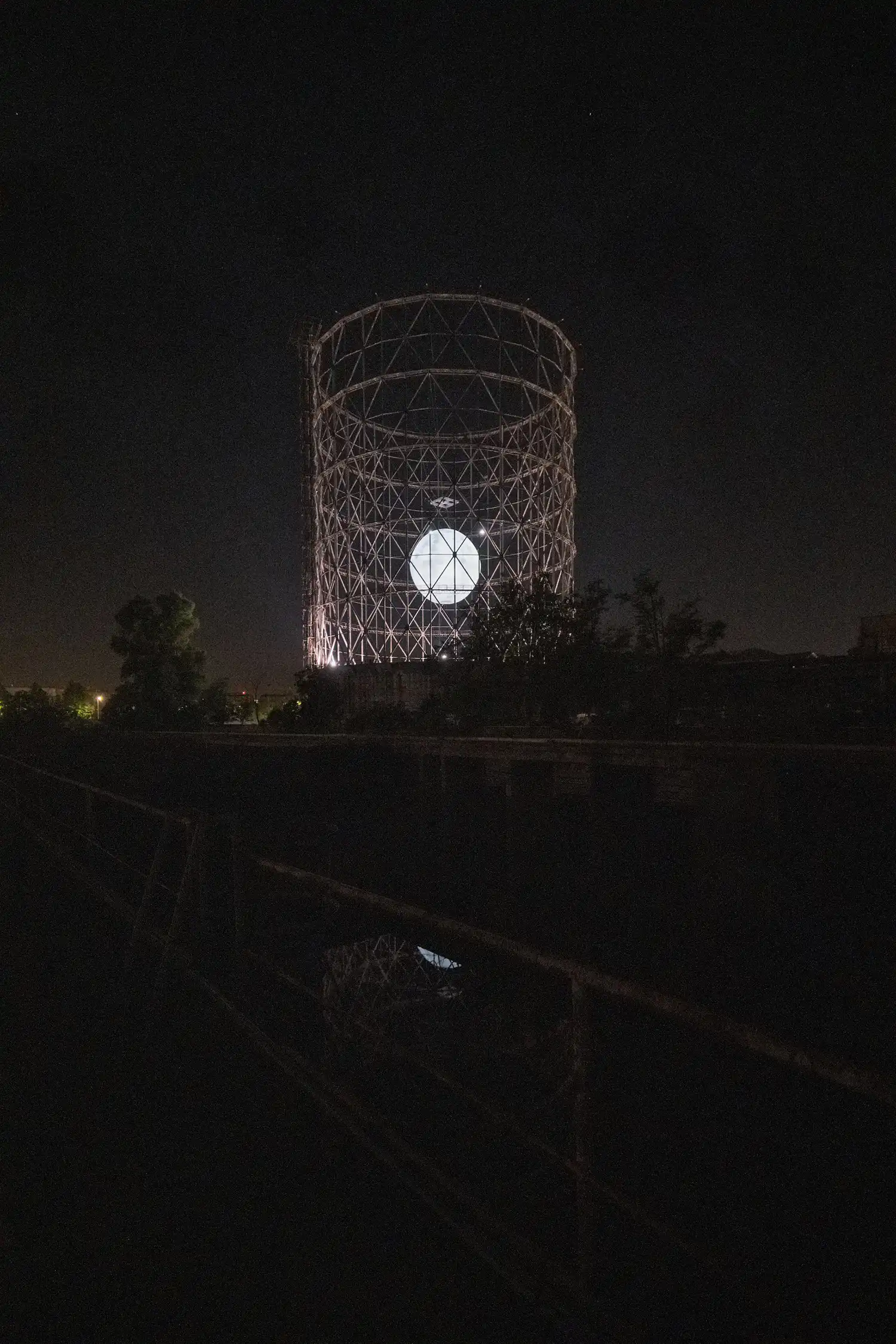
The contextual impact of Luna Somnium lies in its ability to foster a shared moment of reflection in an increasingly fragmented digital age. By grounding high-level scientific concepts in a “sensory experience” of light and sound, fuse* successfully bridges the gap between the analytical and the emotional. The work leaves the viewer not just with a sense of the moon’s beauty, but with a renewed understanding of our own planet’s fragility and place in the stars. It is a reminder that art, much like the science of Kepler’s era, remains our most powerful tool for expanding the boundaries of what we believe to be possible.