



London-based architecture practice Material Works has transformed a once-dark Victorian terrace in Hackney into a luminous sanctuary of sustainability and craftsmanship. Dubbed Hackney Bay House, this radical yet sensitive renovation replaces cramped quarters with soaring volumes and a deep connection to nature, proving historic homes can achieve cutting-edge energy performance without sacrificing warmth.

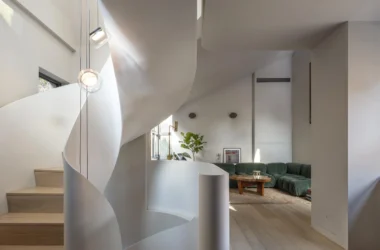
The project’s heart is a breathtaking double-height living space, forged by excavating the lower level and unveiling dramatic ceiling heights. Anchoring this transformation is a sculptural double-height bay window—a modern reinterpretation of Victorian bays—that floods the kitchen and living area with light while framing the garden like a living painting. The strategic floor-lowering not only amplifies spatial generosity but also enhances the home’s thermal efficiency, creating a naturally bright, healthy living space.

Above the open-plan expanse, a mezzanine study hovers like a treehouse retreat, its vantage point fostering “layered connections” between family life and quiet contemplation. This vertical dialogue extends outdoors, where stepped terraces and integrated planters blur boundaries between the home and a revitalized garden. At the landscape’s far end, a cork-clad studio—roofed in timber shingles and acoustically insulated—serves as a serene hub for creativity, demonstrating Material Works architecture’s holistic ethos.

True to its name, the practice prioritized natural materials with minimal environmental impact. The rear facade was rebuilt using timber framing and wood fibre insulation, clad in reclaimed bricks salvaged for their patina and low embodied carbon. Inside, walls of breathable lime plaster and tinted cement floors merge with bespoke English Oak joinery, celebrating raw textures and structural honesty. Every element, from exposed beams to custom cabinetry, whispers of organic materiality.

Beyond aesthetics, the home is a stealthy model of sustainability. High-performance insulation and triple-glazed windows work alongside a discreet air-source heat pump, slashing energy demands while maintaining comfort. This sustainable renovation proves that low-carbon materials and historic frameworks can coexist elegantly—no aesthetic sacrifice required.

Hackney Bay House transcends the typical Victorian terrace upgrade. It’s a manifesto for mindful intervention, where spatial drama, ecological integrity, and tactile warmth converge. As Material Works notes, “The home isn’t just retrofitted—it’s reimagined.” For design aficionados and eco-conscious dwellers alike, this project sets a compelling precedent: heritage needn’t hinder the future.