

A collective vision of tomorrow. The built landscape of 2026 is moving beyond mere occupancy toward a profound dialogue between structural mass and social fabric. Projects like the Shanghai Grand Opera House by Snøhetta embody this transition; here, the formal gesture is not an end in itself but a continuous public surface. The spiraling roof, conceived as a monumental staircase emerging from the riverfront in China, invites a level of engagement that transcends theatrical function, transforming the building into a dynamic extension of the city where civic participation becomes the core of the work.
Shanghai Grand Opera House Unfurls: Snøhetta’s Spiral Staircase Takes Form Like an Unfolding Fan
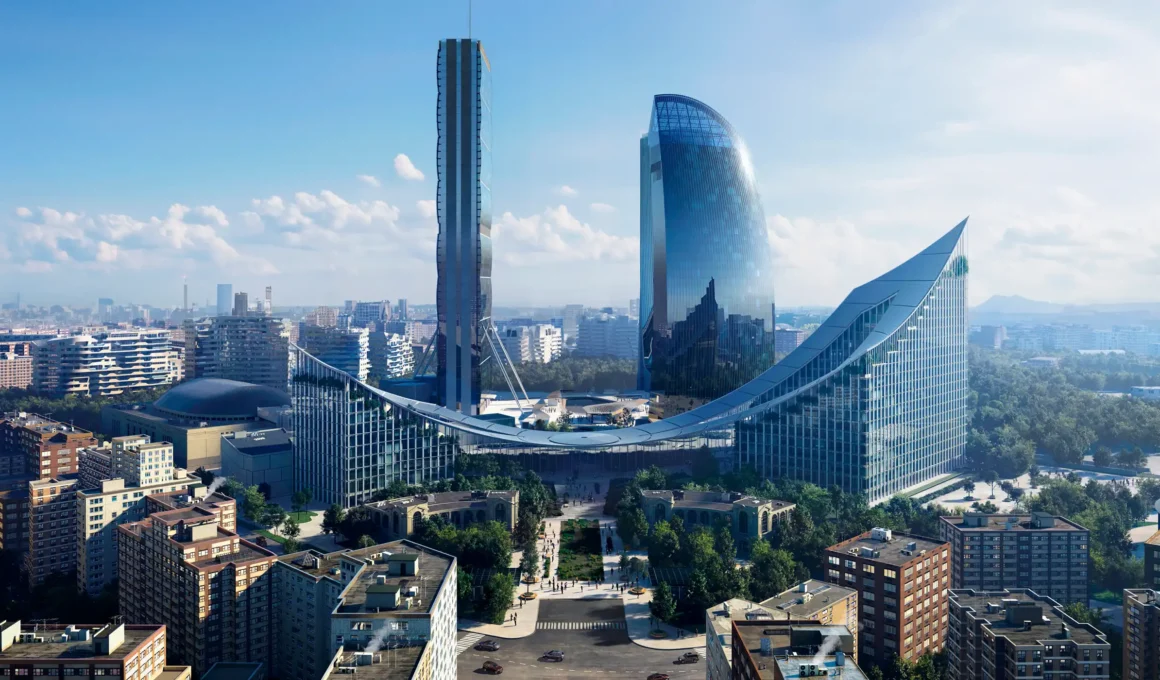
Material symbiosis and technological innovation. Shifting the focus to Europe, the CityWave (image above) project by BIG (Bjarke Ingels Group) in Milan introduces a deep reflection on the spatial configuration of the CityLife district. Characterized by a suspended catenary structure, the building acts as an urban veil that unifies two distinct volumes through a generative canopy. The materiality of the intervention, which integrates extensive photovoltaic arrays into an almost ethereal silhouette, suggests a new paradigm of sustainability where energy performance is not a late addition but the very generator of form.
CRA-Carlo Ratti Associati Unveils Crystalline Bivouac to Merge with Alps for Milano Cortina 2026
Algorithmic shelters and geological memories. The tension between artifice and nature finds an extreme synthesis in the alpine shelter designed by Carlo Ratti for the Milan-Cortina 2026 Games. Through the use of 3D scans of local rock formations, the structure proposes a radical juxtaposition: a technological shell that mimics the mountain’s skin to disappear into the landscape. This search for a new digital vernacular demonstrates how advanced prefabrication can now dialogue with fragile environmental contexts, reducing physical impact without sacrificing a cutting-edge aesthetic.
Spherical monuments and programmatic stacking. In the evolving skyline of Tirana, Albania, the Grand Ballroom by MVRDV challenges traditional urban typologies through a monumental 100-metre-wide sphere. This radical spatial configuration stacks a 6,000-seat arena, a hotel, and residential units within a single, singular volume. The sensory experience is defined by the interior oculus and a lush, semi-outdoor domed courtyard that serves as a communal lung for residents. By avoiding a traditional “rear” facade, the sphere engages the city from every angle, acting as a luminous beacon that references both classical geometry and the dynamic spirit of modern sport.
Repurposing and industrial memory. The rejuvenation of the former cement factory warehouse in Shanghai, transformed by MAD Architects into The Ark, represents a masterclass in adaptive reuse. The preservation of the massive pre-existing silos is paired with new, fluid volumes that appear to float above the raw concrete. This collision of scales and textures creates a dense, almost dreamlike atmosphere where the industrial past of the metropolis is not erased but elevated into a stage for new creative dynamics, celebrating a raw and tactile beauty.
Cultural heritage and contemporary layering. In New York, the New Museum expansion curated by OMA interrogates the concepts of verticality and transparency within a densely layered context. The new structure does not seek to compete with the iconic stack of volumes by SANAA, but rather establishes a rhythmic counterpoint through a glass facade that exposes internal circulations. This approach fosters a sensory experience based on visual porosity, where the cultural institution ceases to be a closed sanctuary and becomes a lens through which to observe—and be observed by—the Lower East Side.