

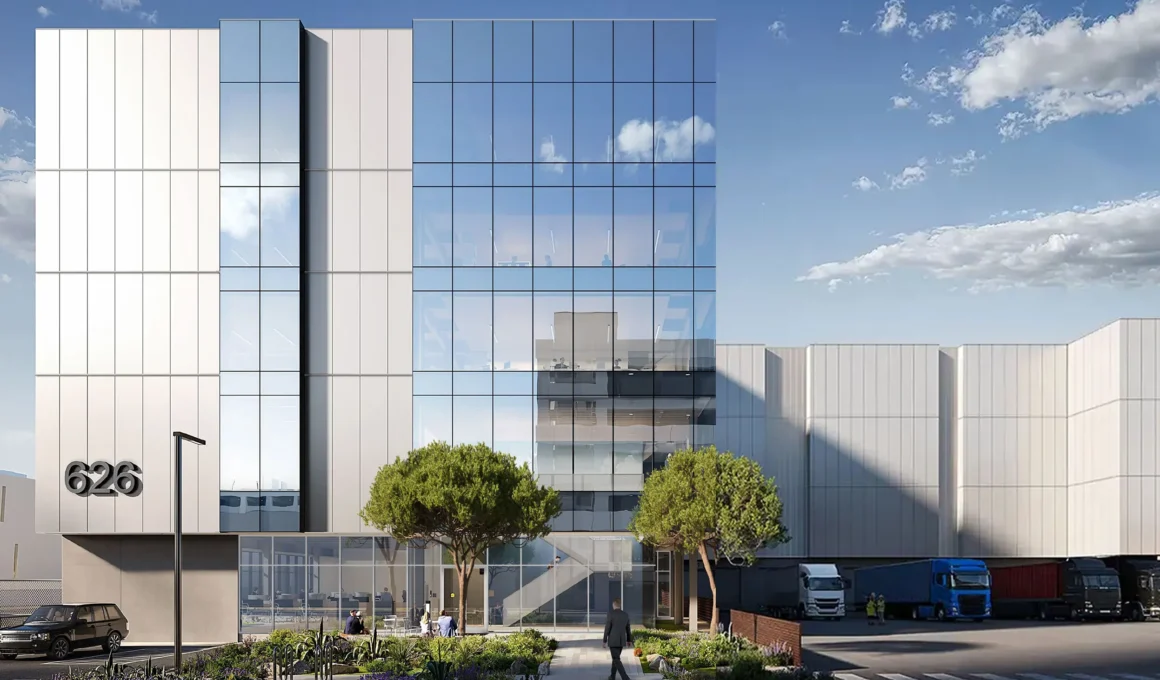
Large infrastructure environments rarely prioritize the everyday experience of the people who keep them running. At San Francisco International Airport, one of the busiest and most complex transportation hubs in the United States, a new project currently in development seeks to shift that condition. Scheduled for completion by 2027, the redevelopment of the West Field Administrative Campus aims to establish a new center of gravity for airport employees, rethinking how landscape can operate within a highly regulated, operational setting.
Rather than treating outdoor space as residual, the project reimagines the campus ground as an active framework. A sequence of garden rooms and open plazas will be designed to support daily movement, informal gathering, and larger campus events, all while accommodating the intense logistical demands of an airport environment. The landscape is conceived as both social space and infrastructure, integrating stormwater treatment systems, durable materials, and long-term maintenance strategies directly into its design.
Working at this intersection of environmental performance and institutional complexity requires a level of technical precision often invisible in the finished space. Within Petersen Studio’s ongoing work at SFO, this responsibility includes shaping site-specific landscape systems, coordinating across multiple consultant teams, and navigating layers of regulatory oversight that define airport development. The work unfolds across documentation, compliance, and construction phases, where design intent must remain legible under constant operational constraints.
Justin Thomas is part of the team carrying this work forward. His role on the West Field Administrative Campus builds on sustained experience within public and infrastructural projects where landscape design functions as a mediator between systems rather than a visual overlay. At Petersen Studio, he has contributed to transportation landscapes, civic parks, and major research campuses, environments where coordination authority and professional judgment are as critical as formal design decisions.
That background informs the approach to the West Field campus, where the landscape must perform continuously rather than episodically. Circulation routes are designed for clarity without rigidity. Garden spaces offer moments of relief within a dense operational setting. Plazas are scaled for flexibility, capable of hosting daily use and larger institutional gatherings without reconfiguration.
Environmental systems are embedded throughout the project. Stormwater management is integrated through planted areas and grading strategies that reduce reliance on underground infrastructure while reinforcing resilience goals. Material selections prioritize durability and ease of maintenance, acknowledging the long-term operational demands of the site. These choices position the landscape not as an aesthetic gesture, but as a working system aligned with the airport’s sustainability objectives.
Unlike passenger-facing airport spaces, which often emphasize wayfinding and visual identity, the West Field Administrative Campus is designed around the rhythms of those who work on site every day. The project recognizes that employee environments benefit from spaces that support well-being, informal interaction, and a sense of continuity within an otherwise fragmented infrastructure landscape.
As development progresses, the West Field Administrative Campus reflects a broader shift in institutional design. It suggests that even within the most constrained environments, landscape architecture can provide structure, adaptability, and human scale. By grounding environmental performance and social use within a single framework, the project demonstrates how design at ground level can quietly reshape the experience of complex systems.
Author Adana Vincent