


In the heart of Kuala Lumpur, amidst the frenetic pulse of the city’s central business district, Spacemen Studio has unveiled Sun & Moon—a transformative architectural project that breathes new life into a previously abandoned bungalow. More than a simple renovation, the design is a sophisticated exercise in duality, exploring the metabolic shift between the restorative clarity of daylight and the rhythmic allure of the night. By stripping the structure back to its essential bones while layering it with tactile, organic interventions, the studio has created a sanctuary that functions as a temporal bridge, evolving in character as the earth rotates.

The conceptual vision for Sun & Moon is rooted in the “patina of memory,” where the building’s history is not erased but rather curated. Exposed brick walls from the original bungalow are preserved as a rugged backdrop, contrasting sharply against a minimalist palette of light oak, reclaimed timber, and grey travertine. This dialogue between the old and the new establishes a sense of permanence and restraint, grounding the space in its Malaysian context while nodding to the clean, human-centric lines of Scandinavian design. The result is an environment that feels both curated and evolved, avoiding the sterile tropes of modern minimalism in favor of a lived-in, sensory richness.
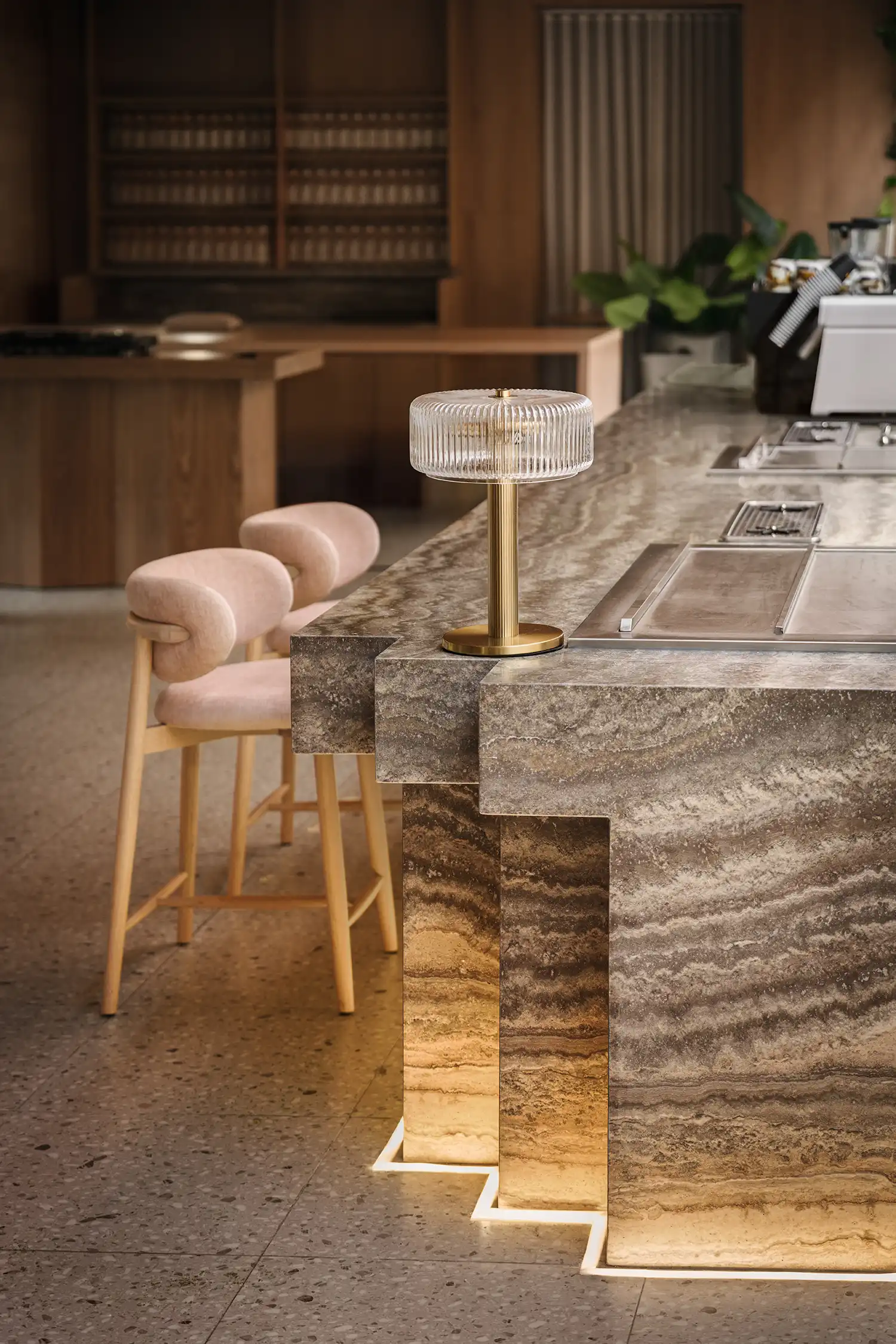
A choreography of natural light defines the guest’s arrival, centered around an ebony tree that stands as a silent sentinel beneath a circular skylight. This gesture immediately blurs the threshold between the interior and the lush greenery of the outdoors, suggesting that the architecture has grown around the landscape rather than over it. Within the Sun Bar, the experience is dictated by a glass ceiling wrapped in timber slats. As the sun moves across the sky, these slats filter the glare into a rhythmic dance of shifting shadows, creating a dynamic “sundial” effect that animates the sculpted grey travertine counter—the primary focal point of the daytime café identity.
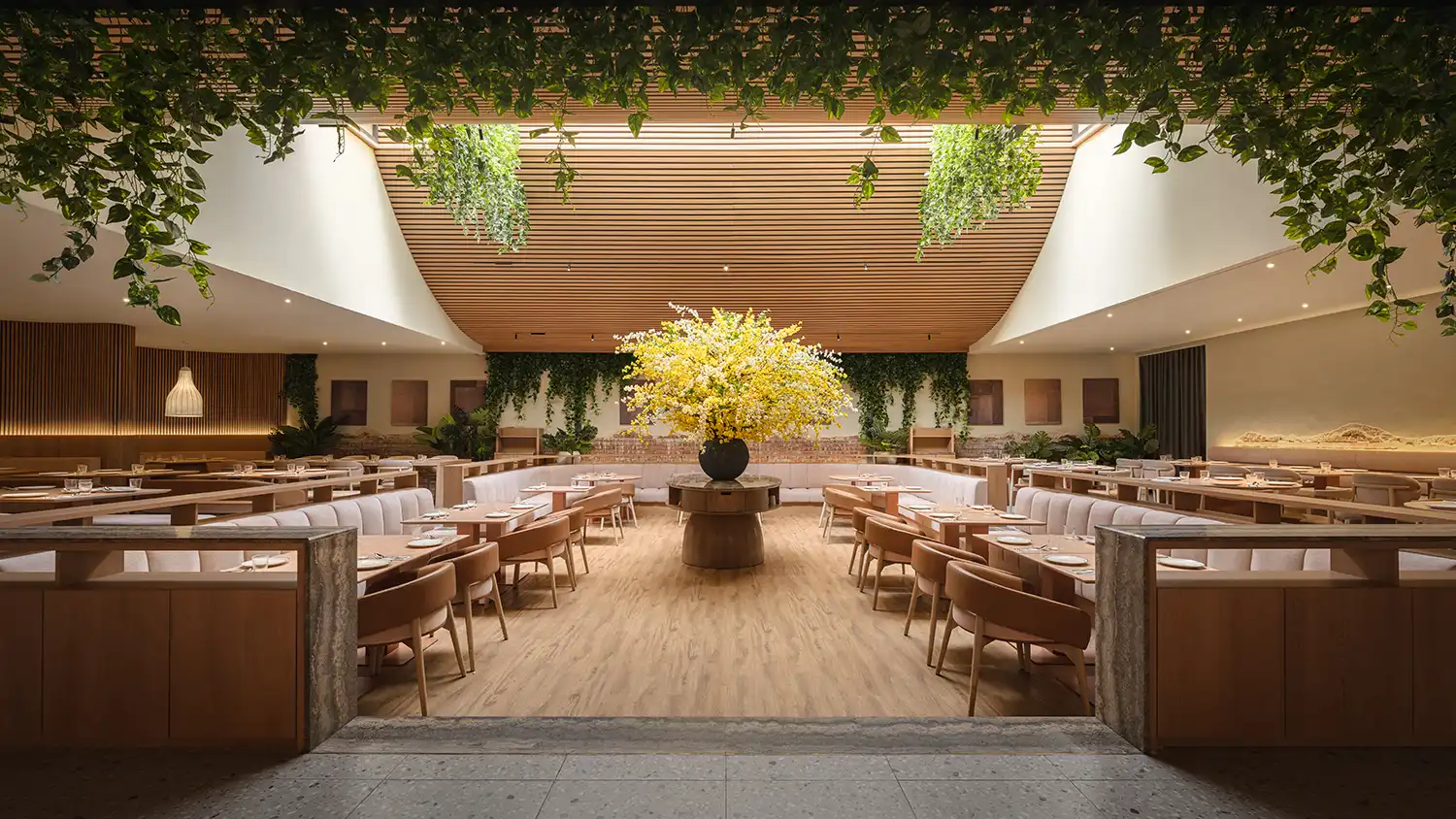
The atmospheric nucleus of the project is the sunken pit dining area, a masterful structural intervention that anchors the entire floor plan. Positioned beneath a linear skylight that spans the room’s length, this recessed zone acts as a light well, gathering luminosity to create a serene, communal experience. By lowering the floor plane, Spacemen Studio has achieved a sense of intimacy without the need for physical barriers, allowing the space to feel expansive yet protective. This architectural “hearth” serves as the transition point for the venue’s dual soul; by day, it is a bright, airy brunch spot, but as dusk falls, it morphs into a high-energy social hub where the architecture begins to pulse with a different frequency.
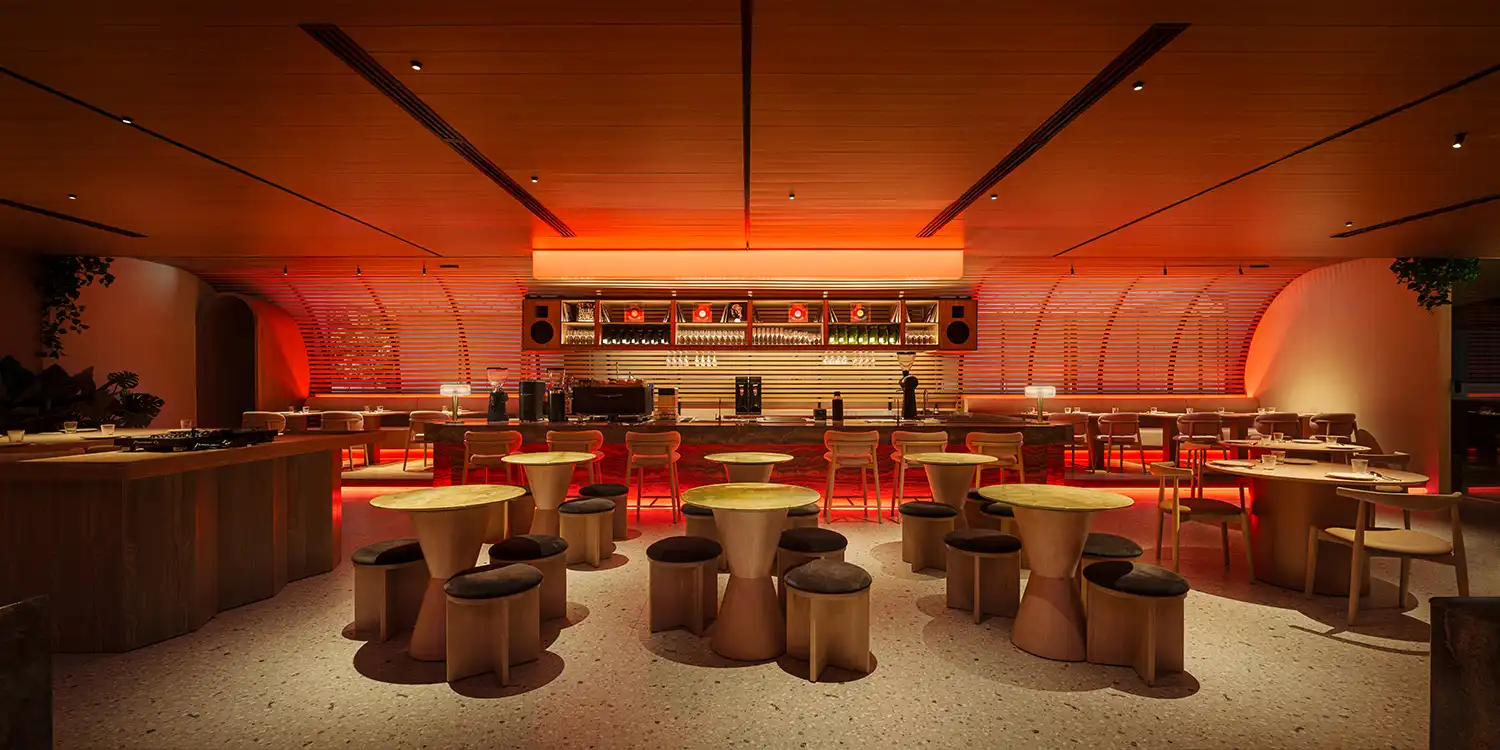
Technical precision meets acoustic warmth in the semi-private dining nooks that ring the periphery. Sculptural vertical timber slats are used here to create “soft” enclosures, offering a sense of privacy while maintaining a visual connection to the central pit. These elements are particularly relevant given the venue’s emergence as a premier listening bar, a typology that prioritizes high-fidelity audio and acoustic comfort. As we have previously explored in our deep dive into the global trend of listening bars, these spaces represent a shift toward intentional consumption and sensory immersion. At Sun & Moon, the timber-heavy materiality and fragmented surfaces work double-duty, diffusing sound to create an optimal environment for DJ-led, hi-fi experiences.

The nocturnal metamorphosis completes the cycle, as the “Sun” yields to the “Moon.” As natural light fades, the timber tones appear to deepen under the influence of warm, integrated amber lighting. The shadows that were once sharp and architectural become soft and atmospheric, and the sunken pit transitions from a sun-drenched lounge into a vibrant, animated center for nightlife. In Kuala Lumpur, a city defined by its rapid pace, Sun & Moon stands as a rare example of architecture that respects the circadian rhythm, offering a space that is not just a destination for food or music, but a poetic reflection of the cycle of the day.