


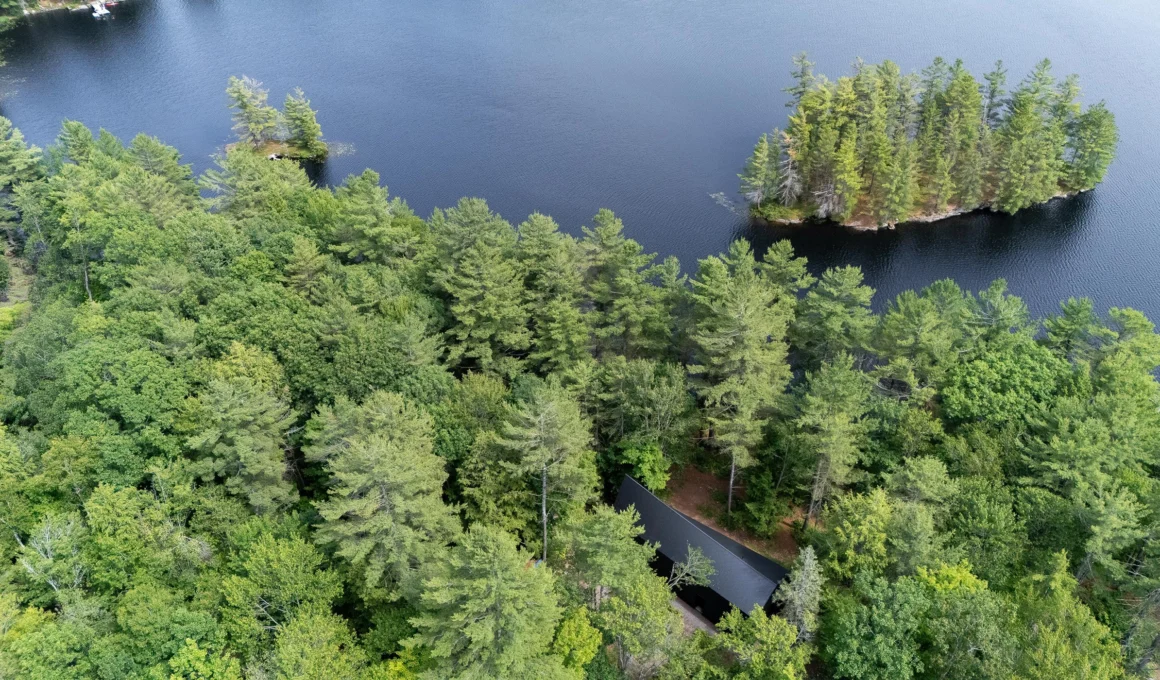
Architecture studio Reasonable Projects has finished the Angle of Repose lake house, a minimalist, sculptural dwelling nestled in the Algonquin Highlands of Canada that achieves rigorous Passive House certification. Conceived for an art history professor, the design boldly marries high design with the highest level of sustainability, challenging the conventional separation between the two. The brief specifically called for an inscrutable and beautiful house, a concept fully realised in the final form.

The dwelling’s massing is deceptively simple: a trapezoidal volume situated between two distinct gable elevations. However, this simplicity conceals a sophisticated roof geometry. The roof is defined as a hyperbolic paraboloid, dynamically shaped by simultaneously lowering the roof peak and widening the building’s plan from east to west. This subtle manipulation of form creates unexpected, dynamic perspective effects that subvert traditional domestic references, making the house feel at once familiar and startlingly contemporary. Clad entirely in monolithic black metal shingles, the exterior reinforces the structure’s perceived objecthood against the rugged, natural backdrop.

A key driver of both the aesthetic and the environmental performance are the exceptionally thick 2.8-foot-deep walls. These massive envelopes, punctuated by deeply recessed fenestration, express the structural commitment to thermal efficiency while visually lending the house its desired air of inscrutability. The dark, formal north façade, where visitors arrive via a winding driveway designed by DIRTT studio, creates a stark, deliberate contrast upon entry. Inside, the double-height living space is revealed as warm and luminous.

The main living areas benefit from extensive south and west glazing, providing expansive views through the tree canopy to the lake. This large glazing expanse is not merely for aesthetics; it is the core engine for the building’s passive heating and cooling strategy. Beyond the glazed south door, the surrounding landscape terraces down toward the water in controlled, geometric forms that reflect the precision and angles of the architecture itself.

The commitment to achieving the highest level of sustainability meant eliminating all on-site fossil fuel combustion and aiming for the incredibly demanding Passive House standard. This process required the close involvement of a Certified Passive House Designer (JMV) as an integral part of the design team from the earliest stages. Going beyond operational energy, the project team actively addressed embodied carbon by using WBLCA tools to optimize material selection, favouring low-carbon choices like dense-pack cellulose insulation to reduce the environmental impact across the building’s entire lifecycle.

A mass timber structure was selected as the optimal solution, supporting both the ambitious architectural geometry and the sustainable goals while providing a unified, warm interior finish. This complex geometry necessitated having the mass timber elements digitally milled on a 5-axis robot in Austria, before being shipped and hoisted into position on site. This highly controlled fabrication process was critical to achieving the required air tightness—a cornerstone of Passive House performance—and ensuring the flawless quality of the exposed interior structure. Similarly, the ultra-high-performance EnerSIGN windows, doors, and exterior blinds were manufactured in Germany.

The successful realization of this advanced dwelling involved engaging a local builder experienced in prefabricated construction. To bridge the gap between regional techniques and international best practices, the builder participated in a specialized ‘Passive House Techniques for Tradespersons’ course. This strategy ensured the expert execution of crucial details like thermal-bridge-free construction and the continuous air barrier. Reasonable Projects describes the resulting home as an exemplar of an emerging potential for architectural practice: one defined by highly collaborative, globally sourced prefabricated components, and a firm belief that design and performance are inseparable—a singular category of architectural excellence.