


In contemporary architecture, the concept of “new” is undergoing a radical shift. As the industry grapples with its environmental footprint, the focus has moved from resource extraction to resource curation. Reclaimed materials are no longer just an ethical alternative; they have become the primary language of a new, sophisticated aesthetic: Circular Luxury.
This movement isn’t about nostalgia; it’s about “Material Intelligence.” As the renowned architect Kengo Kuma once suggested, “Material is not something to be consumed, but something to be lived with.” This philosophy is driving designers to look at ruins, waste, and old structures as high-value quarries for the buildings of tomorrow.
The Aesthetic of the “Second Life”
The allure of salvaged elements lies in their inherent character—a “patina” that cannot be replicated in a factory. Integrating these materials requires a surgical precision that balances the raw texture of the past with the clean lines of modern minimalism.
A masterclass in this balance can be seen in the silent precision of stone restoration in Puglia, where architects Flore & Venezia utilized “Stone Whispers” to revive a historic Masseria. Here, the reclaimed stone is not merely a structural choice but a narrative tool that connects the inhabitant to the land’s geological history.
Projectroom Uses Hempcrete to Build Carbon-Negative “Paradigm Shift” Home in Szentendre
Strategic Integration: From Heritage to High-Tech
To outrank the standard “green building” guides, we must look at how reclaimed materials interface with modern construction techniques. The trend is moving towards hybrid sustainability, combining ancient salvage with bio-based innovation.
-
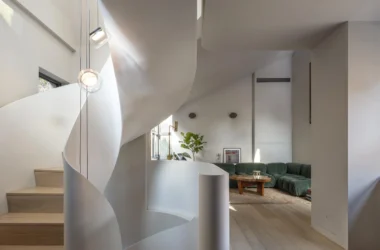
Urban Re-adaptation: In London, the Victorian renovation with a double-height bay by Material Works demonstrates how reclaimed brickwork can be reimagined to enhance thermal mass while preserving the urban fabric’s visual continuity.
-
Bio-Material Synergy: The sustainable hempcrete house in Hungary by Projectroom shows that the future of circular design lies in the dialogue between salvaged components and carbon-negative materials like hempcrete.
The Architect as a Curator
The shift toward reclaimed materials is also changing the role of the architect. In the minimalist Belgian residence by Marge Architecten, we see a “sober-rich” approach where the limited palette of materials is chosen for its longevity and reuse potential.
As Francis Kéré, Pritzker Prize winner, famously stated: “Architecture is much more than building. It is a way to improve people’s lives.” In the context of circularity, improving lives means building with a consciousness of where materials come from—and where they will go after the building’s lifecycle ends.
This curatorial approach is evident in projects like the circular design of the Runda House or the traditional-meets-modern Estel’s House, where every reclaimed element is treated as a piece of heritage.
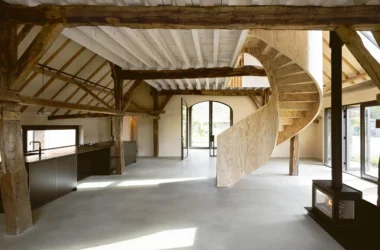
Nikjoo and Flawk Use “Refined Playfulness” to Animate a Timber-Framed Home in Gospel Oak
Conclusion: A Zero-Waste Future
The adoption of reclaimed materials is the cornerstone of Circular Construction Practices. By treating our existing built environment as a resource, we move closer to a zero-waste reality. For the discerning homeowner and the professional architect alike, the “reclaimed” tag is now a badge of authenticity, durability, and forward-thinking luxury.