





Imagine arriving at the terminal and never once reaching for your passport, never stopping to take off your shoes, and never standing in a serpentine queue. The next frontier of aviation design isn’t just about faster planes—it’s about the total removal of friction. The goal for 2026 and beyond is “Invisible Design”: a terminal where you move through security as effortlessly as a car through a McDonald’s drive-through.
For decades, airports were the quintessential “non-places”—sterile, anxiety-inducing corridors of glass and steel. But a silent revolution is underway. Today, the terminal has transitioned from a transit hub to a high-stakes testbed for the future of urban life, proving that if a design solution can survive the relentless pressure of 80 million passengers a year, it can survive anywhere. This is why, according to the latest reports from IATA on the future of aviation, the world’s most influential architecture firms are no longer just building gates; they are building the cities of tomorrow, today.
From Duty-Free to the “Airport Mall” Concept
The most visible shift is happening in the shopping aisle. The era of generic, neon-lit duty-free shops is collapsing. In its place, we are seeing a strategic shift toward the “Boutique Terminal.” Airports are no longer just transit points but destinations that mirror the grandeur of Dubai’s world-renowned luxury malls, combined with the sophisticated, editorial feel of a flagship store in Milan or Paris.
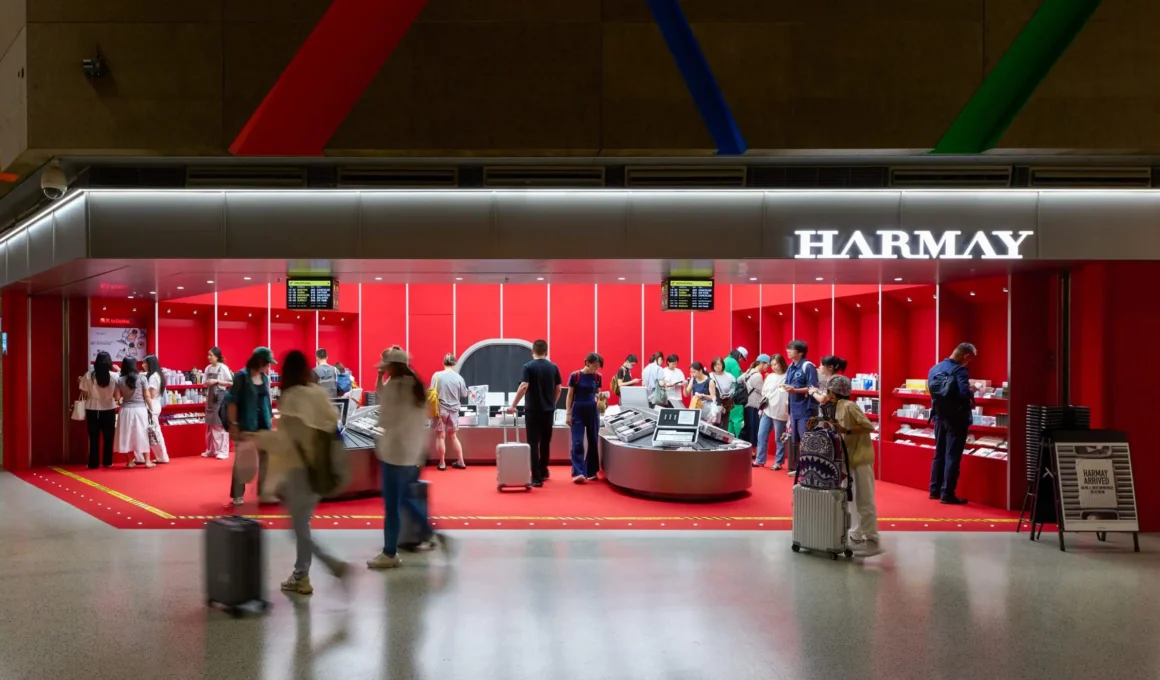
We are witnessing a transition from convenience-based shopping to high-end flagship experiences, a trend recently analyzed by The Business of Fashion regarding travel retail as a new frontier for global brands. A prime example of this retail metamorphosis is the Harmay store at Shanghai Hongqiao Airport designed by AIM Architecture. By utilizing industrial aesthetics and a bold red palette, the project breaks the “safe” airport mold, proving that physical retail in a terminal can be as provocative and brand-centric as a boutique in the heart of the Quadrilatero della Moda.
The Biofilic Blueprint
Beyond retail, the “testbed” concept extends to our psychological well-being. As global stress levels rise, architects are using airports to prove that biofilia is not a luxury, but a necessity.
“To design an airport is to design a city’s first and last impression. It’s about creating a gateway that breathes with the land it stands on,” says Bjarke Ingels.
This philosophy is being pushed to the extreme in the Gelephu International Airport in Bhutan, where BIG Architects is blending mindfulness with infrastructure. Similarly, the Portland International Terminal (PDX) renovation by ZGF Architects showcases how massive timber structures can transform a transit hub into a warm, forest-like sanctuary, setting a new standard for public architecture.
Engineering the “Invisible” Gate
The next frontier is the total removal of friction. The goal for 2026 and beyond is “Invisible Design”: a terminal where you never stop moving, never reach for a passport, and never feel the weight of the infrastructure.
Zaha Hadid Architects is pioneering this fluid future with the Bishoftu International Airport in Ethiopia, where the architecture itself guides the flow of people through organic, intuitive forms.
Other visionary projects currently under development are redefining the “green” label:
-
Foster + Partners’ Techno International Airport in Phnom Penh is aiming to become one of the world’s greenest, utilizing a massive grid-shell roof that maximizes natural light.
-
The Lishui Airport in China by MAD Architects, which looks more like a white bird resting in the landscape than a traditional terminal, emphasizes the emotional connection between the traveler and the horizon.
The New Urban Frontier
The innovations we see at the gate—from AI-driven “walk-through” biometrics to advanced sustainable materials—are the blueprints for our future smart cities. The airport is no longer a place you want to leave as quickly as possible; it is becoming a destination in its own right, consistently climbing the ranks of the Skytrax World Airport Awards for its convergence of luxury, nature, and technology.
The terminal has quietly led a revolution. Now, the rest of the world is just trying to keep up.