





In a global landscape where connectivity defines economic power, the commencement of works at Bishoftu marks a turning point not only for Ethiopia but for the entire international stage. The new Bishoftu International Airport (BIA), championed by the Ethiopian Airlines Group, emerges as a $12.5 billion infrastructural giant, conceived to transcend the physical limitations of the current Addis Ababa hub and strategically position itself at the crossroads of Africa, Asia, and the Middle East. With an initial capacity of 60 million passengers, scaling to 110 million in subsequent phases, the project is a bold response to the exponential growth of global air travel demand.
An architectural vision carved from the Great Rift Valley defines the terminal’s visual identity, where the unmistakable signature of Zaha Hadid Architects (ZHA) transforms Ethiopian geology into built form. Following a landmark year that saw the studio complete world-class projects—from the sculptural fluidity of the Xi’an Football Centre to the kinetic energy of the Guangzhou Sports Centre—ZHA applies a parametric sensitivity here that honors the Great Rift Valley. The terminal is structured around a central spine that not only evokes the region’s geological fissures but optimizes passenger flow, ensuring intuitive connections in what will become Africa’s primary aviation gateway.

Sensory experience and cultural resonance permeate every detail of the interiors, designed to welcome the vast majority of travelers—approximately 80%—who will use the airport exclusively for international transfers. ZHA’s approach, previously lauded for its meticulous detail and sophisticated atmosphere in the Hotel Romeo Roma, is reflected here in a material and color palette that shifts across each pier, narrating the stories of Ethiopia’s diverse regions. The vast communal spaces are not merely transit zones; they are enriched by indoor gardens and outdoor courtyards that allow visitors to experience the temperate climate of the Oromia region, offering a breath of nature within a high-tech environment.

Operational efficiency merges with environmental stewardship through cutting-edge technical planning. Situated at an elevation nearly 400 meters lower than the existing Bole Airport, BIA allows aircraft to operate with a higher Maximum Take-Off Weight (MTOW), drastically reducing fuel consumption for long-haul flights. This drive for optimization is central to the strategy for achieving LEED Gold certification. The use of locally produced materials from Bishoftu, such as recycled steel and concrete, combined with natural ventilation systems, demonstrates a concrete commitment to reducing the carbon footprint. This vision echoes the functional precision of other recent studio works, such as the Shenzhen Science & Technology Museum.
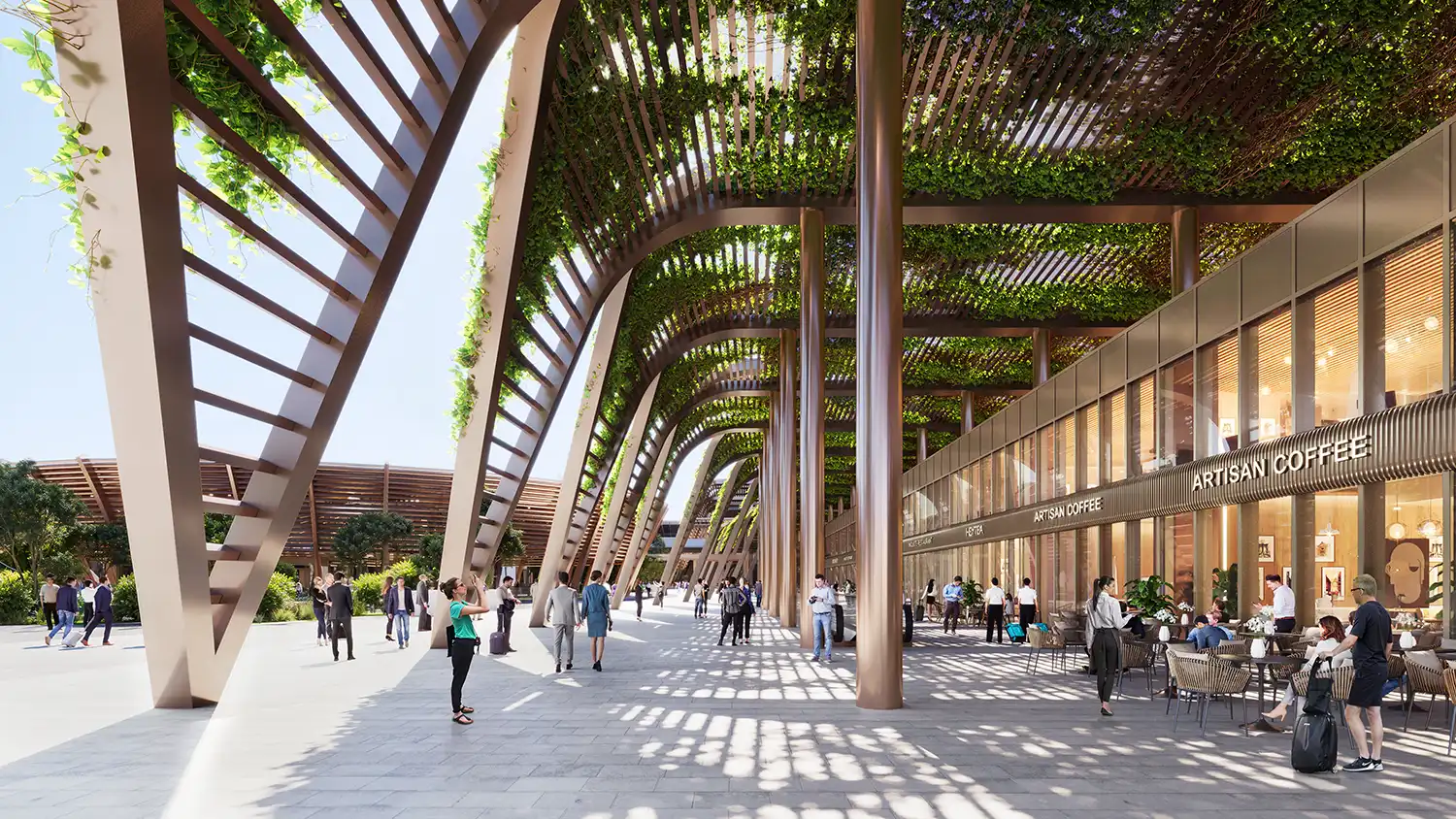
An integrated urban ecosystem is rising around the runways, with the ambition of creating a true “Airport City.” The project extends beyond air travel to include a high-speed rail link to central Addis Ababa, public parks for the local community, and mixed-use zones that will support a population of 80,000. This ability to weave complex infrastructure into the social fabric recalls the approach taken for the dynamic Go Park Sai Sha hub in Hong Kong, where public and private spaces coexist in harmony. Even in specialized sectors, as seen in the Malpensa Hospital and the futuristic Vertex Hotel in Okinawa, ZHA confirms its mastery of technological complexity without losing sight of the human dimension.

The future of African aviation finds its most powerful symbol in the Bishoftu International Airport. Through the collaboration between lead consultants Dar Al-Handasah and the design excellence of ZHA, the airport will be more than a machine for flight; it will be a cultural bridge linking the continent to the world. In line with the “Vision 2035” of the Ethiopian Airlines Group, this hub represents the promise of resilient growth—an architecture that does not just house the journey but defines its quality, transforming every transit into an experience of excellence in the heart of East Africa.