



The contemporary obsession with total illumination is not merely a technical preference but a manifestation of a pervasive cultural anxiety toward the unseen. By equating visibility with safety and productivity, modern residential architecture has effectively sanitized the domestic sphere, purging the “productive darkness” that historically facilitated introspection and the essential boundaries of the private self. Reclaiming the shadow is therefore an act of architectural resistance, a necessary recalibration of the domestic experience against the flattening effects of the 24/7 digital glare.
The Tyranny of the Well-Lit Room
The homogenization of light in the 21st century has led to a state of sensory atrophy. In the pursuit of “efficiency” and “open-plan” transparency, we have traded the layered environments of the past for high-output, low-character voids. This lighting strategy treats space as a commodity to be fully exposed rather than a sequence of moments to be felt.
When we design for total visibility, we eliminate the hierarchy of importance; the kitchen counter receives the same luminous priority as the art on the wall or the person across the table. This lack of contrast creates a spatial dissonance, where the eye—and by extension, the mind—has no place to rest, leading to a subtle but constant state of cognitive fatigue. While understanding how to choose the right light temperature provides a technical foundation, a truly critical approach to modern interiors requires a shift from lumens to perception.
Shadow as a Structural Material
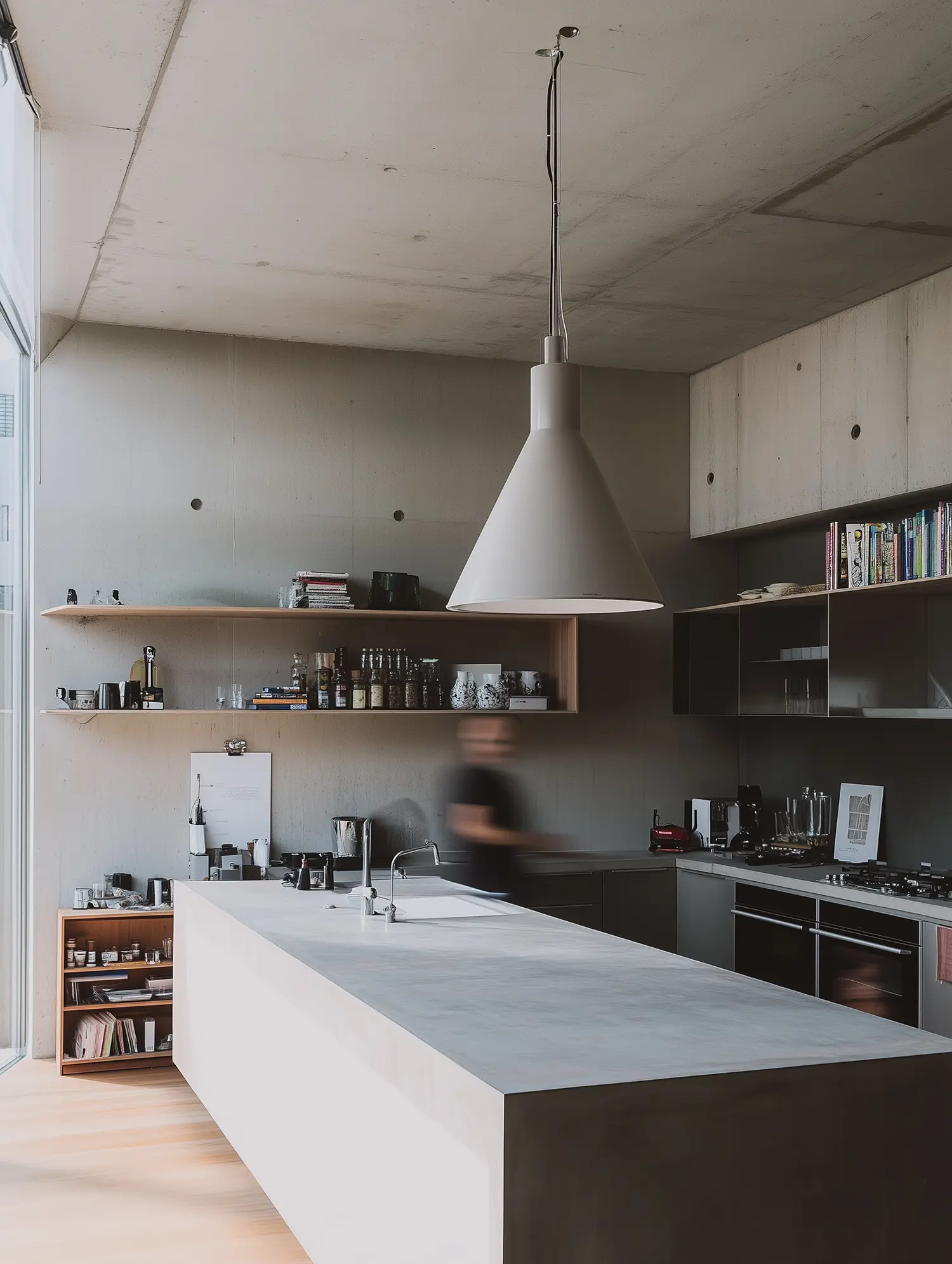
Architects must recognize that shadows are not the absence of design, but a structural material in their own right. Just as silence defines a musical composition, the “un-lit” corner defines the room. By intentionally placing light to leave certain areas in the dark, we engage the inhabitant’s imagination. This subtractive methodology allows for the creation of “visual niches”—pockets of space that feel physically separate without the need for physical partitions.
This concept echoes the philosophical inquiries found in Jun’ichirō Tanizaki’s seminal text, In Praise of Shadows, which argues that beauty exists not in the object itself, but in the patterns of shadows and the light that the object creates. By mastering the psychology of garkness, we create a spatial depth that flat, uniform lighting immediately destroys, allowing the material honesty of a building to surface through the tension of chiaroscuro.
Circadian Integrity and the Biological Night
The erasure of darkness is a biological affront. The “panopticon” effect of modern glass-walled homes, coupled with pervasive blue-light emission, has severed our connection to natural temporal rhythms. A sophisticated lighting design for 2026 does not seek to fight the night but to welcome it. By utilizing low-level grazing lights and focused beams that respect the periphery, we can restore a sense of intimacy to the built environment.
To design by subtraction is to acknowledge that the most powerful architectural statements are often those that remain partially hidden in the gloom. This approach aligns the home with the natural circadian rhythm, providing a much-needed reprieve from the relentless brightness of urban life. The result is a living space that feels lived-in rather than merely staged—a site where the shadow acts as a silent navigator for the human spirit.
Psychology of Darkness Differentiation
Why is visual silence becoming a luxury commodity in residential architecture?
As urban environments become more saturated with light pollution and digital noise, the ability to control and limit light within the home has become a marker of high-end design. Visual silence—the deliberate use of darkness to minimize sensory input—is now recognized as a vital component of mental health, offering a “reset” for the nervous system that cannot be achieved in a standard, evenly lit environment.
How does subtractive lighting challenge the aesthetic of modern interiors?
Social media favors flat, bright, and highly legible spaces that translate well to small screens. Subtractive lighting, however, prioritizes the physical, three-dimensional experience of the occupant over the two-dimensional capture of a camera. It creates a “slow design” experience where the beauty of a space reveals itself over time through changing shadows, challenging the demand for instant visual gratification.
Can Dark Design improve the sustainability metrics of a high-authority project?
Beyond the obvious reduction in energy consumption, subtractive lighting increases the longevity of a design. By avoiding trend-heavy, over-engineered lighting fixtures and focusing on the permanent architectural interplay of light and shadow, designers create timeless environments that require fewer technical upgrades and suffer less from visual obsolescence.