



In the quiet folds of the Italian Alps, where the historic village of Cisore clings to the mountainside near Domodossola, architecture often acts as a bridge between the weight of history and the lightness of contemporary living. This restoration project by ATOMAA is not merely a renovation; it is a meticulous excavation of family memory. Once the home of the client’s grandparents and left dormant for two decades, House Cisore has been reimagined as a sanctuary for a Milan-based professional. The journey to the house is a sensory prelude: a train ride from the bustle of Milan to the northern reaches of Piedmont, followed by a walk along an ancient mule track that reinforces the transition from urban intensity to alpine stillness.

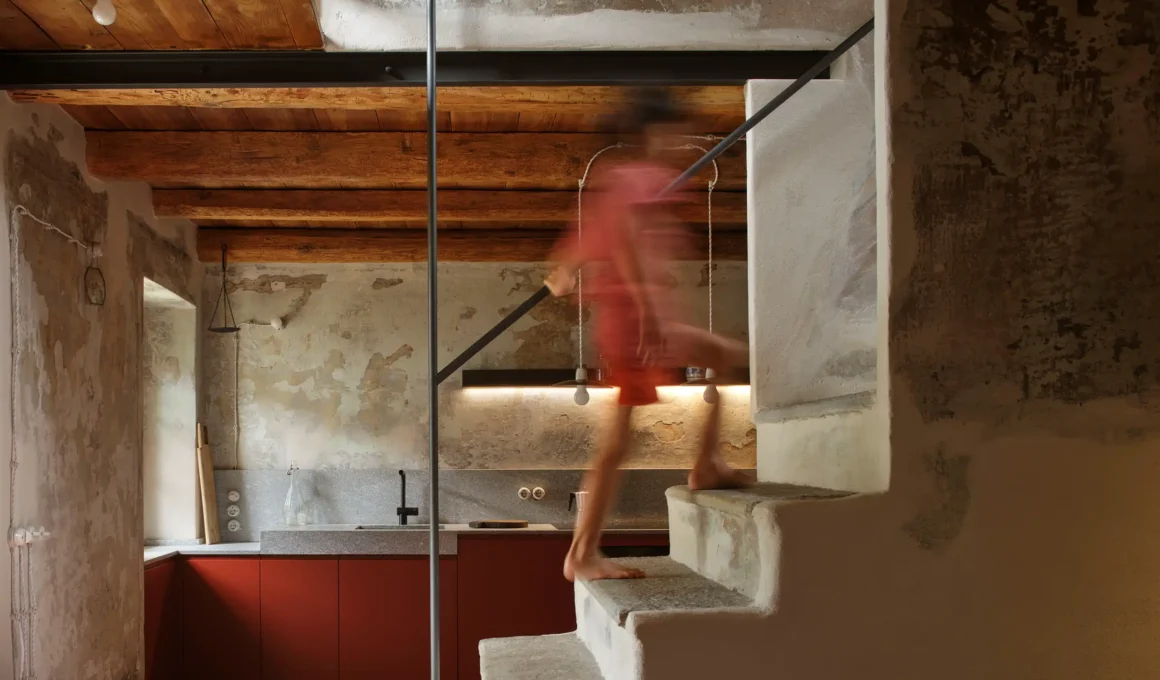
A dialogue between materiality and memory serves as the project’s conceptual anchor, where the architects sought to honor the “Walser” character of the Val Formazza while nodding to the artistic heritage of the nearby Valle Vigezzo. The home’s original layout—typically dark, compartmentalized, and introverted—was carefully unraveled to invite depth and light. The kitchen, once defined by a monumental soot-stained fireplace, has been repurposed into a social living heart. By carving strategic portals into the thick stone walls, ATOMAA transformed a previously claustrophobic staircase into a sculptural protagonist. No longer trapped between masonry, the timber stairs now mediate between the communal ground floor and the private quarters above, framed by dark iron beams that act as honest markers of structural intervention.

The sensory experience of the interior is defined by a sophisticated palette of reclaimed timber and artisanal finishes. Larch, walnut, and chestnut surfaces provide a tactile warmth that contrasts with the “Pompeian red” resin flooring—a bold, contemporary fil rouge that unifies the ground plane. During the restoration, the discovery of ancient painted textures on the walls shifted the design trajectory; rather than covering them, the architects preserved these “forgotten layers,” allowing the patina of the past to converse with clean, modern lines. This approach to functional domesticity mirrors other notable Italian interventions, such as the geometric precision of a hobby house in Pordenone, where traditional contexts are reinvigorated through clear, modern volumes.

Technical precision meets centuries-old tradition in the treatment of the roof. The heavy piode di beola (local stone slabs) were meticulously restored to maintain the building’s rugged alpine exterior. However, beneath this stone shell lies a “wooden heart”—a versatile attic space accessible via a glass hatch. This clever architectural maneuver transforms the massive stone roof into a lantern at night, casting a soft glow into the sleeping quarters below. The integration of modern amenities, including a compact internal bathroom carved from the original footprint, demonstrates a surgical approach to space-making where every square centimeter is negotiated to improve livability without sacrificing the building’s soul.

The contextual impact of the restoration extends beyond the stone walls into a garden that feels as though it was curated by time itself. The intervention here was light-handed: natural lime plaster and local stone provide the backdrop for a resilient American grape vine that survived decades of abandonment. This greenery, alongside olive trees and fragrant jasmine, shades a communal stone table that has returned to its original purpose. It is a space designed for the slow rituals of breakfast and summer dinners, where the boundary between the historic village fabric and the private residence becomes beautifully blurred.

A testament to architectural permanence, House Cisore stands as a sophisticated rebuttal to the “tabula rasa” approach of modern development. By synthesizing the ruggedness of the Piedmont landscape with refined interior gestures, ATOMAA has created a home that breathes with the history of its inhabitants while looking firmly toward the future. It is a bright, welcoming refuge that proves that the most sustainable way to build is often to listen to the stories already whispered by the walls.