



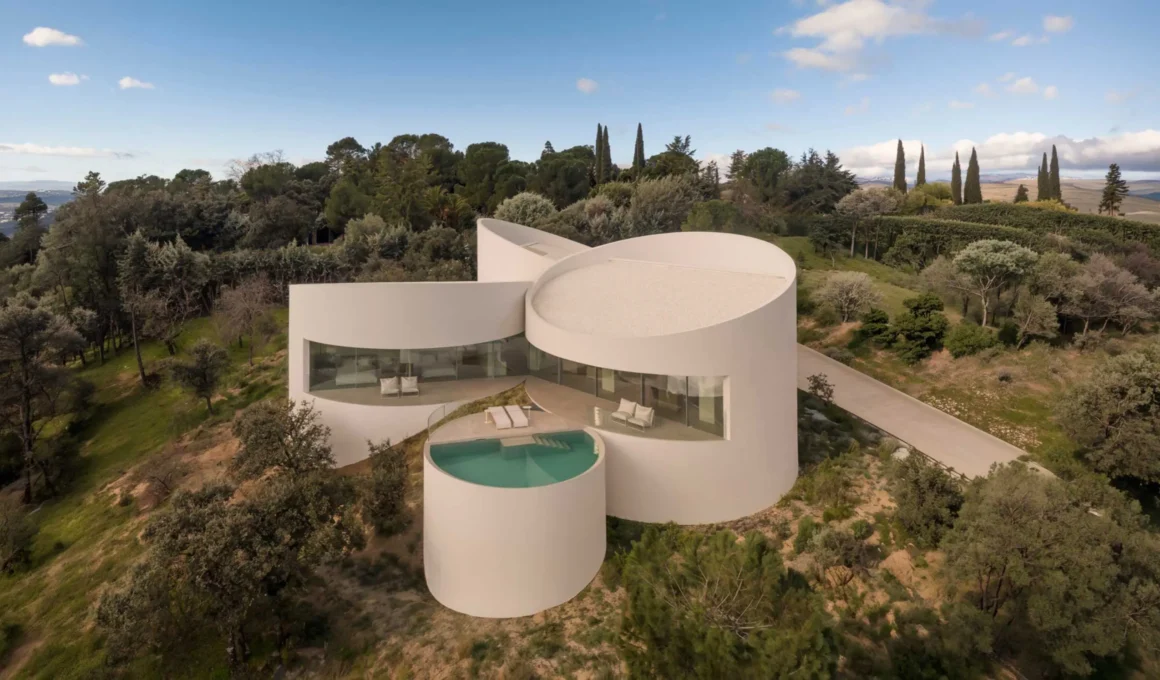
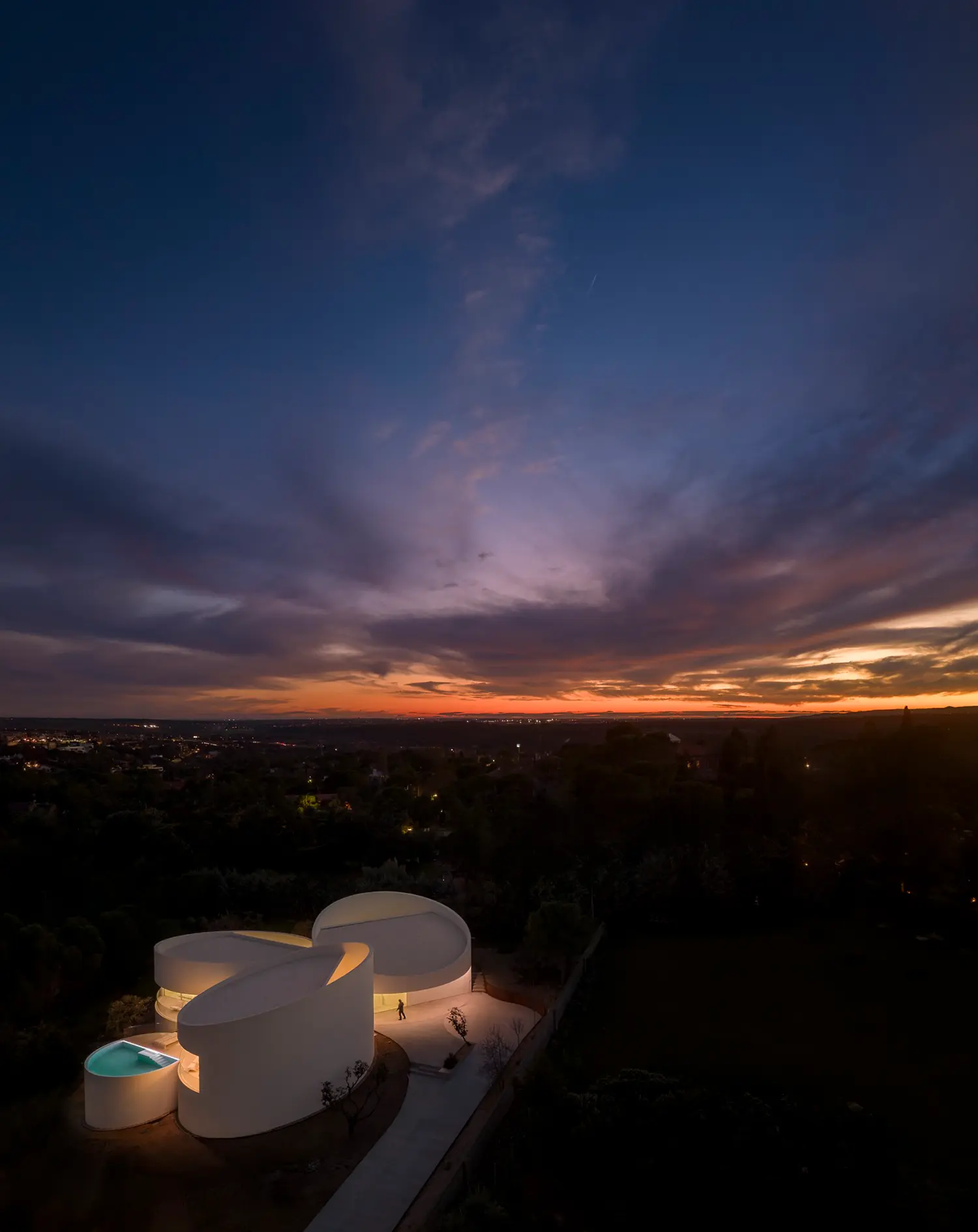
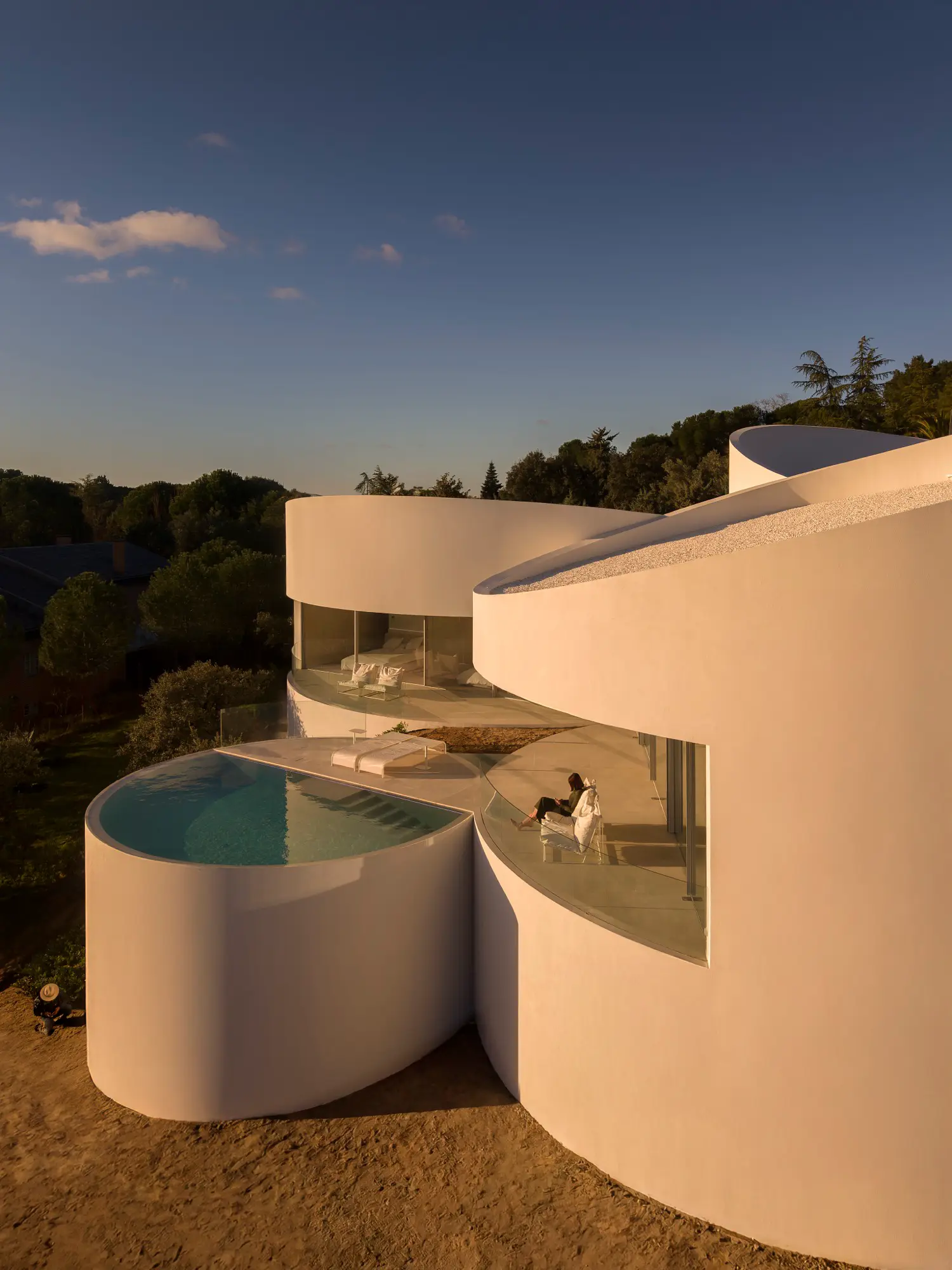
Fran Silvestre Arquitectos breaks a hillside house in Las Rozas into five cylinders, each one shaped by a different demand of program, slope, and light. The volumes are cut obliquely to follow the terrain and to resolve a pitched roof condition typical of the area, while a small inner courtyard, formed where orthogonal walls meet at 120-degree angles, becomes the project’s quiet counterpoint to its curved geometry. The result reads less like a stylistic gesture and more like a structural argument worked out volume by volume.
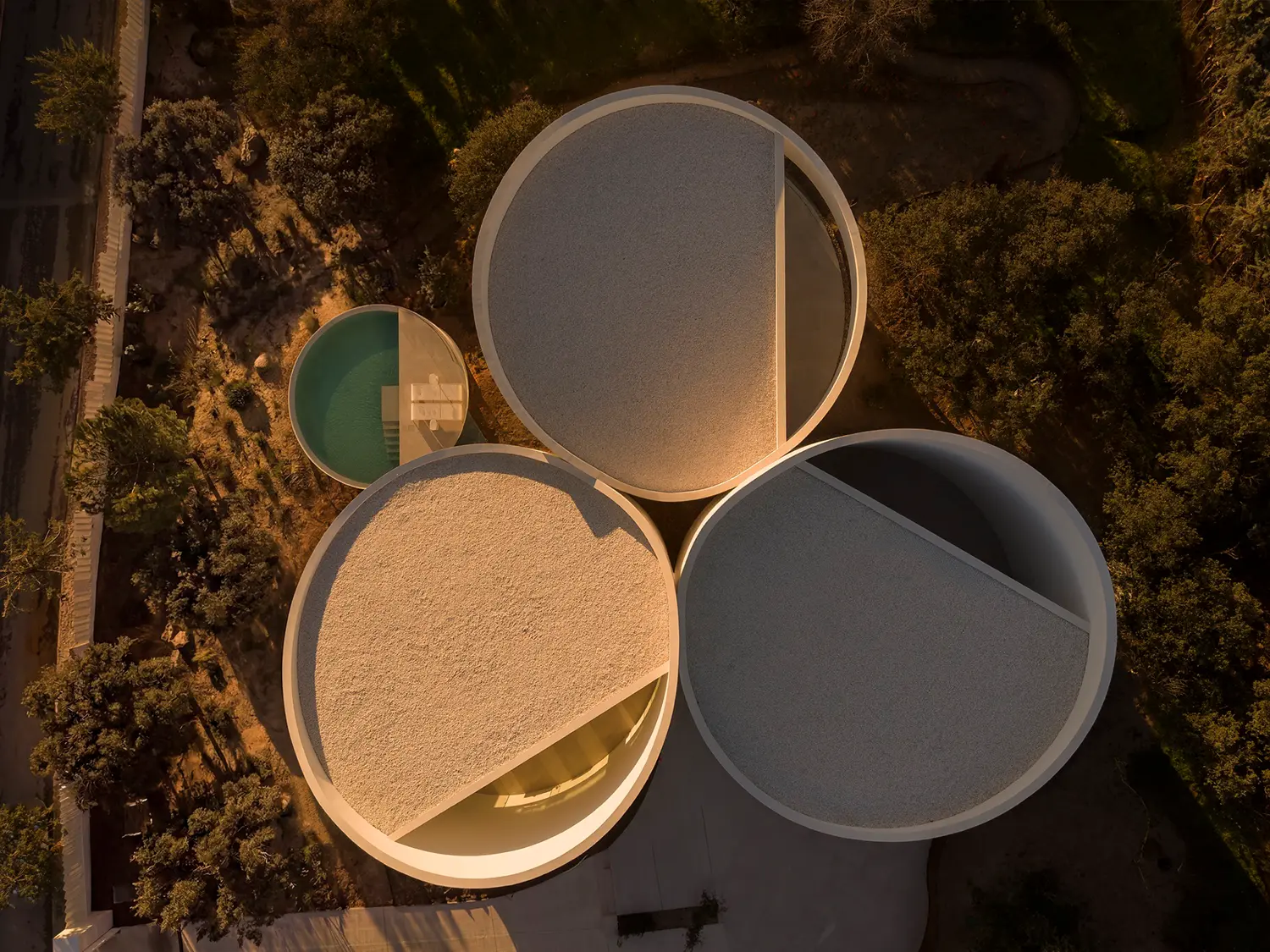
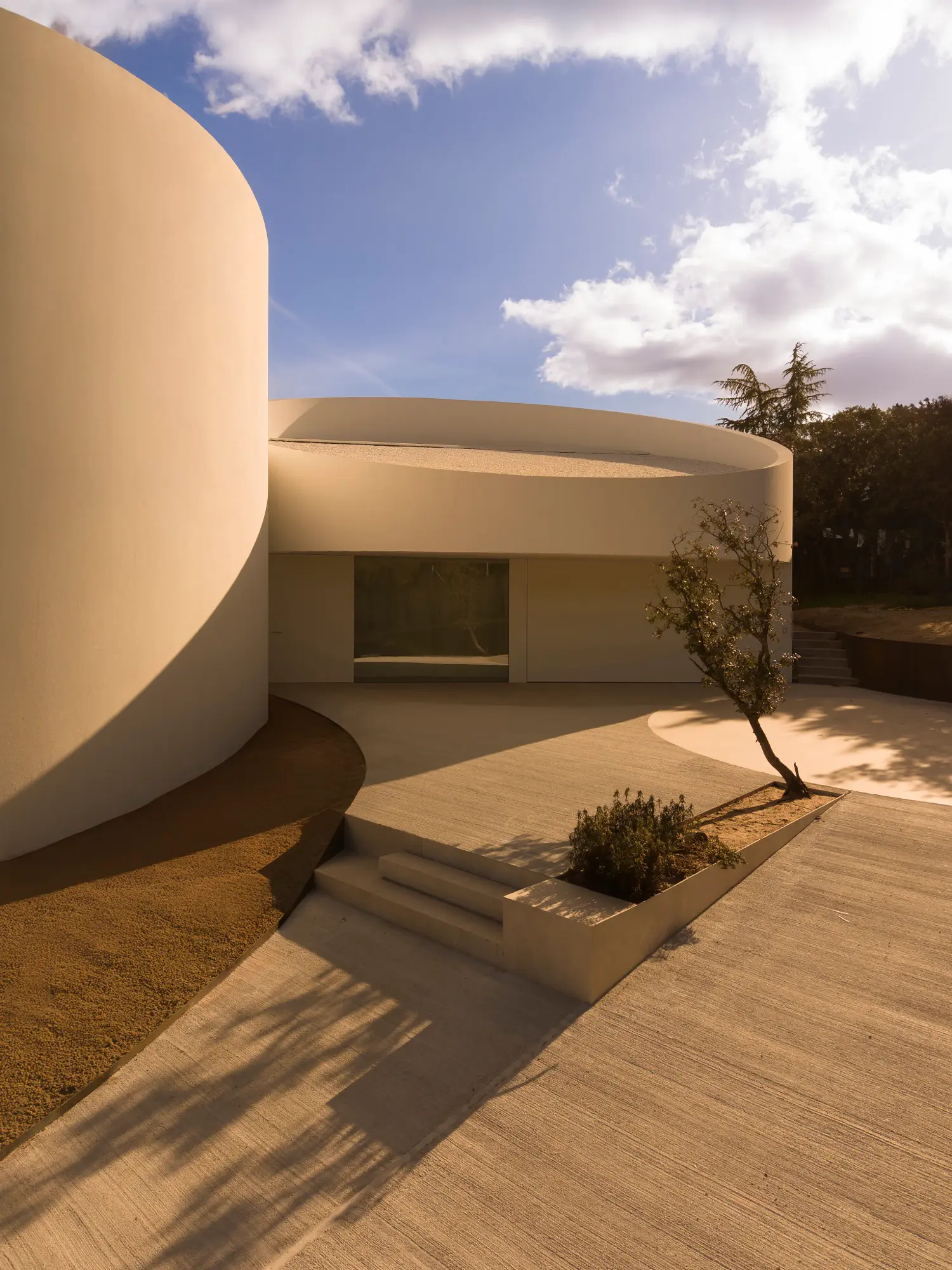
Five cylindrical volumes organize the house in Las Rozas with little ambiguity about what each one is for. One cylinder holds the bedrooms, another the living area, a third combines vehicular access with the garage and a wellness area, a fourth contains the swimming pool and technical facilities, and a fifth marks the entrance. Fran Silvestre Arquitectos treats this distribution as the project’s organizing logic rather than a secondary plan-fitting exercise — the geometry doesn’t decorate the program, it carries it.
The oblique roof cuts that close each cylinder at the top do two jobs at once. They let the volumes settle into the sloped terrain without resorting to heavy excavation or retaining structures, and at the upper level they resolve into a pitched roof — a typology the region expects — while orienting differently toward the sun depending on which volume is being cut. It’s a detail that solves a site problem and a code-adjacent expectation in the same move.
Pitched roof logic here isn’t nostalgic. Each cylinder’s angled top captures light from a distinct orientation, meaning the bedrooms, the living spaces, and the wellness volume are each tuned independently rather than sharing one uniform roof pitch across the house — a calibration the studio also worked through, in a very different climate, on its WELL-certified Camiral House in Girona.
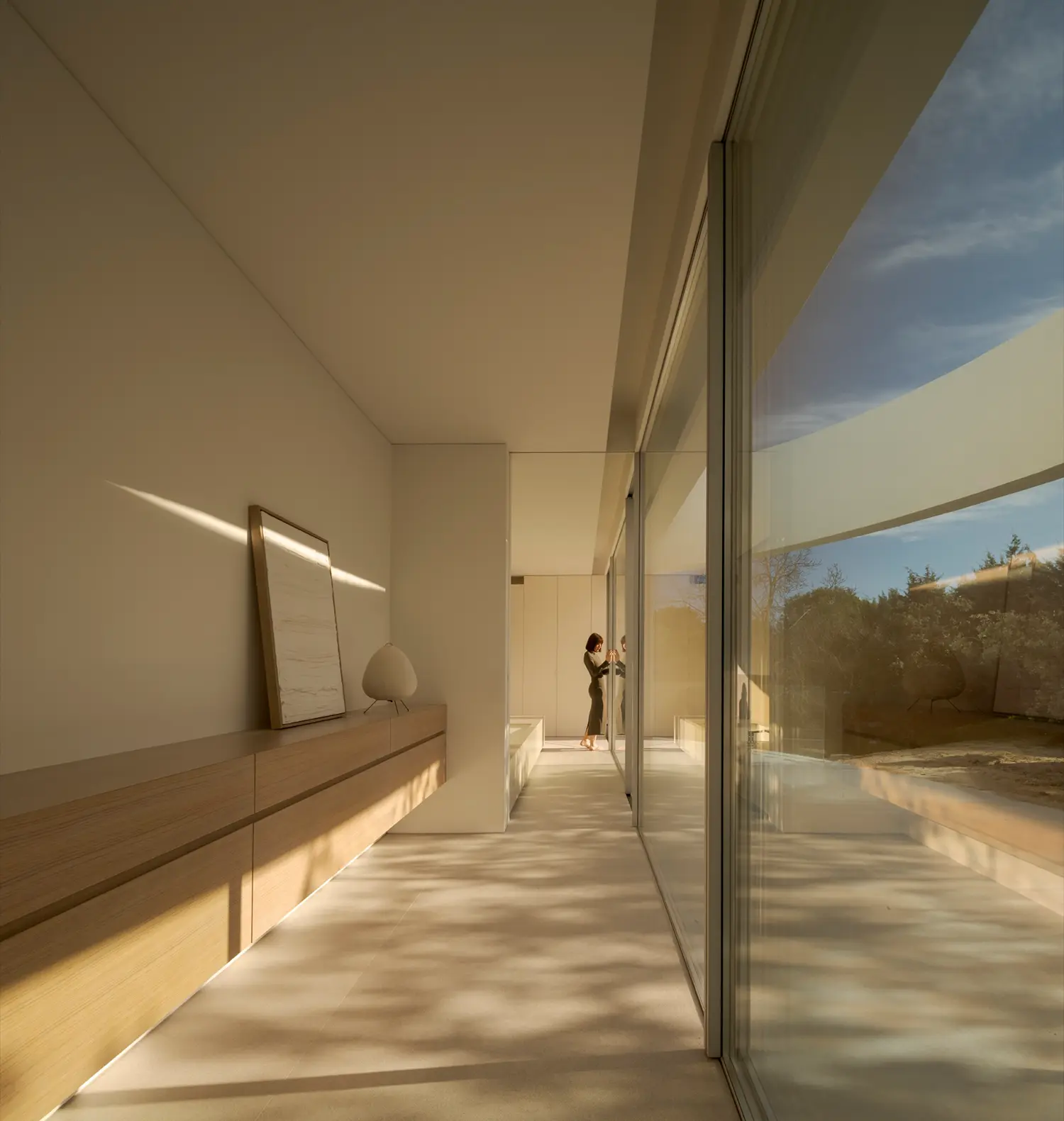
The inner courtyard breaks from the cylinders at one specific point: where orthogonal volumes meet at 120-degree angles to form a small but pivotal space. This is the project’s one rationalist gesture inside an otherwise curved system, and it’s where the geometry does its most legible work — light hits the angled surfaces differently through the day, and the courtyard’s character shifts without a single material change.
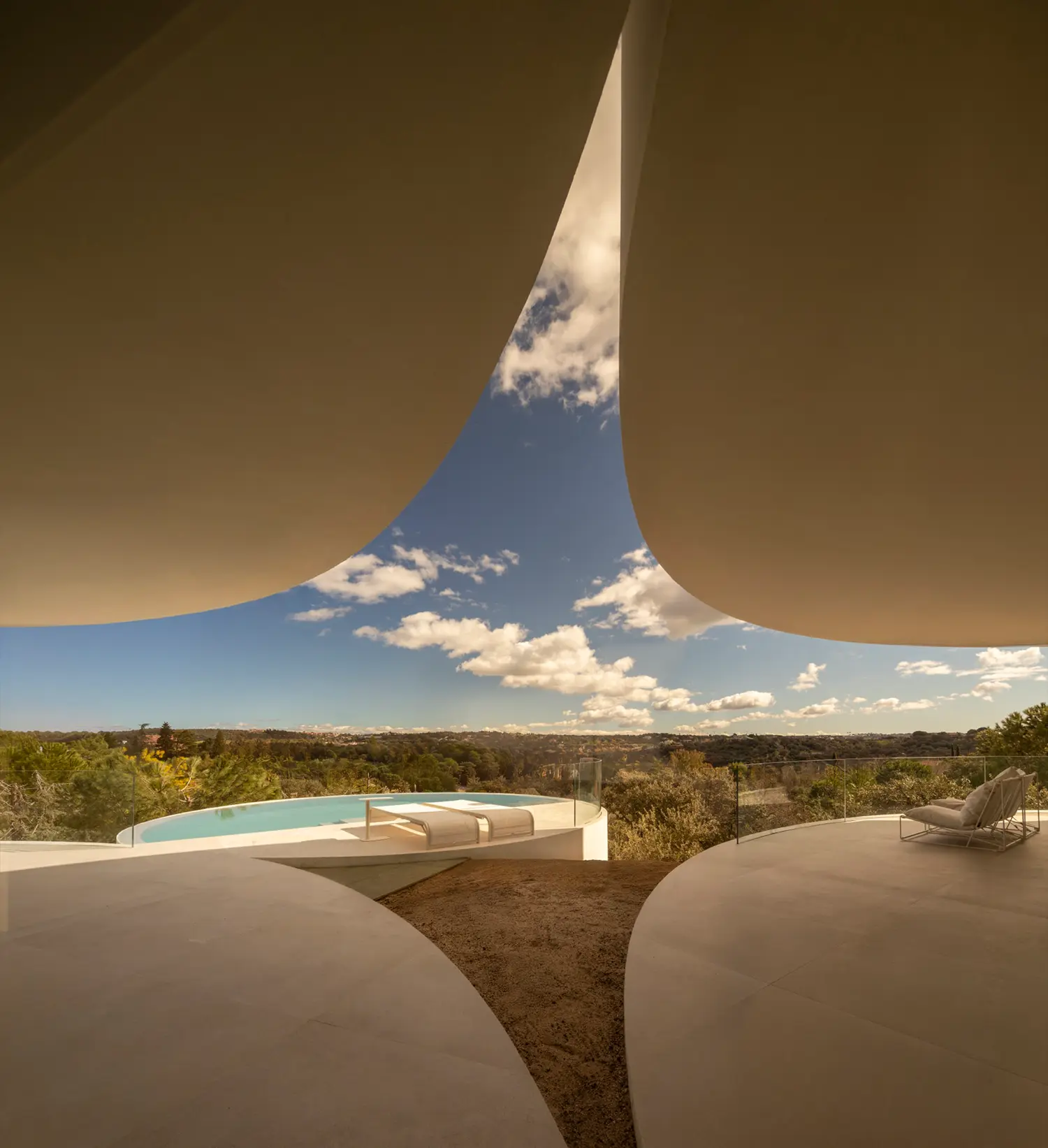
Courtyard light is treated as a variable, not a constant. Because the surrounding walls meet at angles rather than running parallel, the way light falls and the shadows it casts change continuously through the day, altering how the space reads at 9am versus late afternoon. It’s a small space doing outsized perceptual work for a house this geometrically ambitious.
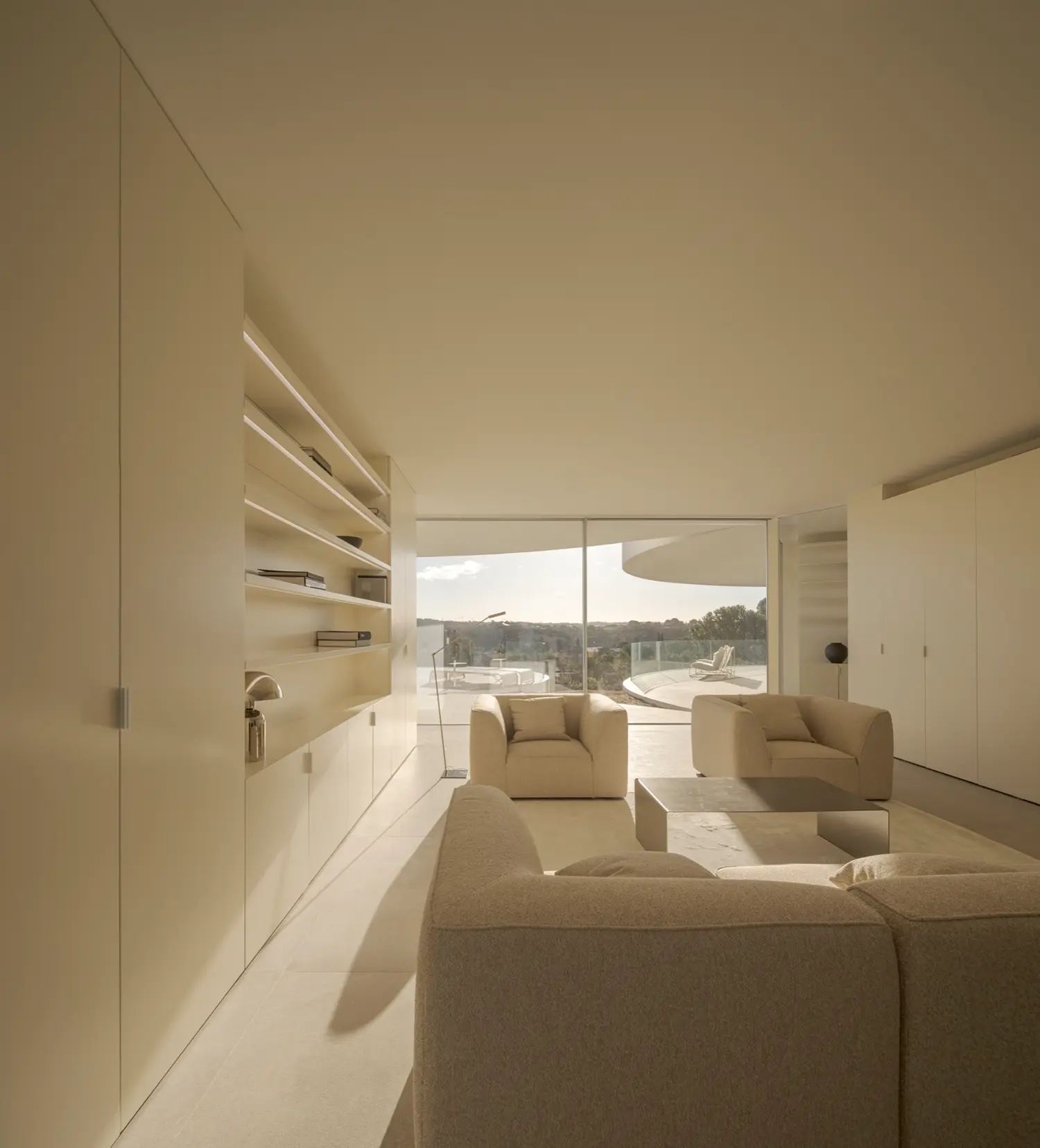
Panoramic views of the Sierra de Guadarrama shape the openings throughout the house, but the more interesting move is what happens at the scale of each individual volume — a strategy the studio has tested before, distributing privacy and exposure unevenly across a single plan rather than treating the whole house as one gesture, as seen in its Villa 95 in Sotogrande. Two of the cylinders here get their own private courtyards, shielded from wind and from outside view, while a third opens onto a terrace.
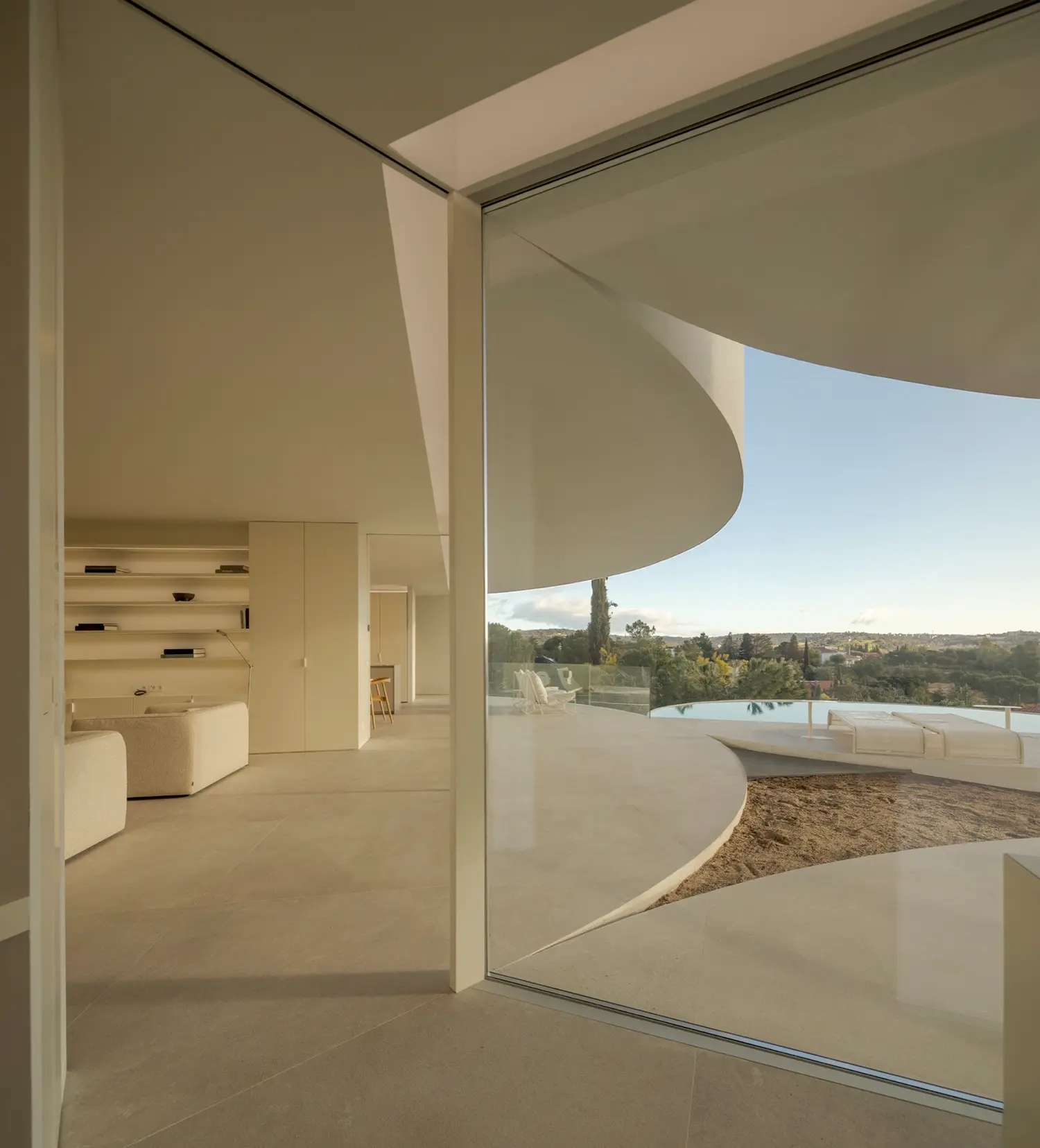
This room-by-room approach to outdoor space extends the same logic that governs the roof cuts and the courtyard: nothing is resolved at the scale of the whole house if it can instead be resolved at the scale of the individual cylinder. It’s a working method the studio has refined across projects — including its Villa 18 in La Moraleja — and it’s consistent enough here to read as deliberate rather than improvised.
Andreu Alfaro’s sculpture “Homage to Brancusi” is cited as an intuitive point of departure for the project — not a literal formal source, but a way of understanding why curved, discrete volumes might cohere into a single composition the way Alfaro’s piece does. Whether that reference does real explanatory work or functions more as a poetic gloss on a decision already made for practical reasons is the kind of claim worth sitting with rather than taking at face value.
House in Las Rozas by Fran Silvestre Arquitectos | Location: Las Rozas de Madrid, Spain — Year: 2026