

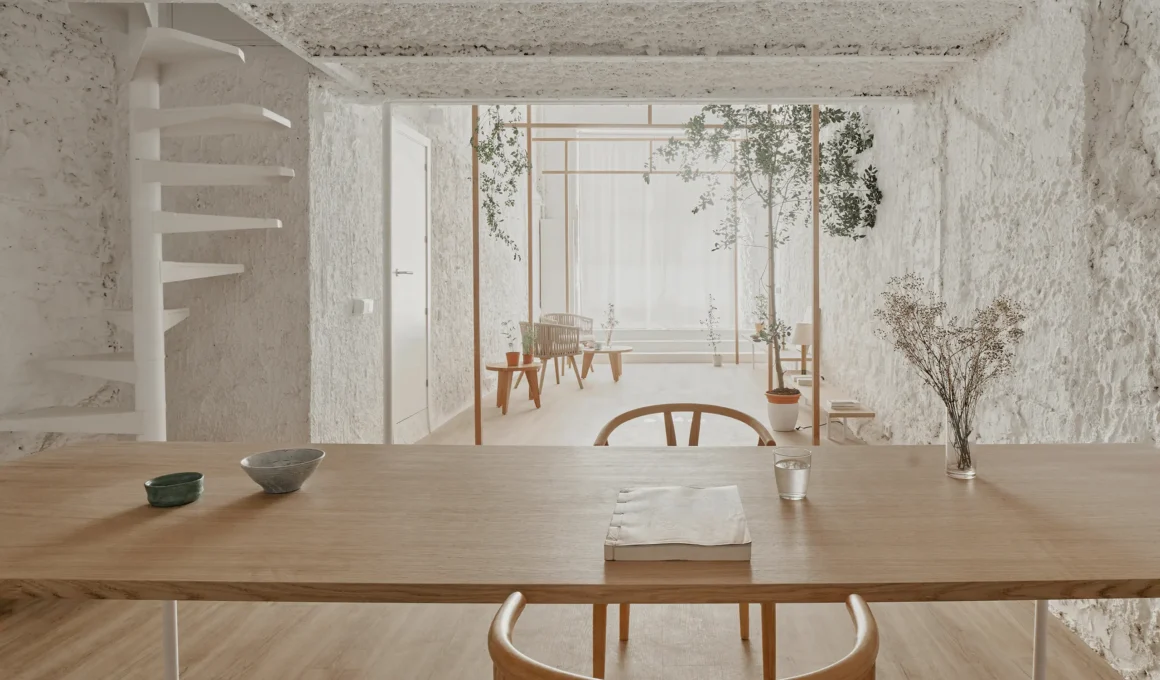
The El Born Loft by Roman Izquierdo Bouldstridge transforms a former commercial space in Barcelona, Spain, into a versatile dwelling defined by a series of modular timber structures and the profound philosophical exploration of the void.
A Conceptual Framework of Absence. Influenced by the Taoist teachings of Lao-Tse, the project posits that the utility of a vessel—or a room—lies not in its walls, but in the empty space they contain. In the historic heart of El Born, Roman Izquierdo Bouldstridge has crafted a residence that feels less like a fixed construction and more like a curated interval. The intervention avoids the heavy-handedness often found in urban renovations, opting instead for a narrative of “the intangible.” By stripping the site to its core, the studio invites a sensory dialogue between the rough-hewn history of the building and the precise geometry of new insertions.
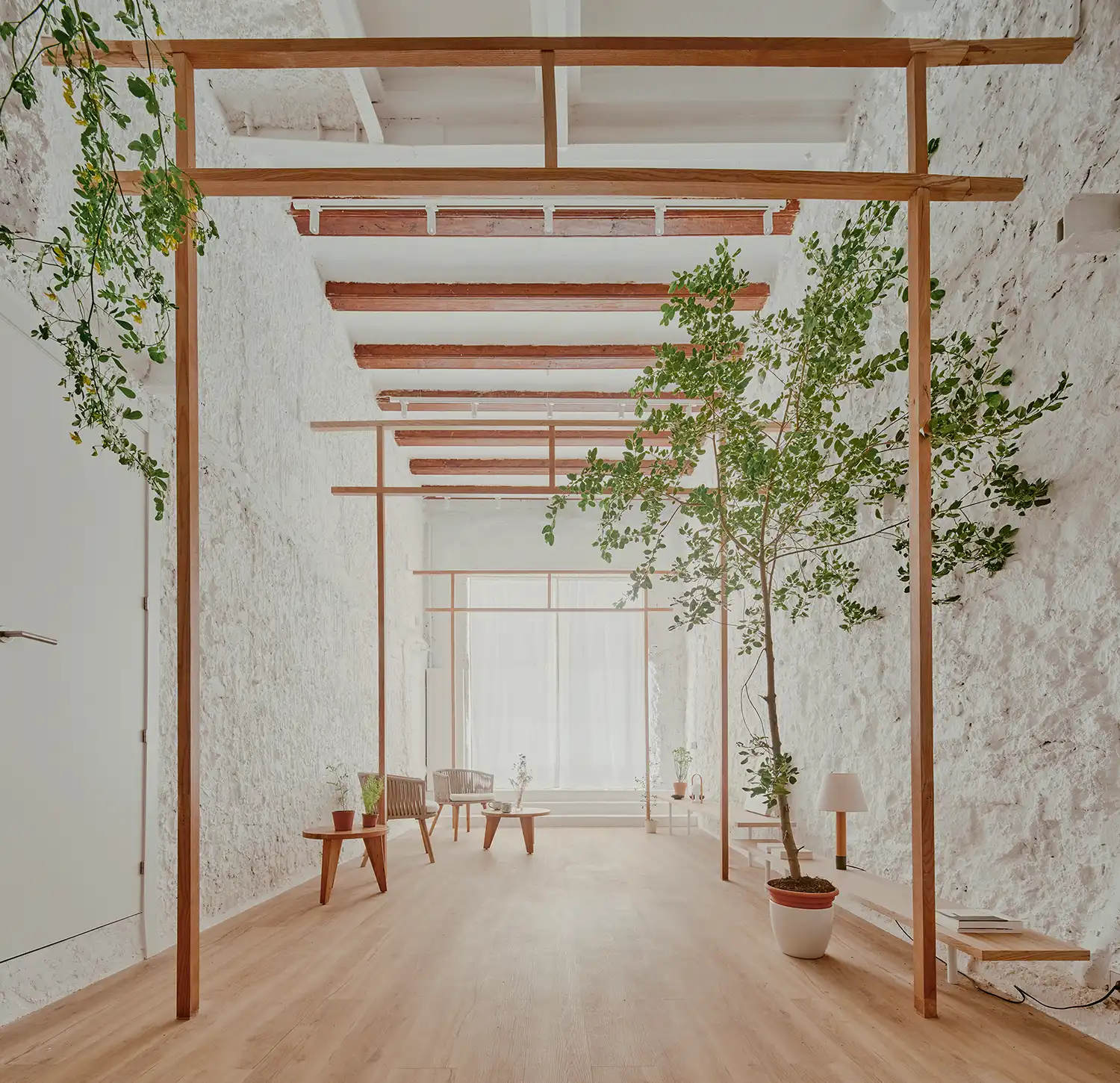
The Evolution of a Modular System. Central to the loft’s identity is a modular ash wood system that challenges the traditional permanence of residential interiors. This is not a static installation; the timber components carry a decade of history, having previously served as commercial displays and office infrastructure. By adapting this sustainable timber framework to a domestic setting, the architect elevates the material beyond its utilitarian roots. The wood bears the soft patinas and tonal shifts of its past lives, turning the “void in time” into a tangible architectural quality that embraces impermanence.
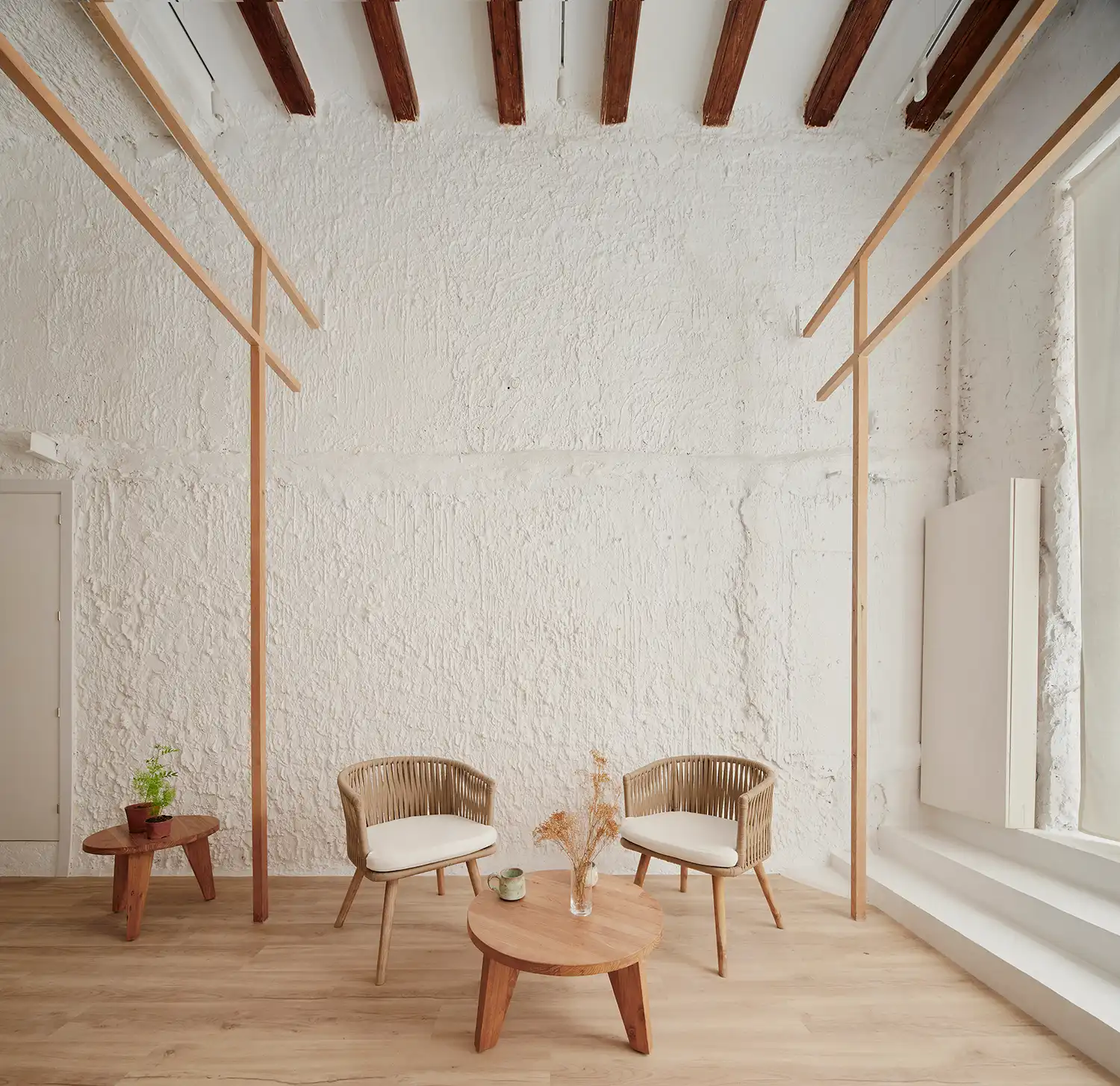
The Ritual of the Threshold. The spatial logic is dictated by the rhythmic placement of three torii—traditional Japanese gateways that mark the transition between different states of being. These structures do not divide the room into conventional chambers but instead create a sequence of pauses. This application of ma—the Japanese concept of intermediate space—ensures that the interior layout is defined by the relationships between objects rather than by physical partitions. Moving through the loft becomes a processional experience, culminating in a staircase that draws the eye toward the influx of natural light.
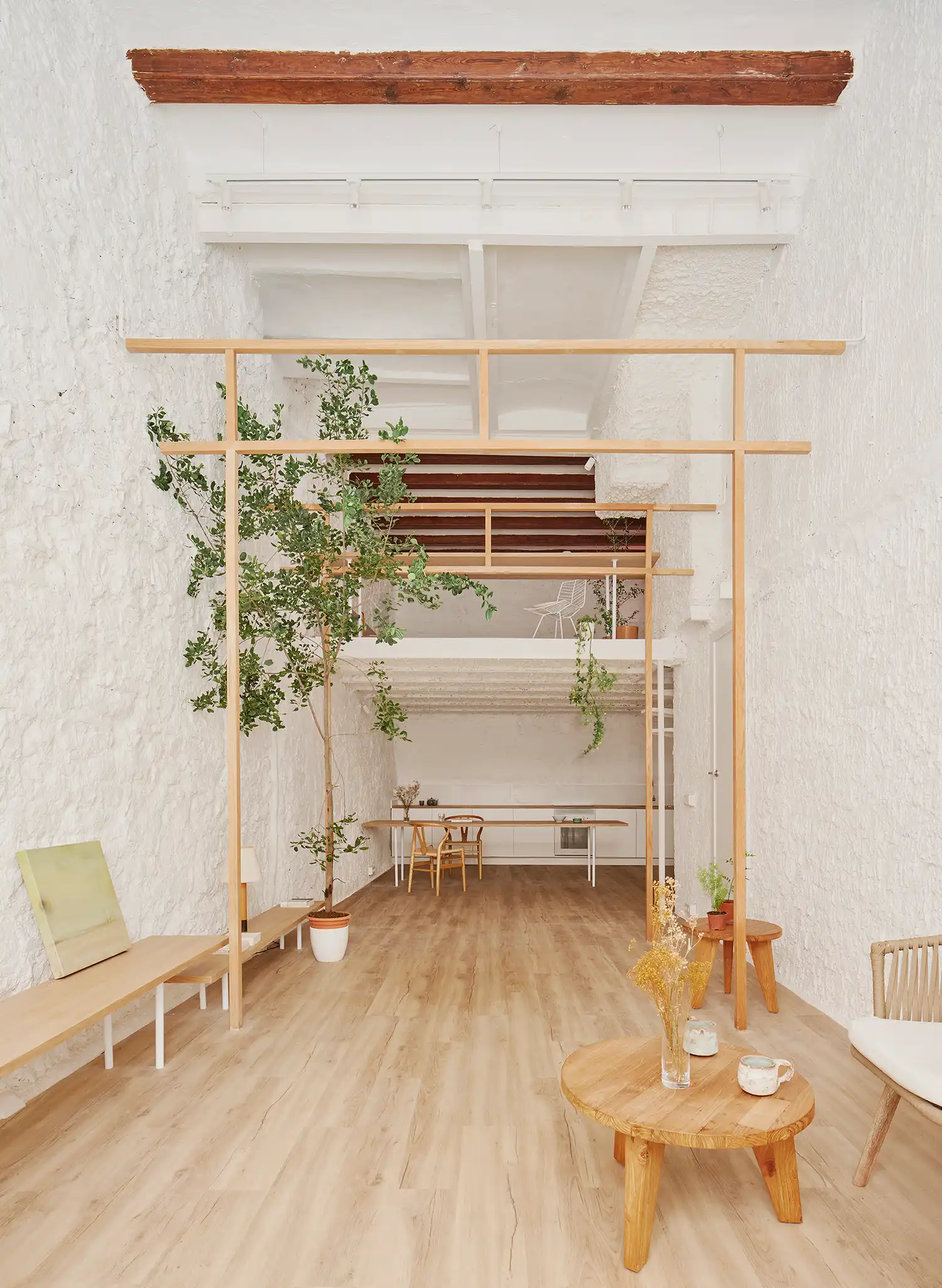
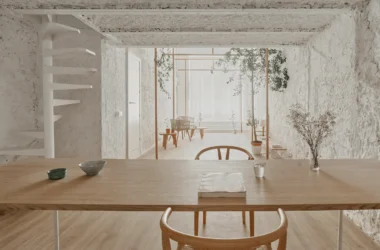
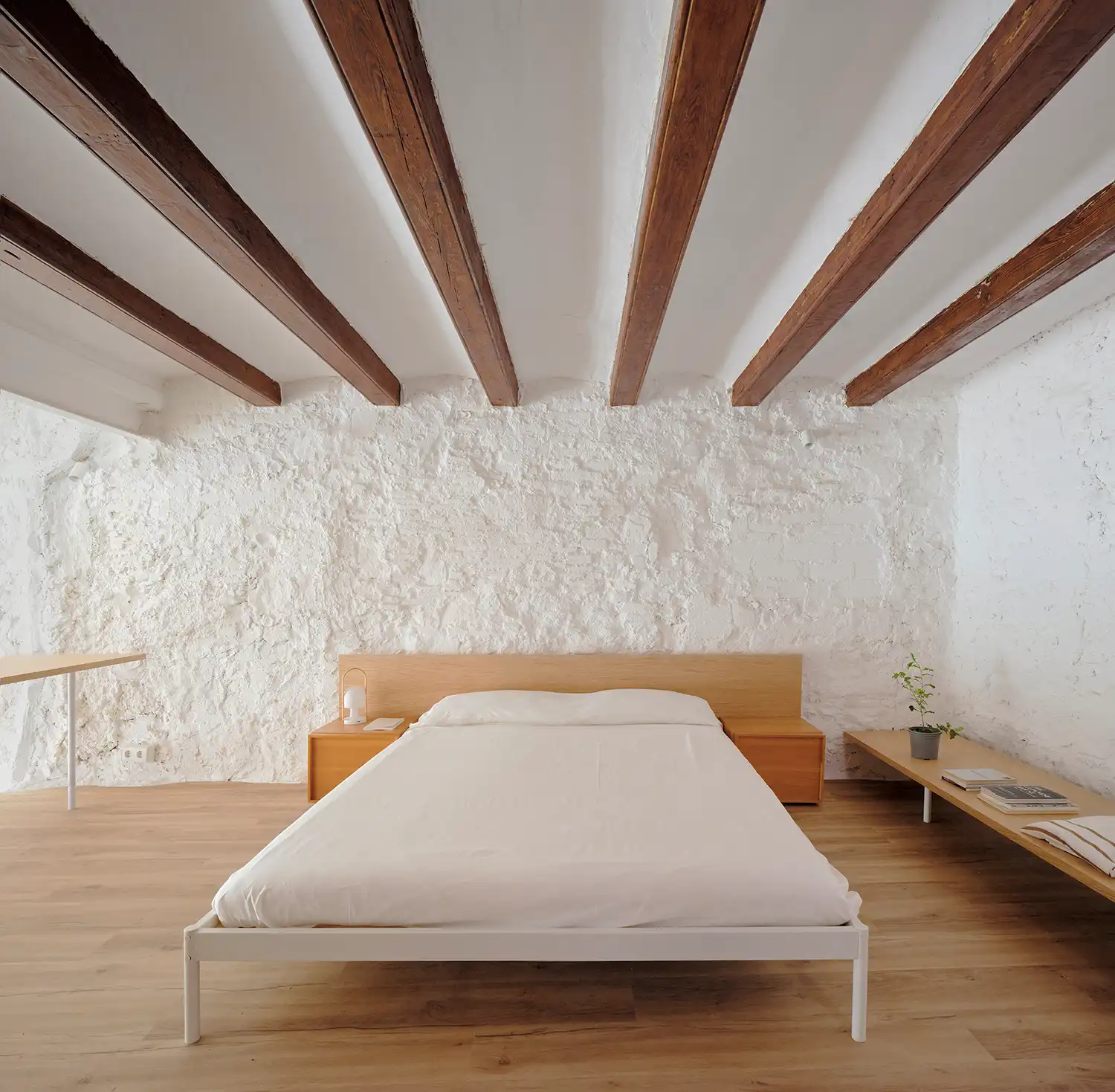
Materiality Under a White Veil. To achieve a “field of possibility,” the studio stripped back layers of previous interventions to reveal the building’s original skeleton. The exposed brickwork, stone masonry, and Catalan ceramic vaults are unified under a singular coat of white. This monochromatic treatment acts as a visual vacuum, neutralizing the background so that the warmth of the ash wood and the texture of the historic substrate can resonate. Light reflects across these surfaces with a soft intensity, dissolving the boundaries of the five-meter-high volume and making the air itself feel like a primary building material.
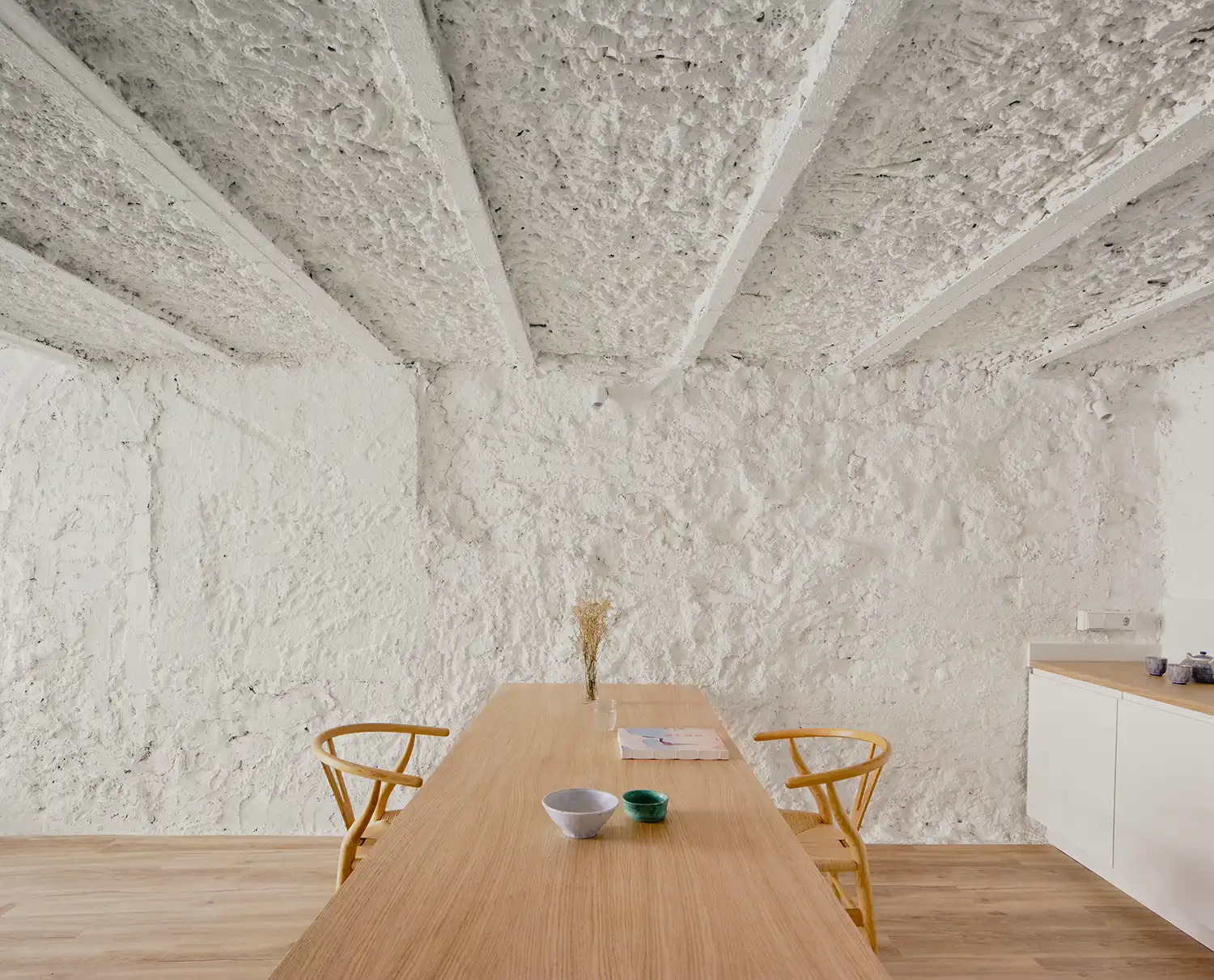
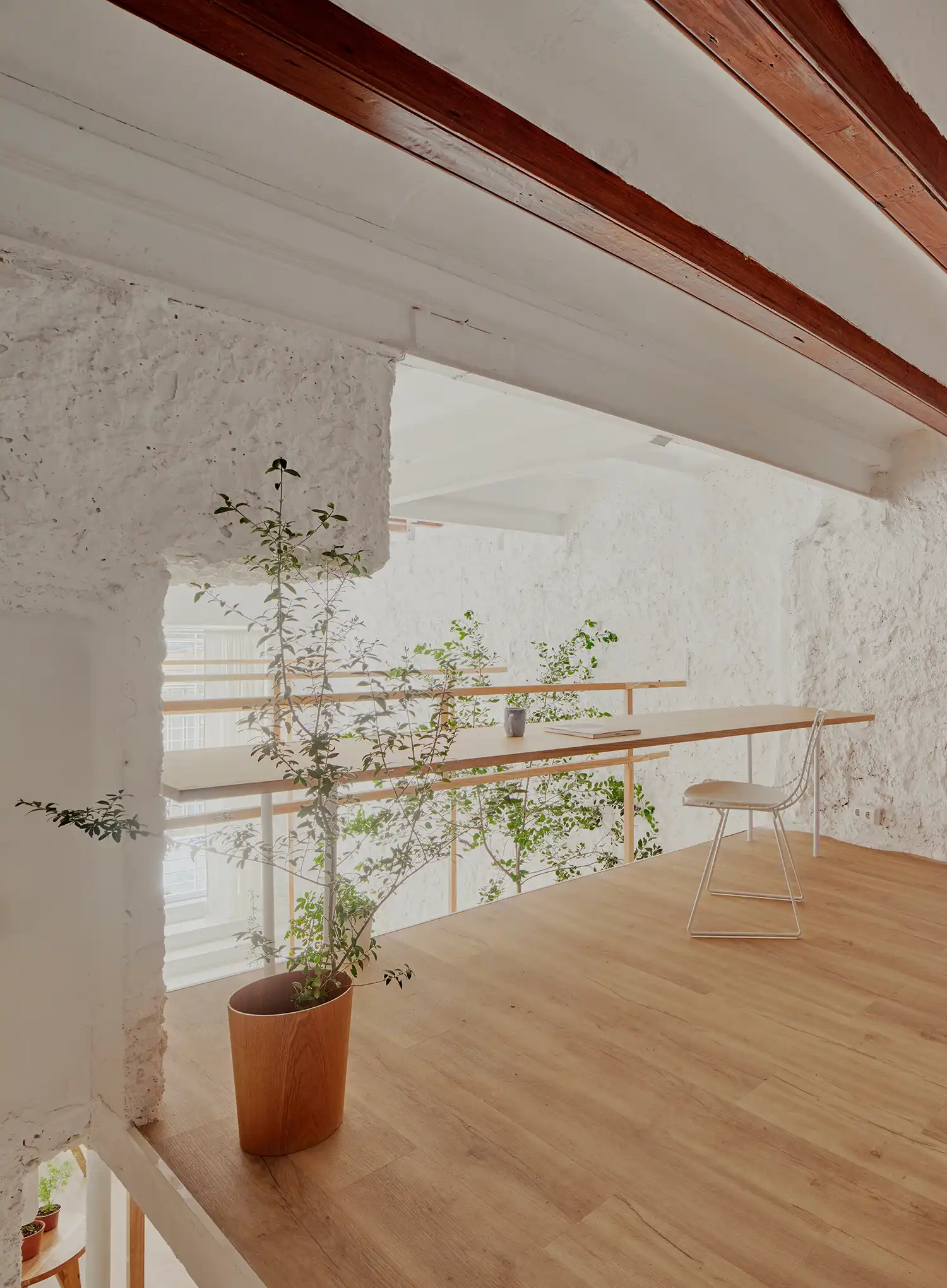
Programming Without Hierarchy. In a departure from typical residential zoning, the loft maintains a strictly open program. Only the bathroom is enclosed, leaving the rest of the floor plan as a continuous, high-ceilinged expanse articulated by a minimalist mezzanine. This flexible living space eschews fixed functions; the furniture consists of elemental panels on four legs that can be reconfigured at will. Whether the space serves as a home, a studio, or a gallery is left to the inhabitant, ensuring the architecture remains a silent, adaptable support for life rather than a prescriptive container.
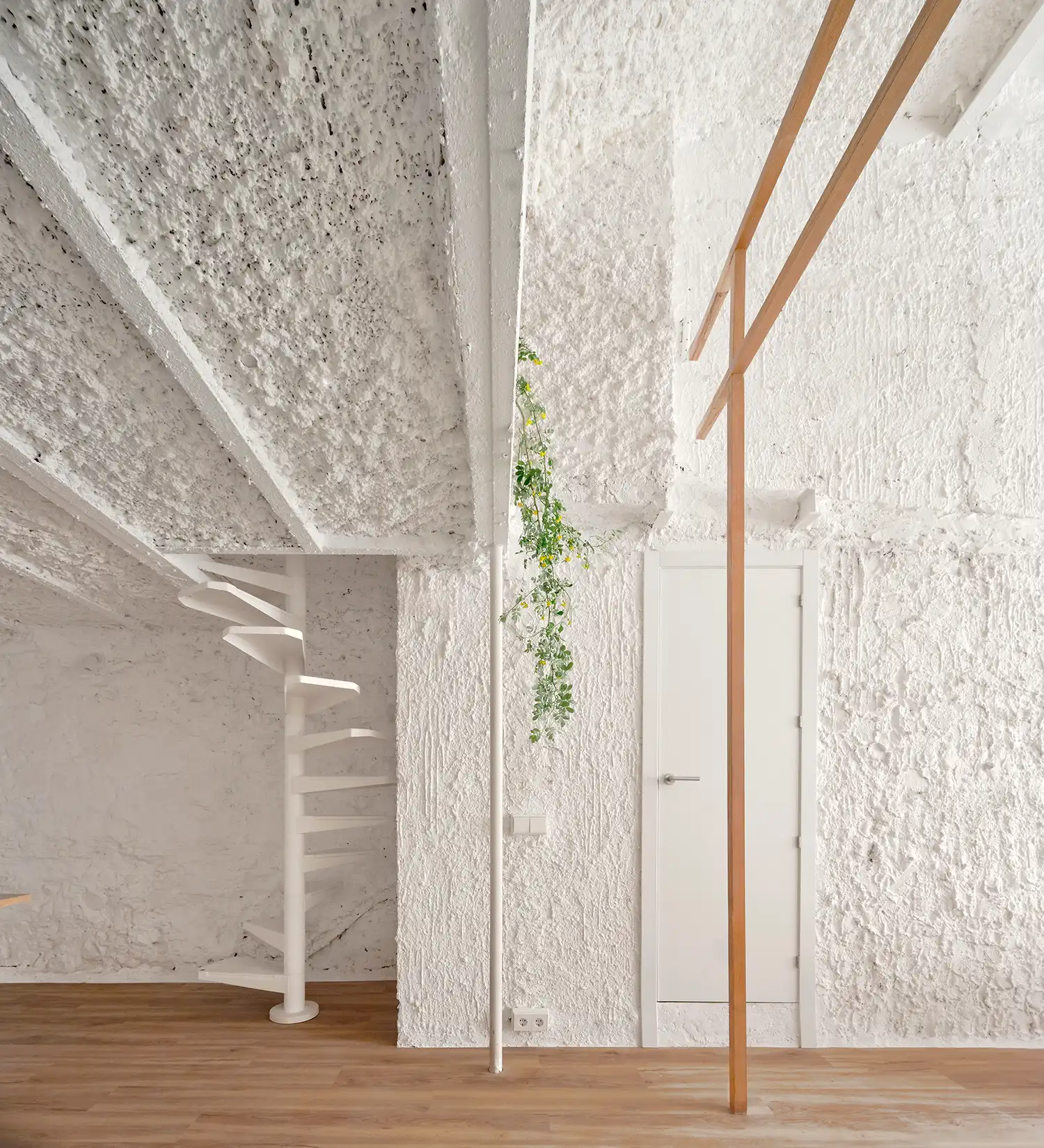
The Living Void. Within this restrained environment, nature is introduced not as decoration but as a living inhabitant. A large tree and various plants occupy the void, their organic forms contrasting with the linear precision of the torii. This integration of greenery emphasizes the project’s focus on simplicity and the “beauty of the minimum.” The lack of ornamentation allows the changing shadows of the foliage and the shifting quality of daylight to become the loft’s primary decorative elements, fostering an atmosphere of profound stillness amidst the vibrant energy of Barcelona.
A Dialogue with Modern Iberian Design. The El Born Loft represents a specific, meditative strand of contemporary Spanish practice that prioritizes atmospheric depth over formal bravado. While other regional projects might utilize bold pigments or aggressive geometries to redefine local identity, Bouldstridge finds power in subtraction. The project’s success lies in its ability to be both a rigorous architectural intervention and an invisible backdrop, proving that the most impactful spaces are often those that leave room for the user to breathe.
Contemporary Context. This nuanced approach to local heritage mirrors a broader movement in the peninsula, where designers are increasingly rethinking the Iberian culture through a modern lens. While Bouldstridge leans into the ethereal, other recent works demonstrate the versatility of this movement, such as the vibrant wood renovation of Casa Eme by Gon Architects or the atmospheric architecture explored by Corrigan Estudio in Madrid. Together, these projects signal a sophisticated era for Spanish interiors, where the history of the Mediterranean is continuously reborn through thoughtful, human-centric innovation.