


Within Shanghai’s fiercely competitive Jing’an District, 889 Plaza is undergoing a radical transformation. Architecture and design practice SpActrum has unveiled the 889GLO Art Space, converting nearly 1,000 square meters into a dynamic community art hub. This project significantly extends SpActrum’s exploration of unseen forces shaping our environment, now focusing sharply on the material realities of consumerism within China’s vast urban landscape.
The concept for 889GLO confronts staggering consumption statistics: China’s projected 2025 usage of 1.283 billion tons of iron ore, 17 million barrels of petroleum daily, and nearly 2 billion tons of cement, alongside 2023 figures like 5.72 billion tons of coal and 590.65 billion cubic meters of water. SpActrum posits that these numbers mask entire ecosystems – lifestyles, social structures, and technologies. Their response, “Landscape of Consumption“, acts as an architectural manifesto, creating a material library from consumer society’s hidden support structures to challenge collective blindness.
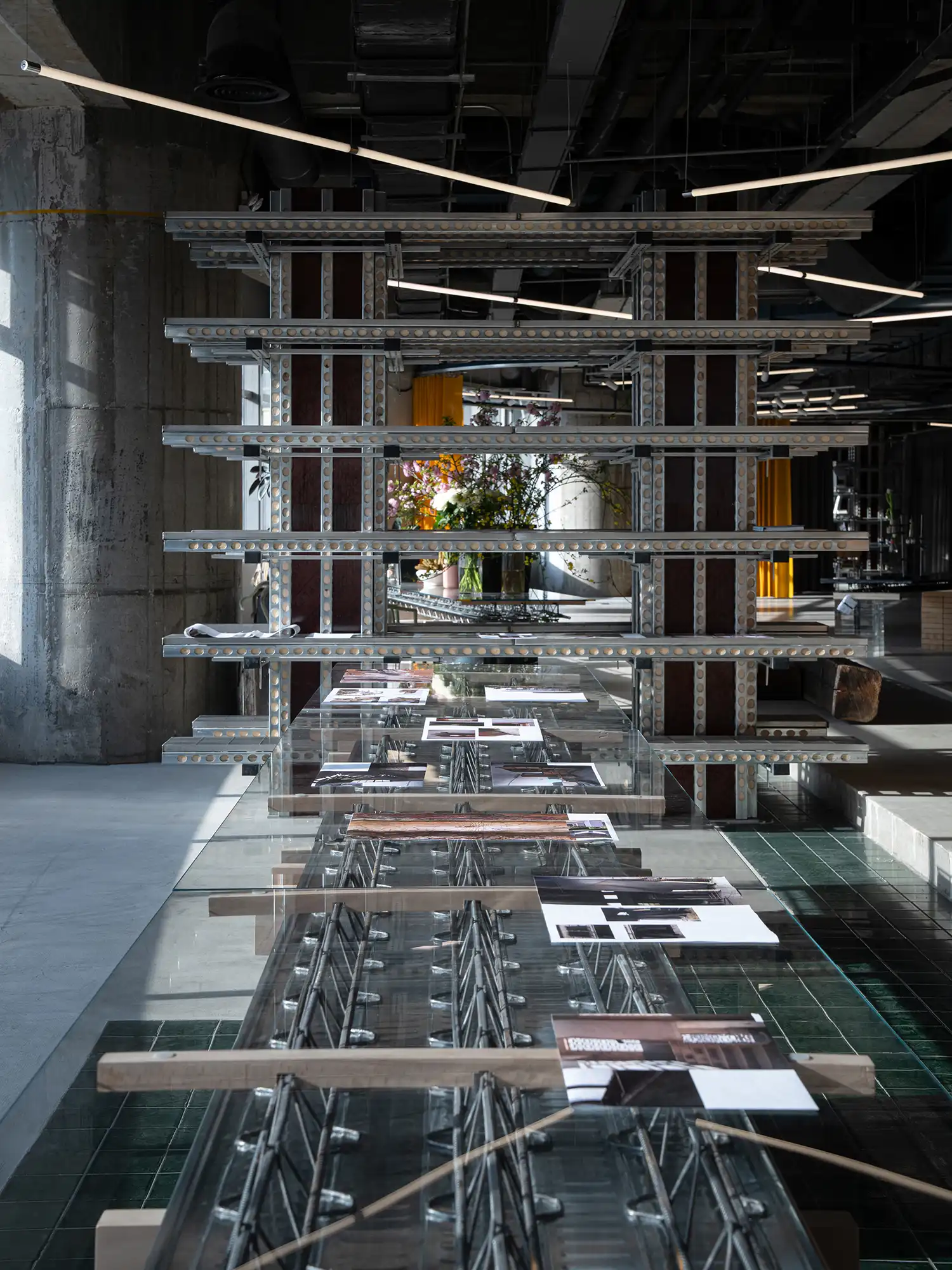
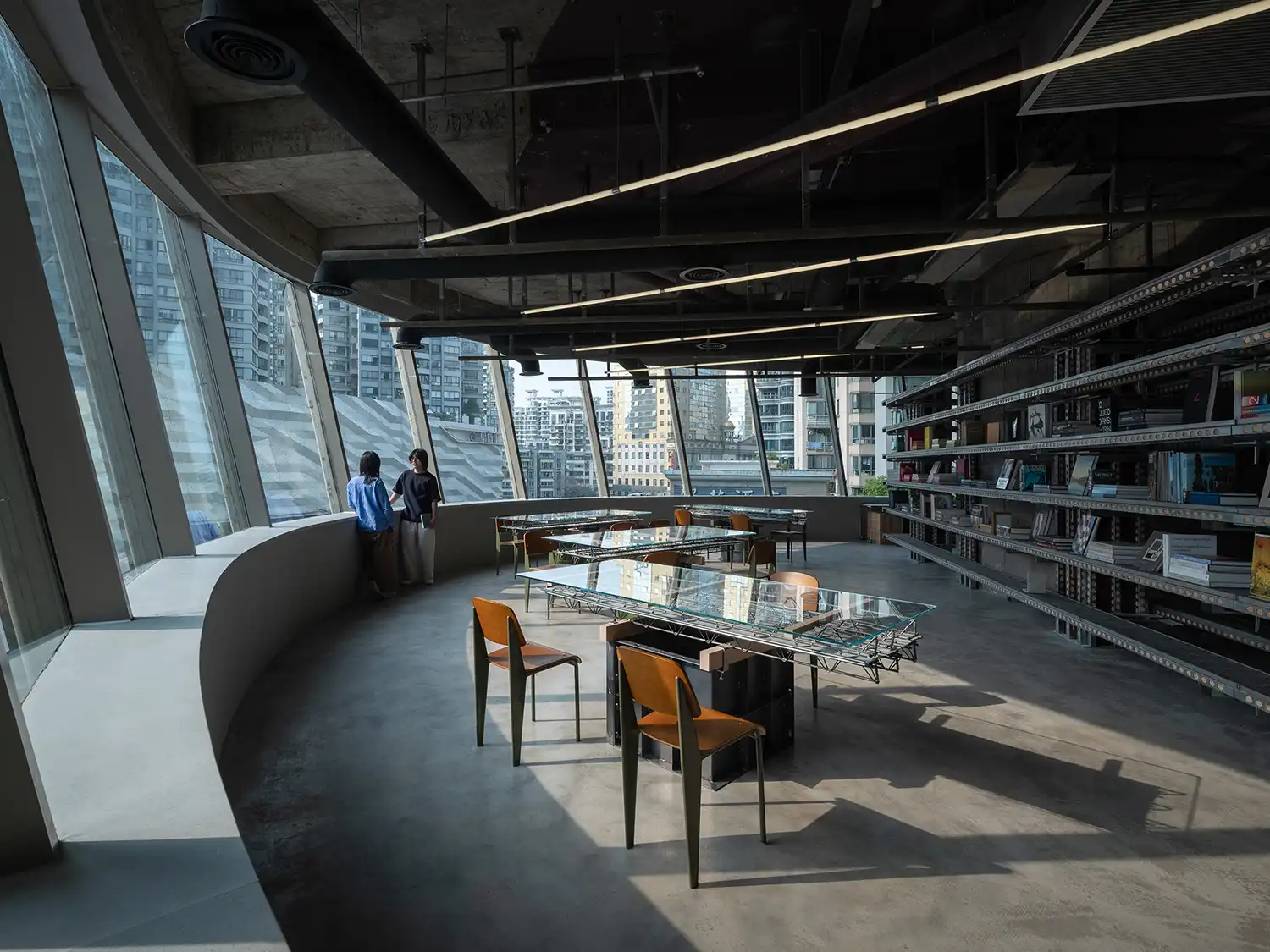
SpActrum executes a profound material transformation throughout the space. Industrial and construction elements are repurposed as functional architecture: factory-made floor bearing plates become imposing long tables, while the YDX Digital Concrete Formwork Integration System is reconfigured into robust shelving and bookcases. This strategy lays bare the backbone of modern logistics.
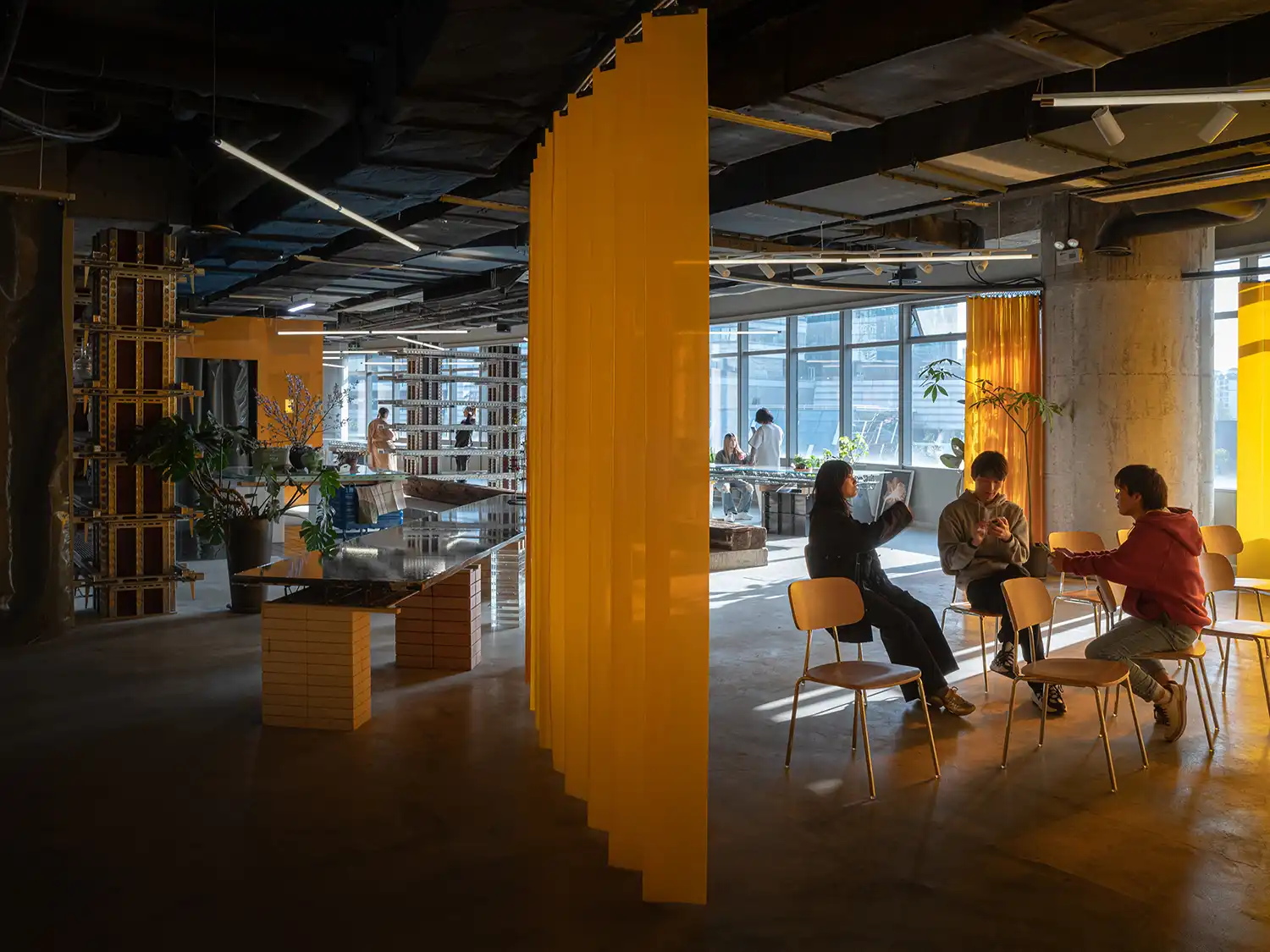
The essential components of consumption’s infrastructure are integrated visibly: heavy-duty forklift pallets and industrial metal drums serve as furniture bases; liquid containers and mineral transport baskets find new life as supports. Factory ventilation grilles are suspended as striking pendant lights, and inherently durable PVC truck tarpaulin becomes space-dividing curtains. Walls coated in regulatory orange fireproof plastic membranes stand as stark documentary evidence, not aesthetic choice, revealing how technical mandates shape our visual world.
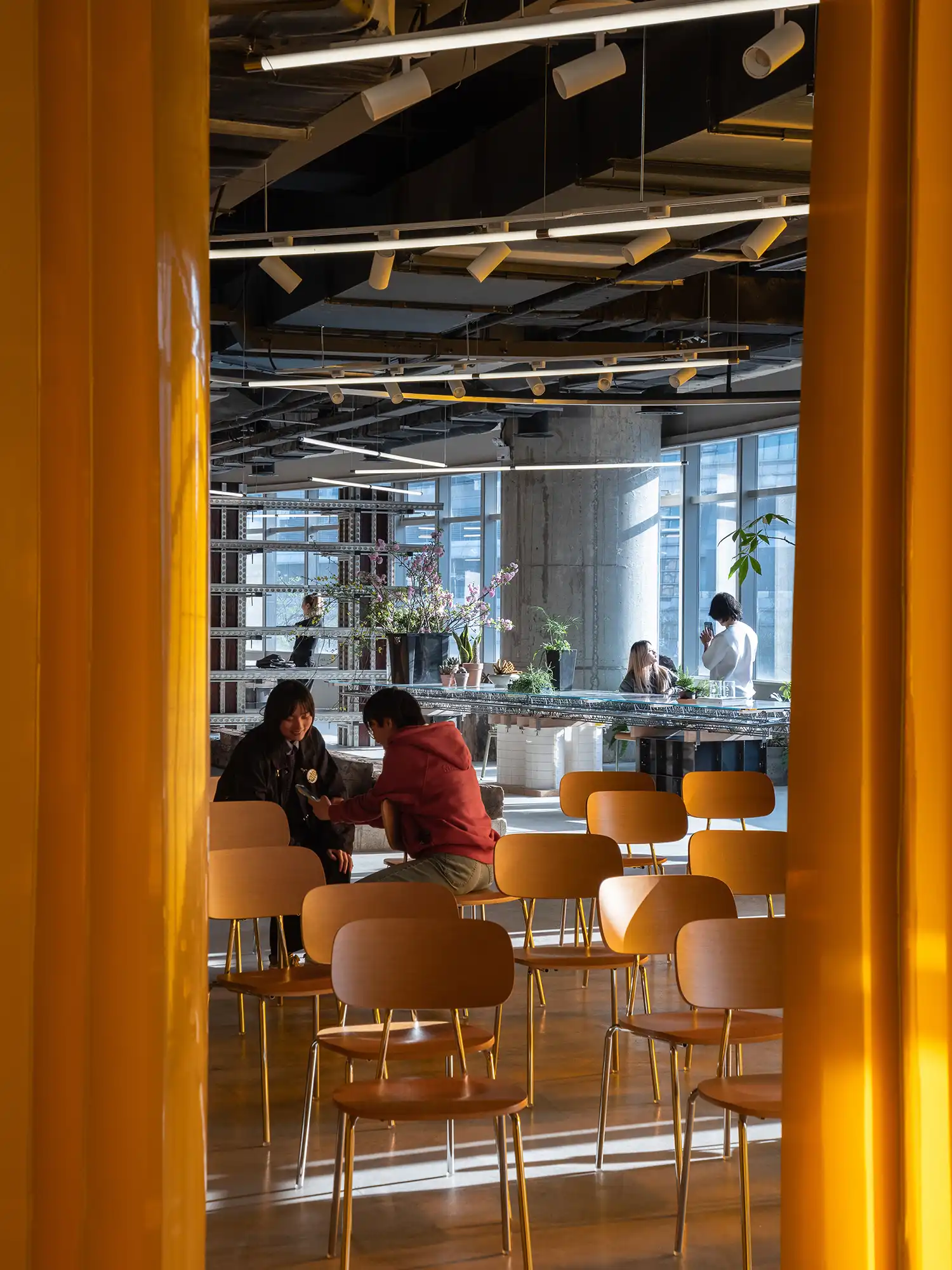
Envisioned as a hybrid cultural space merging library, lifestyle showcase, and art platform, 889GLO respects the building’s history while forging new connections. Removing previous partitions opened panoramic city views; a slightly elevated corridor linking former small rooms was intentionally preserved. The ceiling retains an archaeological record through residual paint on exposed concrete.
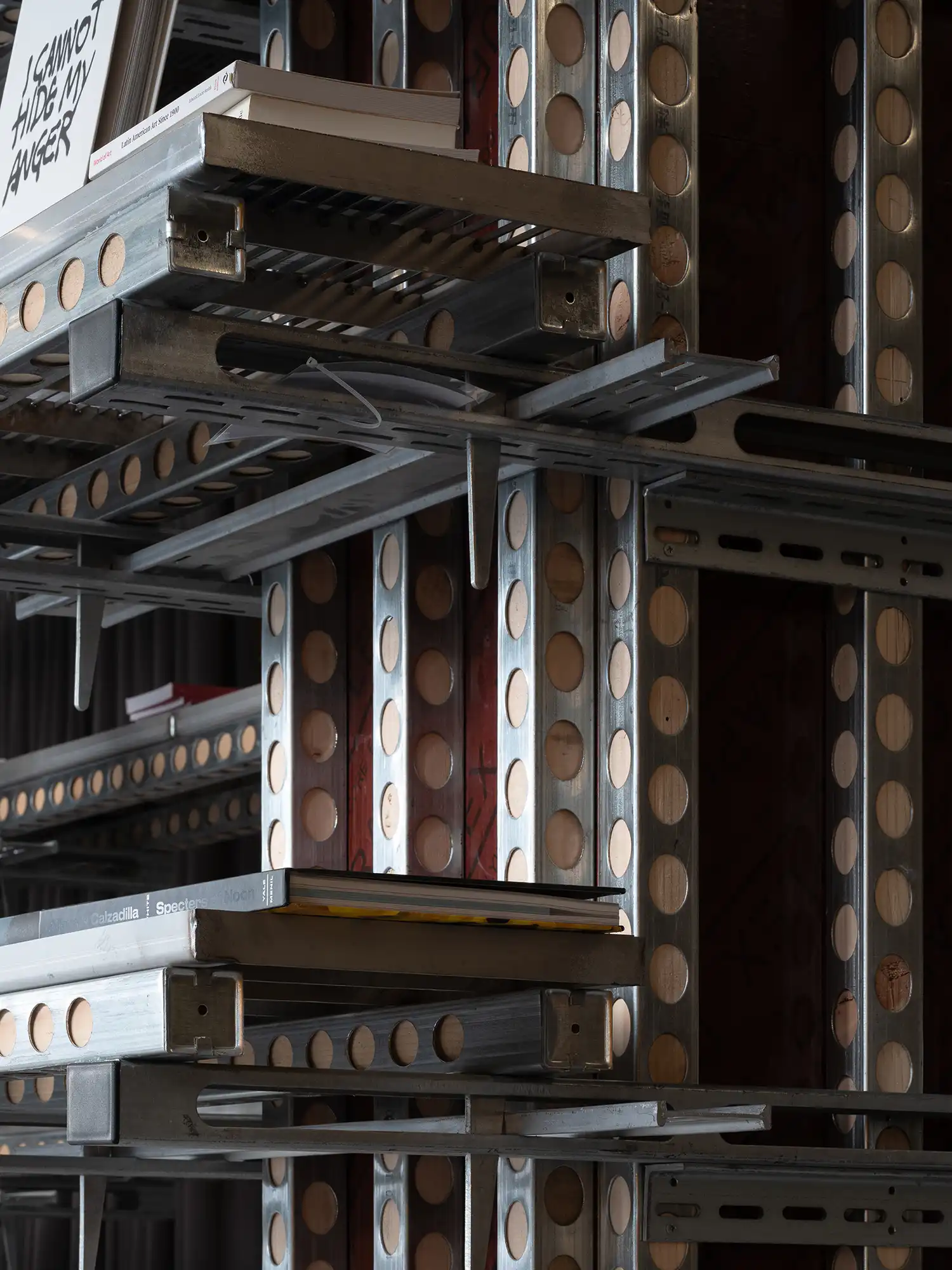
The spatial sequence unfolds as a continuous narrative: starting from a cafe merging with plant-filled terraces, progressing through gallery areas flanked by signature orange membranes, past workspaces featuring repurposed gardening tables, towards a vibrant yellow-curtained lecture arena, and culminating in a monumental library defined by towering bookshelves. Spatial permeability is paramount, dissolving rigid boundaries.

This project advances SpActrum’s exploration of innovative form-making methodologies. They establish “hyperlinks” between social issues and practical scenarios through material intervention. Their approach deliberately inverts conventional commercial design, beginning with value-driven material selection, progressing through physical and aesthetic reinterpretation, and culminating in new forms maintaining multiple interpretive possibilities – a “deliberate ambiguity“.
By making the hidden landscapes of construction and consumption viscerally tangible, 889GLO argues that architectural revelation is the crucial first step towards social engagement and potential change. The intentionally undefined space prioritises fluidity and transparency, evoking what SpActrum terms the “undifferentiated joy of childhood” – a state existing before professional categorization.

SpActrum contends that good design transcends problem-solving; it must actively pose questions. Shared encounters with these reconstituted industrial objects – each prompting inquiry into origins, purposes, and connections to daily life – transform the space into an “architectural provocation.” While not claiming direct societal change, 889GLO suggests this awakened curiosity is the vital seed of broader social awareness.

Ultimately, spatial design becomes a tool to fundamentally reframe our understanding of the material world that sustains, and often invisibly dictates, modern existence. 889GLO uses its reconfigured industrial palette not just to house art, but to provoke critical reflection on the very systems that built it.