



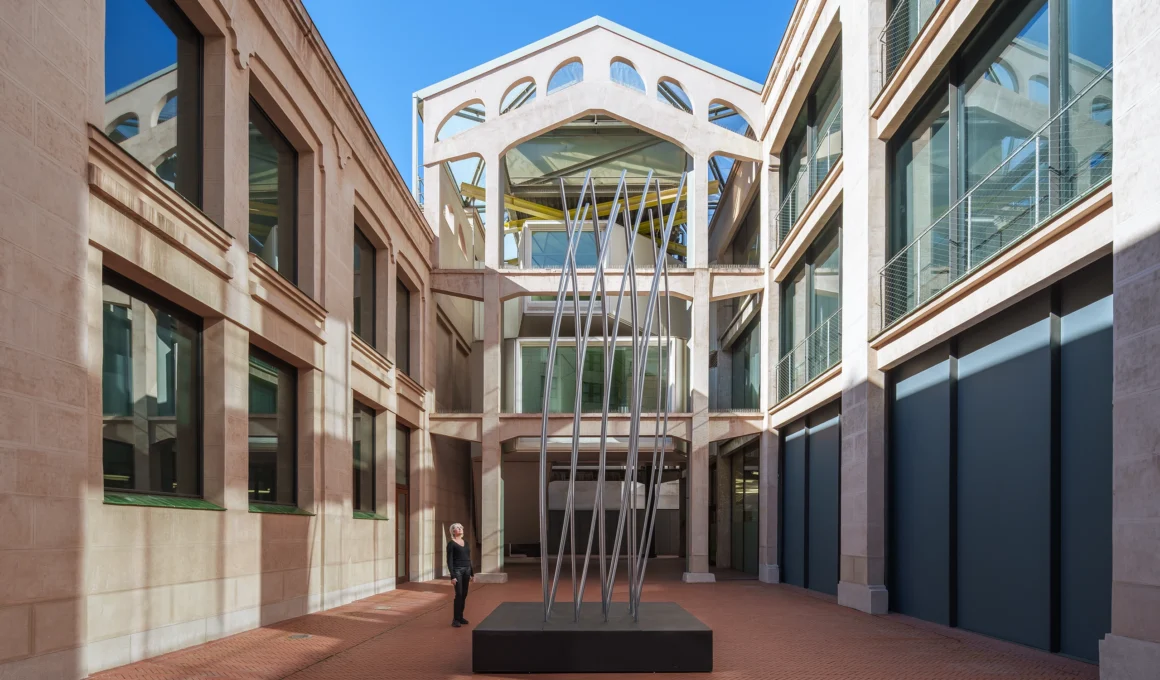
Within the historic atrium of Madrid’s Serrería Belga, the kinetic installation DISLOCATION by Spanish artist SpY pierces the industrial volume with sixteen continuously rotating vertical slats that redefine the relationship between temporal movement and physical form.
The deconstruction of stability serves as the primary encounter for the viewer entering the cultural center. Rather than presenting a static object, the installation acts as a mechanical device that challenges visual certainty. By utilizing motion as a primary constructive tool, the artist strips the material of its perceived weight, creating a work that exists purely in a state of becoming. The form is no longer a fixed entity but a temporal consequence of synchronized rotations.
Visual ambiguity and depth emerge as the sixteen slats perform their synchronized choreography. As the elements turn, the solid boundaries of the sculpture seem to dissolve into a series of rhythmic collisions. Space is constantly renegotiated; what appears as an impenetrable barrier one moment becomes an ethereal, transparent skeleton the next. This mechanical pulse demands a new mode of attention, forcing a detachment from the frantic pace of the surrounding city.
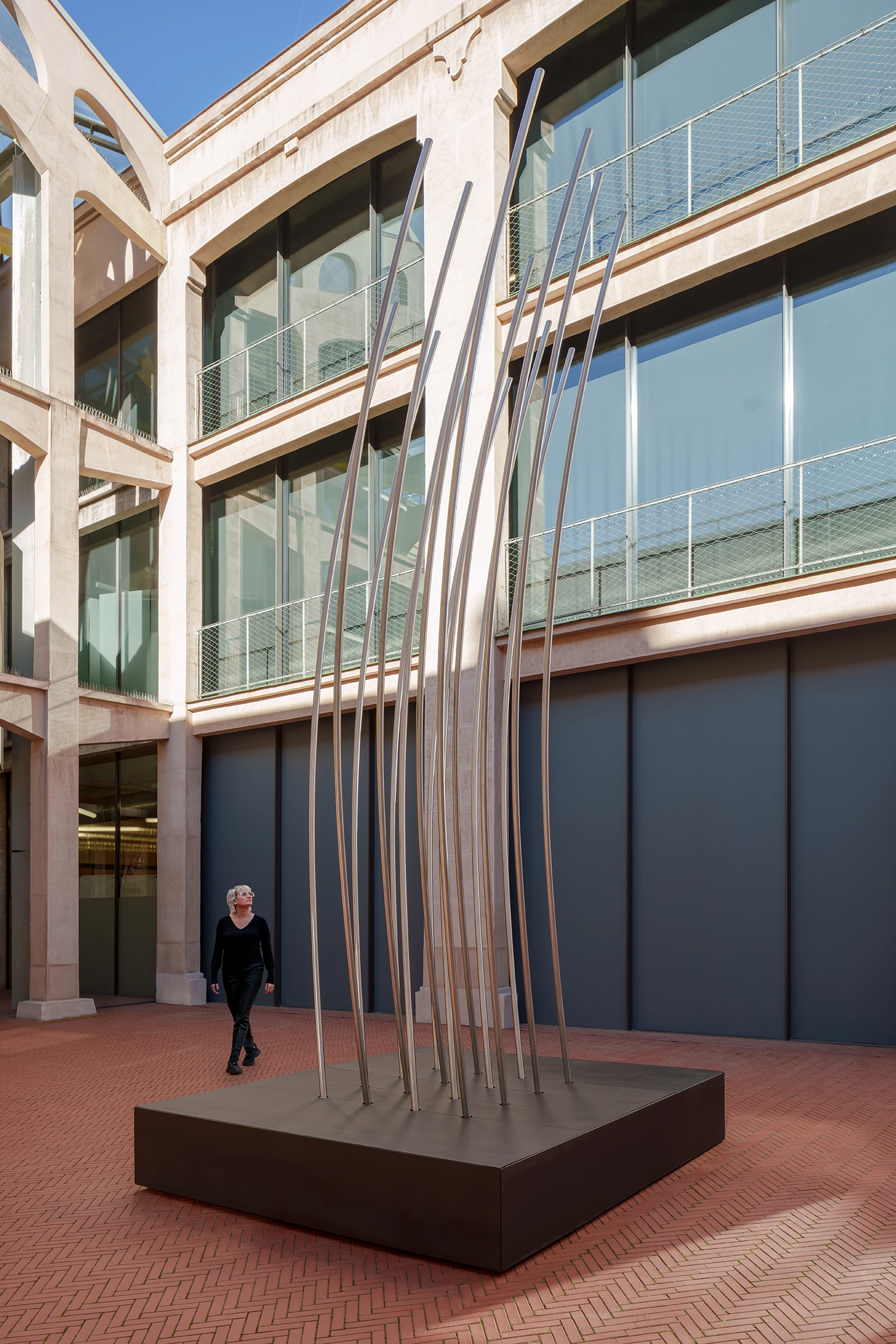
Time as a sculptural material allows DISLOCATION to evolve beyond its immediate physicality. In this intervention, the passage of seconds acts like an invisible chisel, carving out shifting profiles that never repeat in quite the same way. The formal economy of the piece, rooted in a rigorous minimalism, strips away unnecessary ornamentation to focus the observer’s eye entirely on the interplay of light, shadow, and mathematical precision.
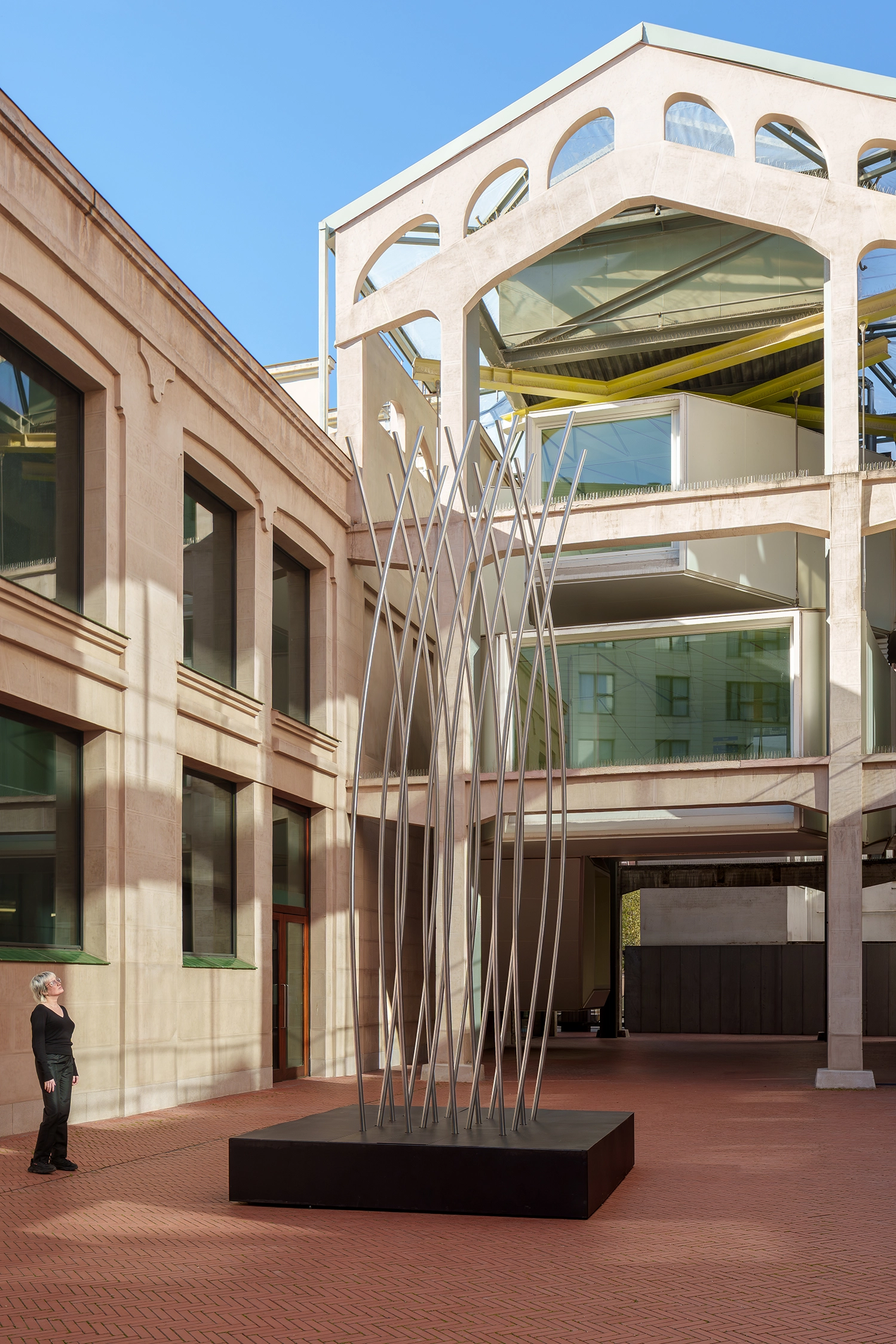
A dynamic sensory engagement is triggered the moment the spectator moves through the space. Because the sculpture’s configuration shifts radically depending on one’s physical position, the work requires active participation rather than passive observation. Walking the perimeter of the atrium reveals successive formal variations, where the notion of rotation blurs with the perception of depth, inducing the very state of cognitive “dislocation” that gives the piece its name.
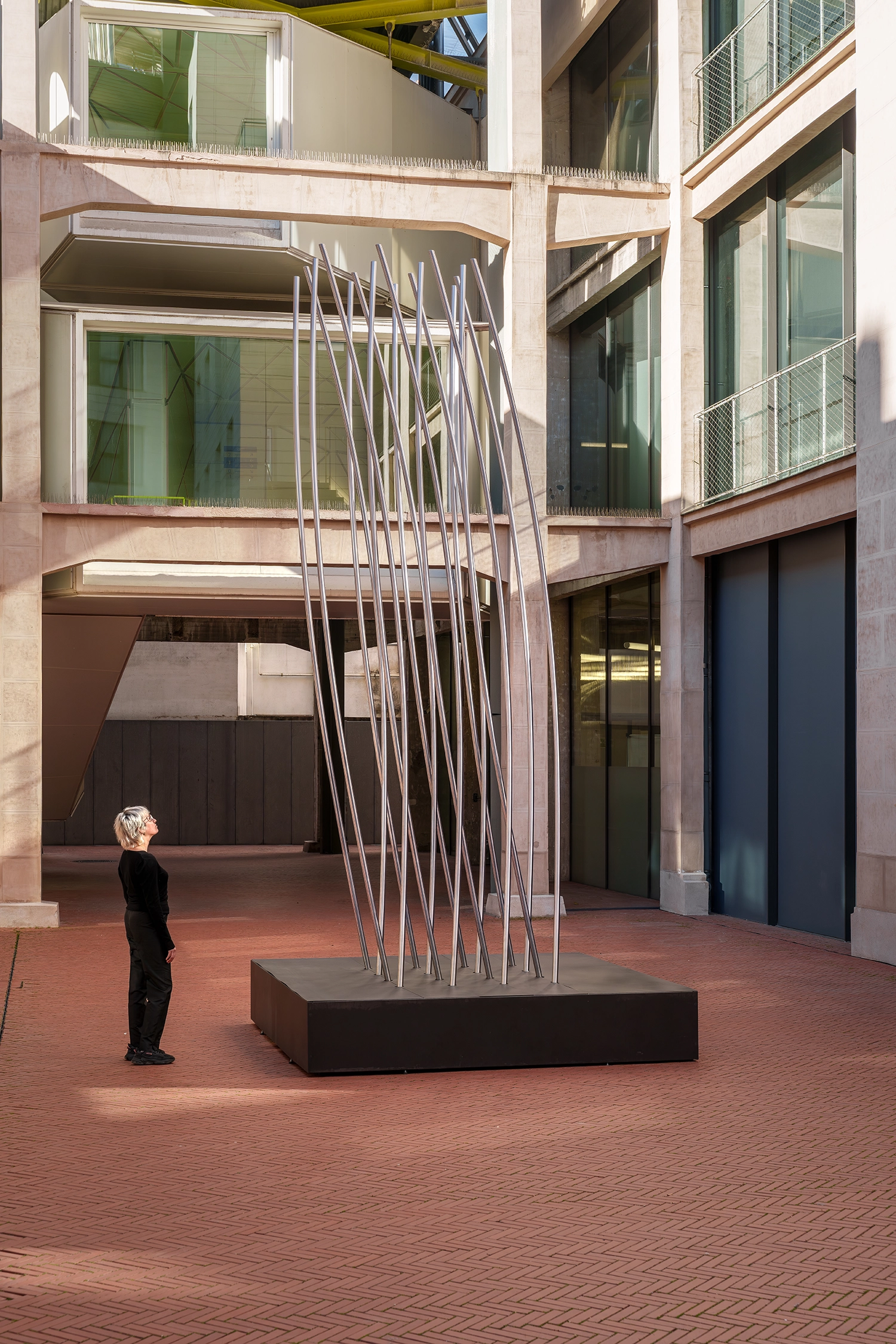
The industrial heritage of the Serrería Belga provides a textured, historical backdrop that heightens the precision of the kinetic slats. The tension between the weathered walls of the former sawmill and the millimetric accuracy of the contemporary intervention creates a vibrant atmospheric contrast. This is public art that does not merely occupy a room; it disrupts the ordinary reading of the environment, turning a transit area into a laboratory of collective behavior.
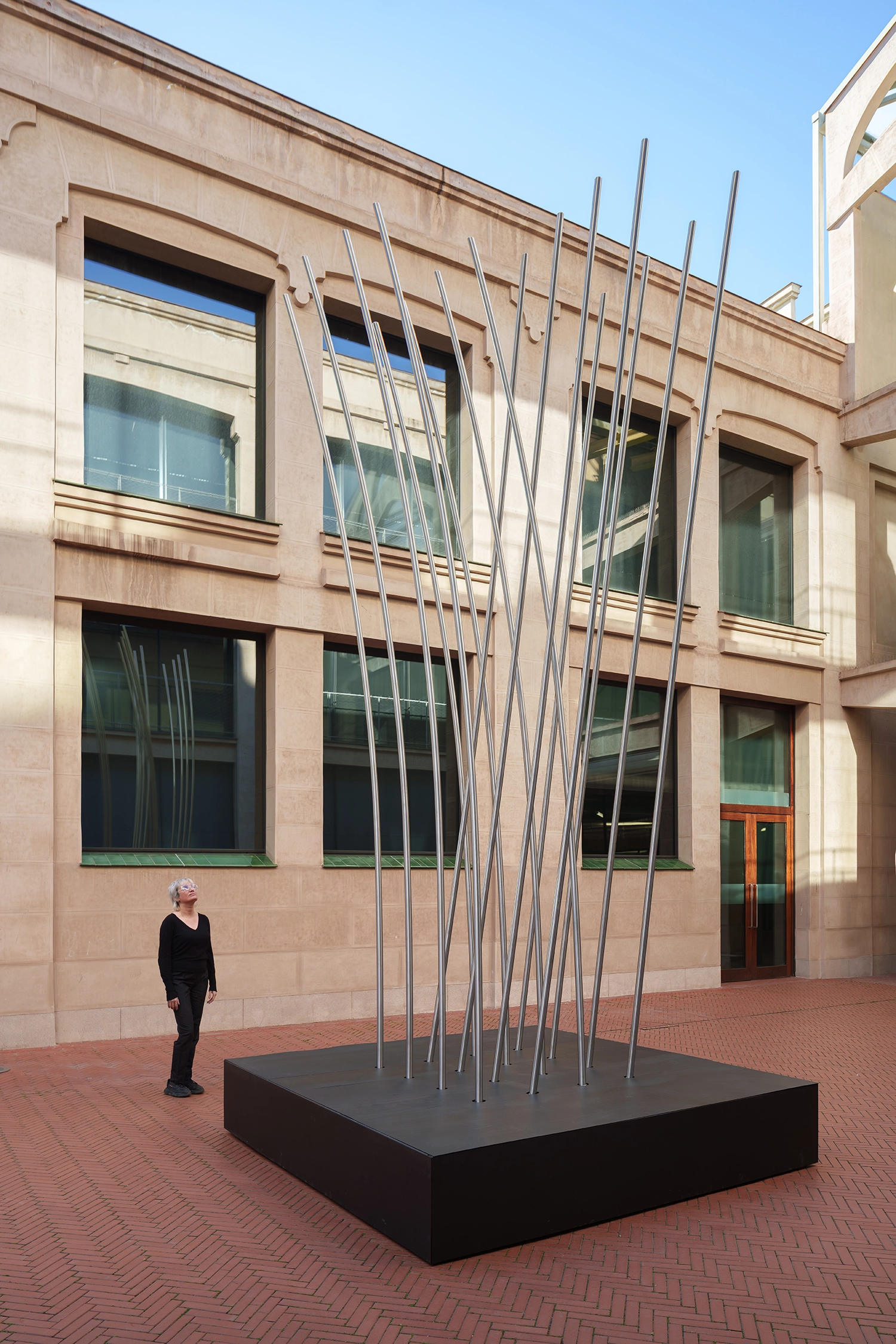
Continuing an investigation into fluidity, this installation represents the latest evolution in a creative trajectory characterized by hypnotic dynamism. Those who followed the circular motion of Cycles, presented in Madrid last year, will recognize a familiar obsession with repetitive movement as a generator of new realities. The artist demonstrates how mechanical repetition, when executed on a monumental scale, can produce emotional and cognitive responses of extraordinary complexity.
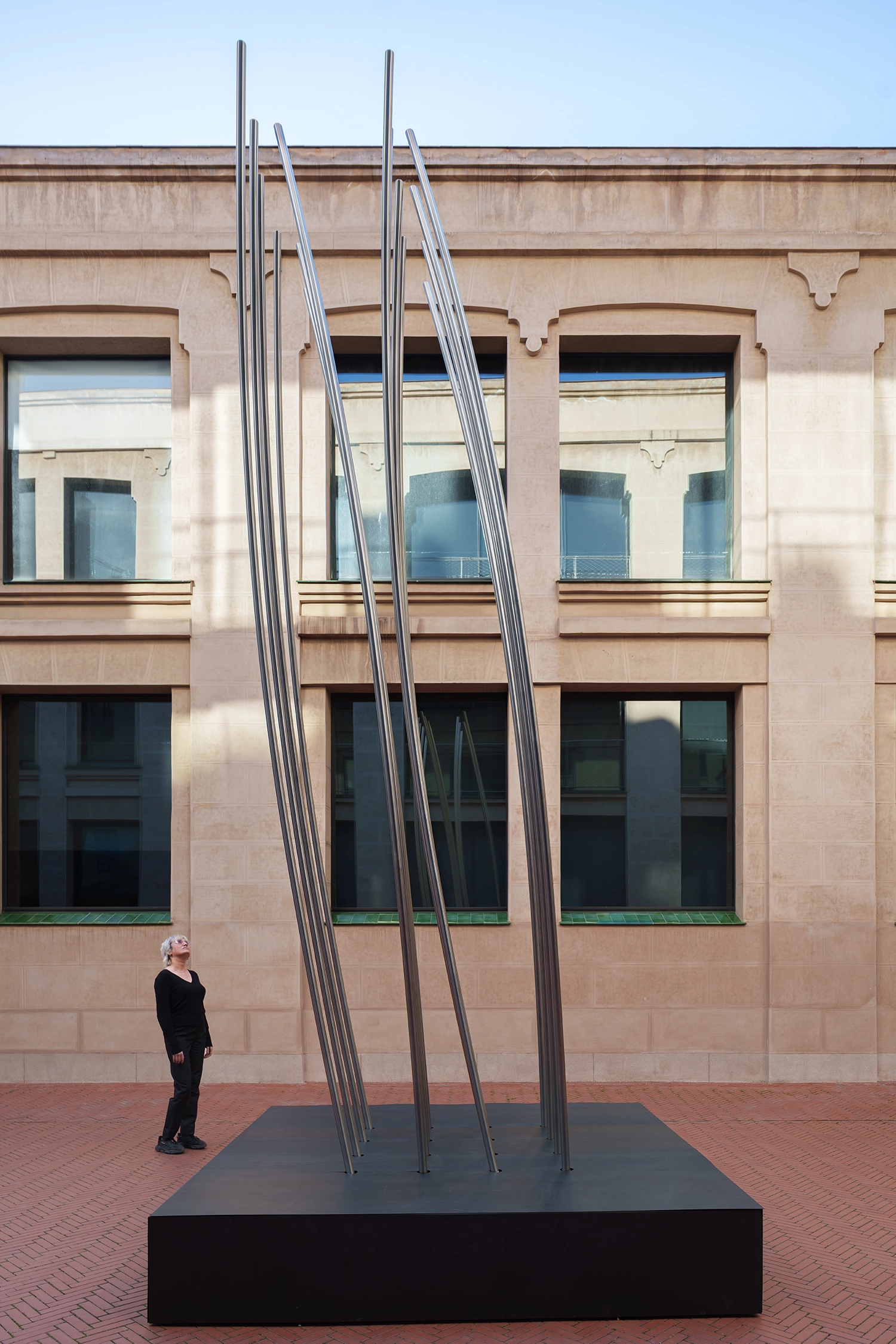
The expansion of the artist’s practice has seen his work move from the spontaneity of the street to the grand volumes of global cultural institutions. From the immersive, glowing depths of Divided in Xi’an to the monumental grid of Matriz within a Budapest turbine factory, the scale of these interventions continues to grow alongside their conceptual depth. In every context, the use of light or mechanics serves to destabilize the observer’s confidence in the physical world.
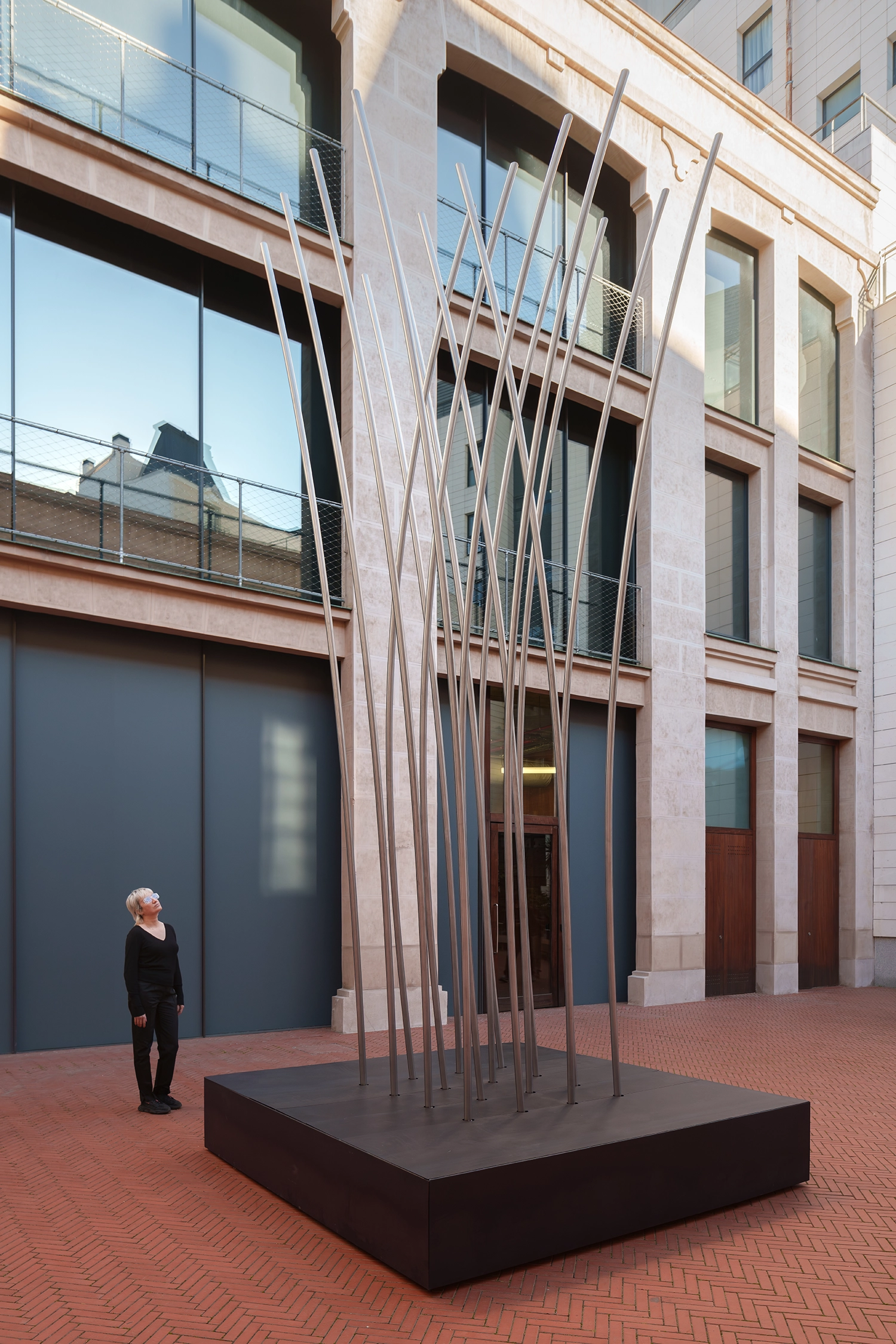
Looking toward the next horizon, the work of SpY suggests a future where technology and human perception are inextricably linked. DISLOCATION is not a final destination but an invitation to view the built environment as a flexible, ever-changing entity. As the artist continues to activate public spaces across the globe, the focus remains on the “what’s next”—the constant search for a viewpoint that, much like the sculpture itself, is always in motion.