



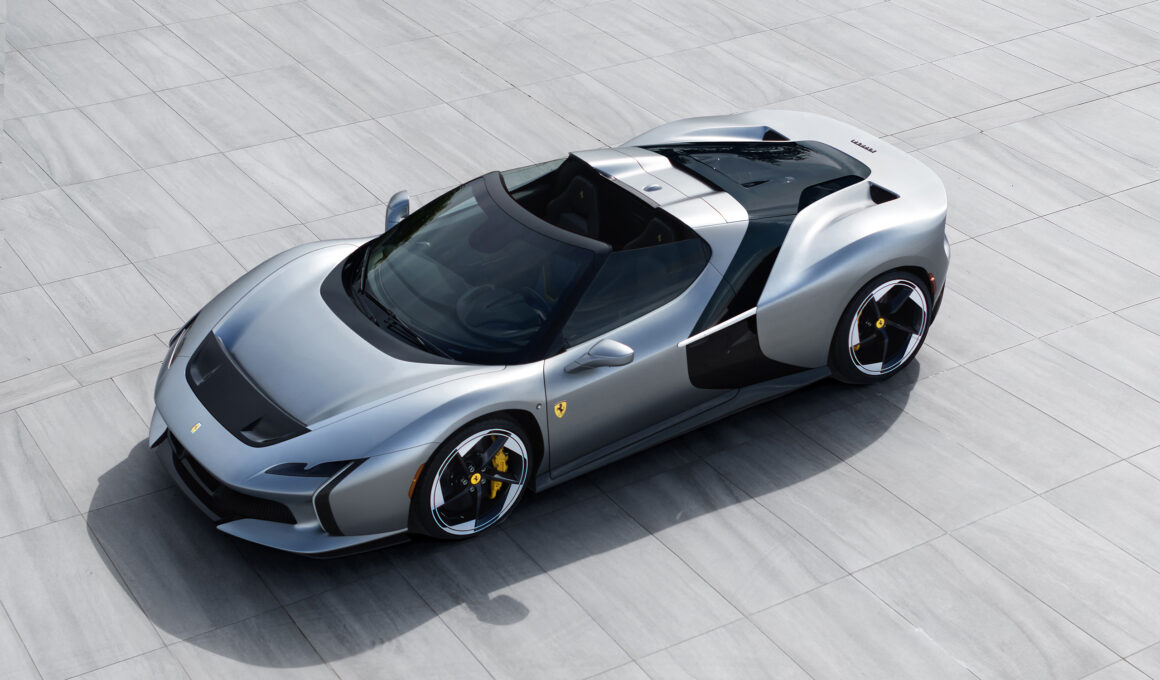
Ferrari‘s Special Projects programme has unveiled the HC25 at the Circuit of the Americas in Austin, Texas — a one-of-a-kind open-top V8 spider conceived by the Ferrari Design Studio under the creative direction of Flavio Manzoni, and built to the exact specifications of a single anonymous client. Derived from the F8 Spider platform, the HC25 is more than a bespoke commission: it is a deliberate act of punctuation, marking the end of the naturally aspirated mid-rear turbo V8 lineage while declaring, with considerable formal confidence, the aesthetic vocabulary Ferrari intends to carry forward.
A bridge between two eras. The HC25 occupies a precise and self-aware position in Maranello’s timeline. The F8 Spider — its donor platform — was the last open-top Ferrari to feature the non-hybrid turbocharged V8 in a mid-rear configuration. Rather than treating this as a limitation, Ferrari used it as a creative premise: the HC25 reads simultaneously as a closing statement and a forward projection, its surface language borrowing the muscular tension of the F80 while retaining the sensual volumetrics of the classic spider tradition. Few car commissions carry this much historical self-consciousness built directly into their proportions.
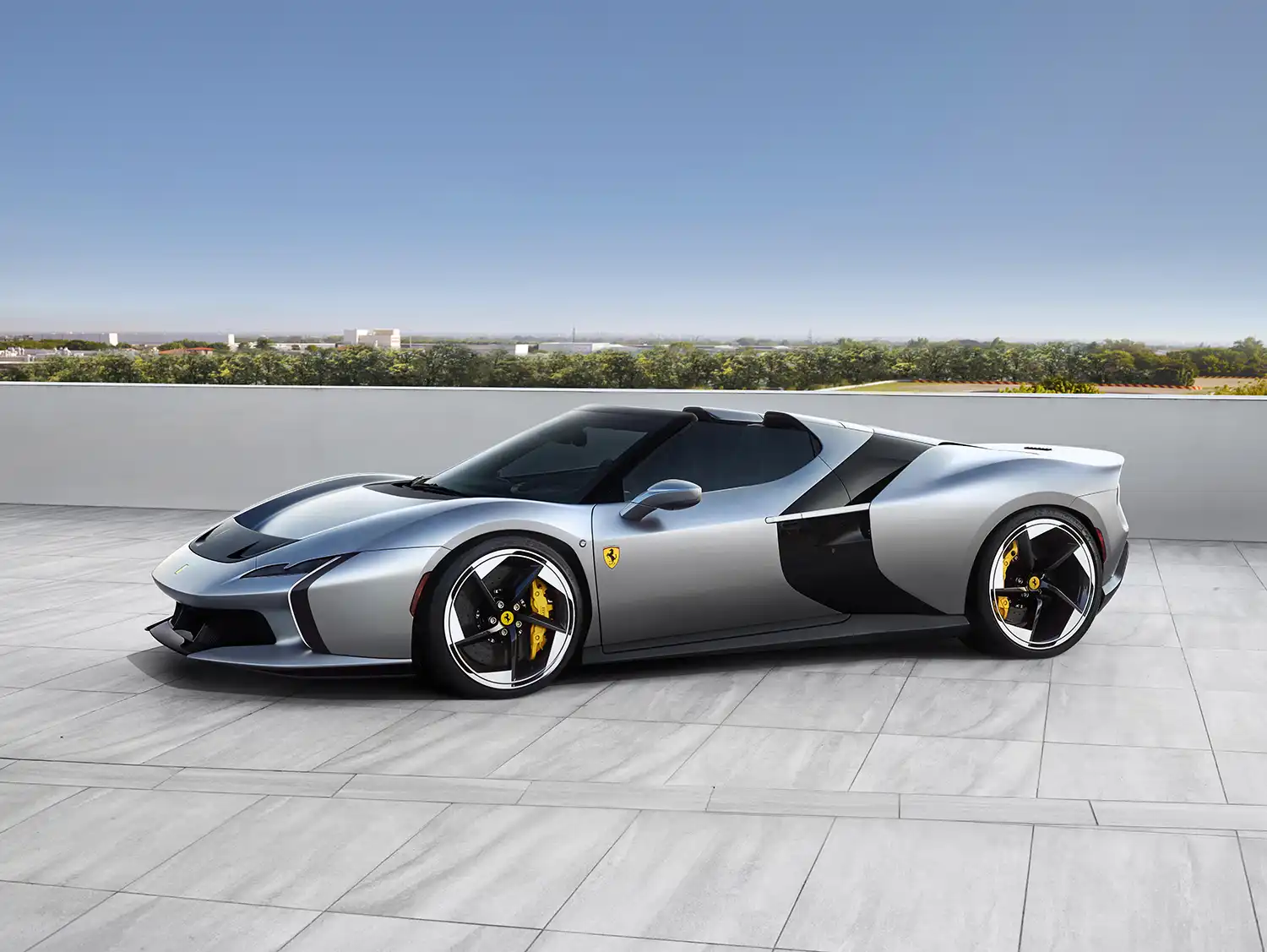
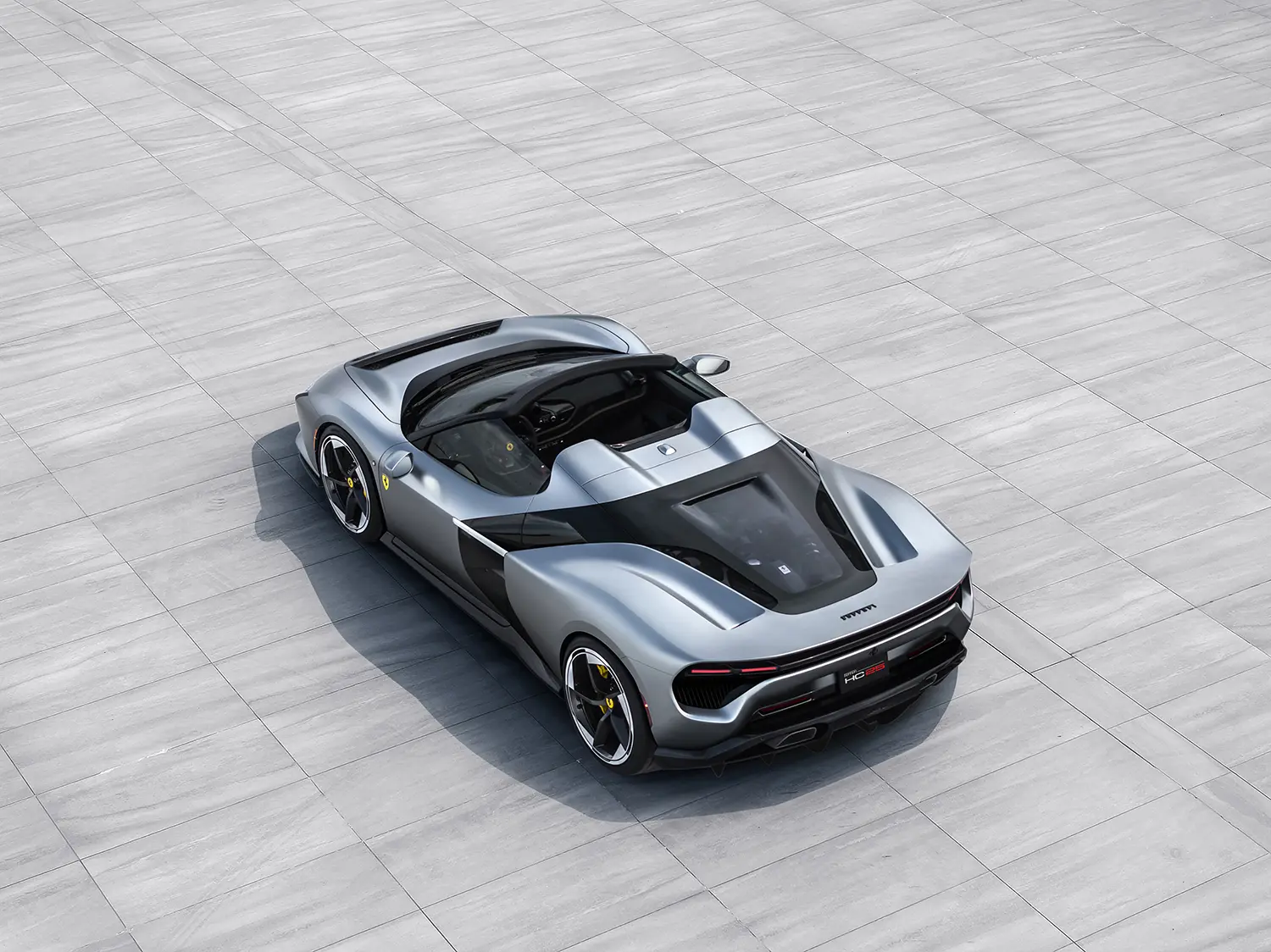
The black ribbon as structural idea. The defining move of the HC25 is a continuous functional band that wraps the car’s midsection — a three-dimensional black ribbon that is never merely decorative. It integrates air intakes for the radiators and heat extraction for the powertrain, turning thermal necessity into formal drama. Seen from the side, this band generates an arrow-like forward momentum: it begins at the base of the rear wheels, sweeps toward the front, curves vertically over the door — where it conceals a handle milled from a single block of aluminium — then arcs back to dissolve into the rear screen. The car seems to be moving at standstill. The ribbon divides the bodywork into two distinct volumes, front and rear, that read as separate masses held in tension by this single binding element.
The door handle as manifesto. Details at this scale of commission become philosophical statements. The door handle — or rather its deliberate absence as a recognizable object — is among the HC25’s most considered gestures. Integrated into a long aluminium blade milled from solid, it stretches like a bridge between the two halves of the body, separated by the black central band. You do not reach for a handle; you reach for a line. It is the kind of resolution that takes dozens of rejected alternatives to arrive at, and it speaks to the level of obsessive refinement that Manzoni’s team brought to this project.
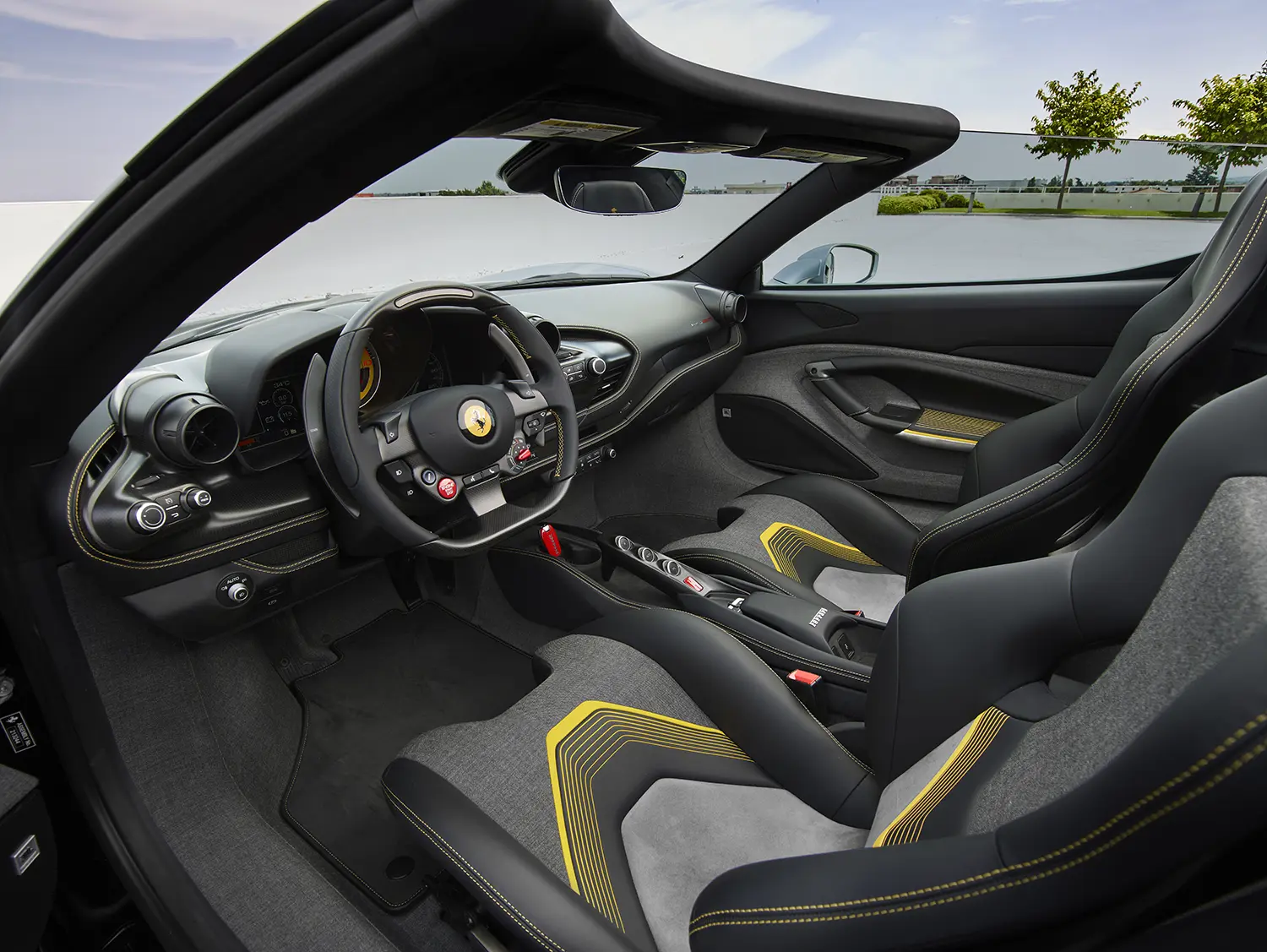
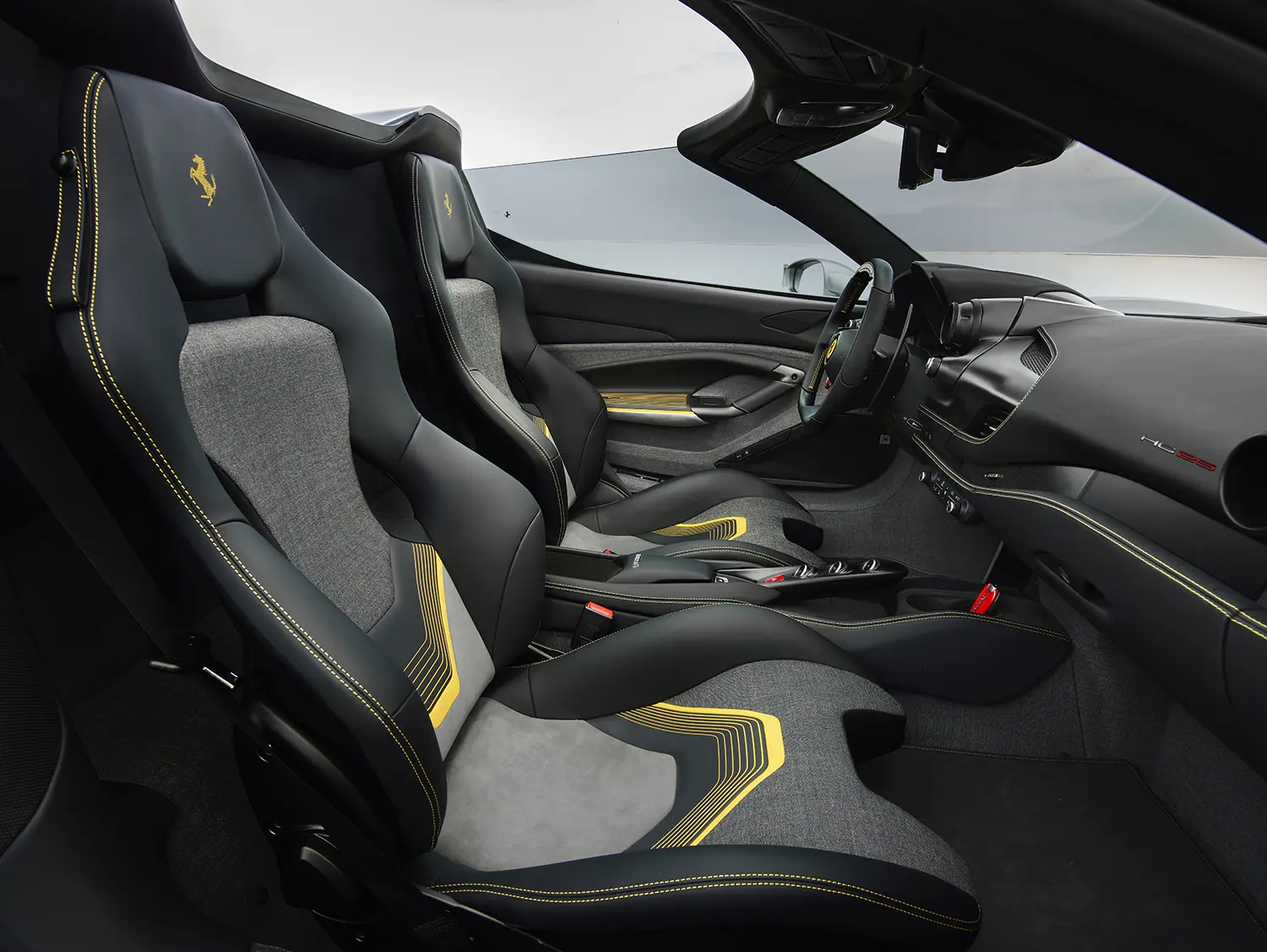
Light behaves differently on matt Moonlight Grey. The chromatic strategy of the HC25 is built around a single, high-stakes contrast: the matt Moonlight Grey bodywork against the glossy black band. Matt surfaces absorb light rather than deflect it, giving the car’s volumes a solidity and fullness that gloss finishes dissolve into reflections. The glossy black band, by contrast, becomes almost liquid — it pulls light in and holds it. The result is a body that appears carved from two different substances simultaneously. Yellow accents on the Ferrari logos and brake calipers detonate against this controlled palette like a frequency signal — precise, deliberate, and echoed inside the cabin through graphic elements that mirror the boomerang shape of the DRL daytime running lights.
Headlamps designed from scratch. The lighting units deserve particular attention. Rather than adapting existing modules, Ferrari developed bespoke headlamp units specifically for the HC25 — components that have never appeared on any other Prancing Horse model. The result is an exceptionally slim lens profile with a central indentation that creates a visual split, mirroring the divided geometry of the rear lights and reinforcing the car’s dual-volume logic from one end to the other. The DRLs adopt a vertical arrangement for the first time, tracing the leading edge of the front wings into a boomerang silhouette that feels both new and formally coherent with the rest of the body’s language. When lit, the front of the car has the focused, sharp-edged expression of something alert rather than aggressive.
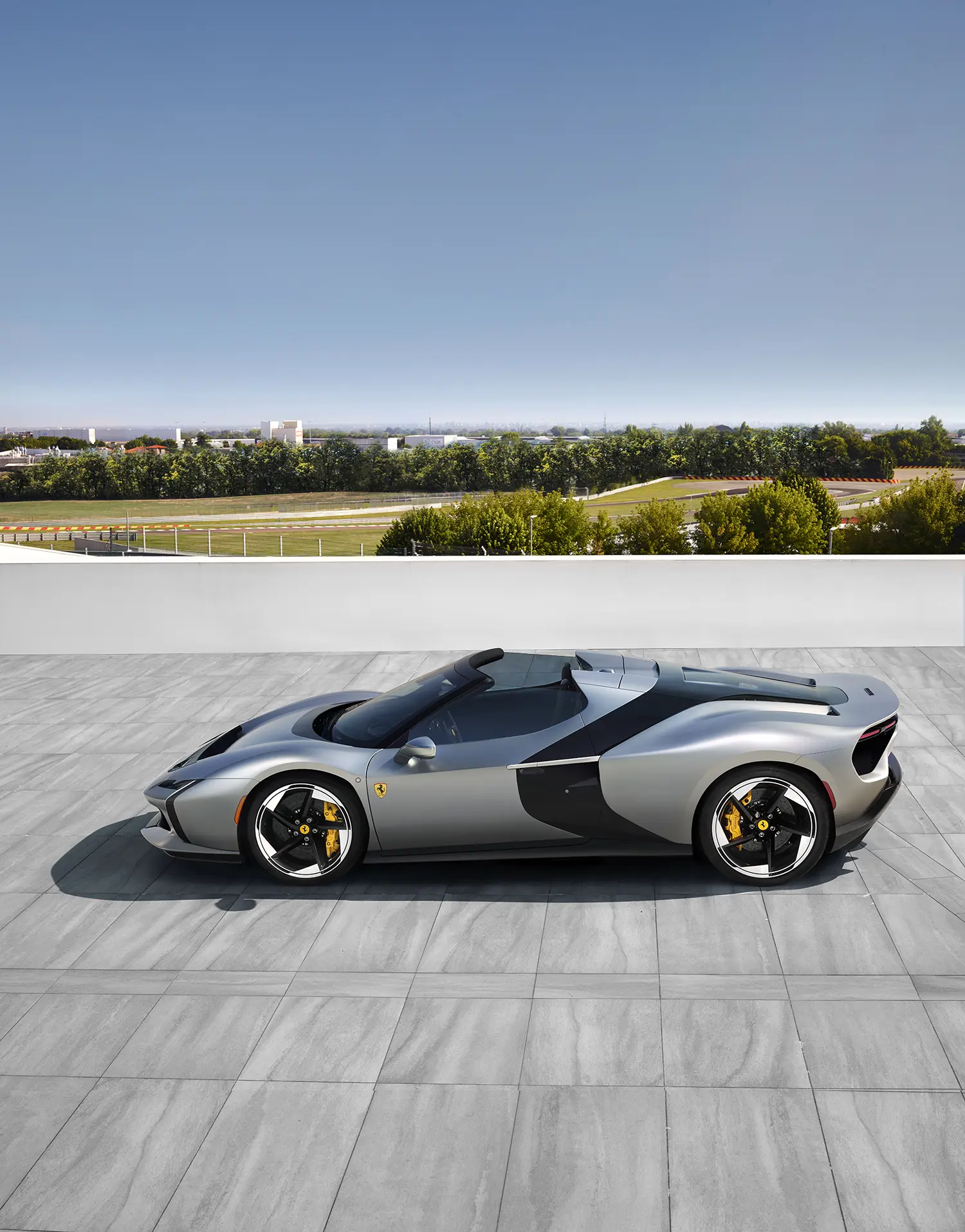
The wheels amplify the whole. The five-spoke wheel design chosen for the HC25 deserves more attention than it typically receives in coverage of one-off commissions. The diamond-finished outer rim features a double recessed groove on the outer channel — a detail that optically enlarges the wheel diameter without increasing it physically. The spokes themselves are slender and dark-toned, emphasizing the size of the rim they frame. It is a compositional trick borrowed from product design: create the perception of scale through contrast and negative space rather than bulk. On a car whose proportions have been explicitly refined to lower the perceived shoulder line, this kind of perceptual precision at every scale is not incidental — it is the method.
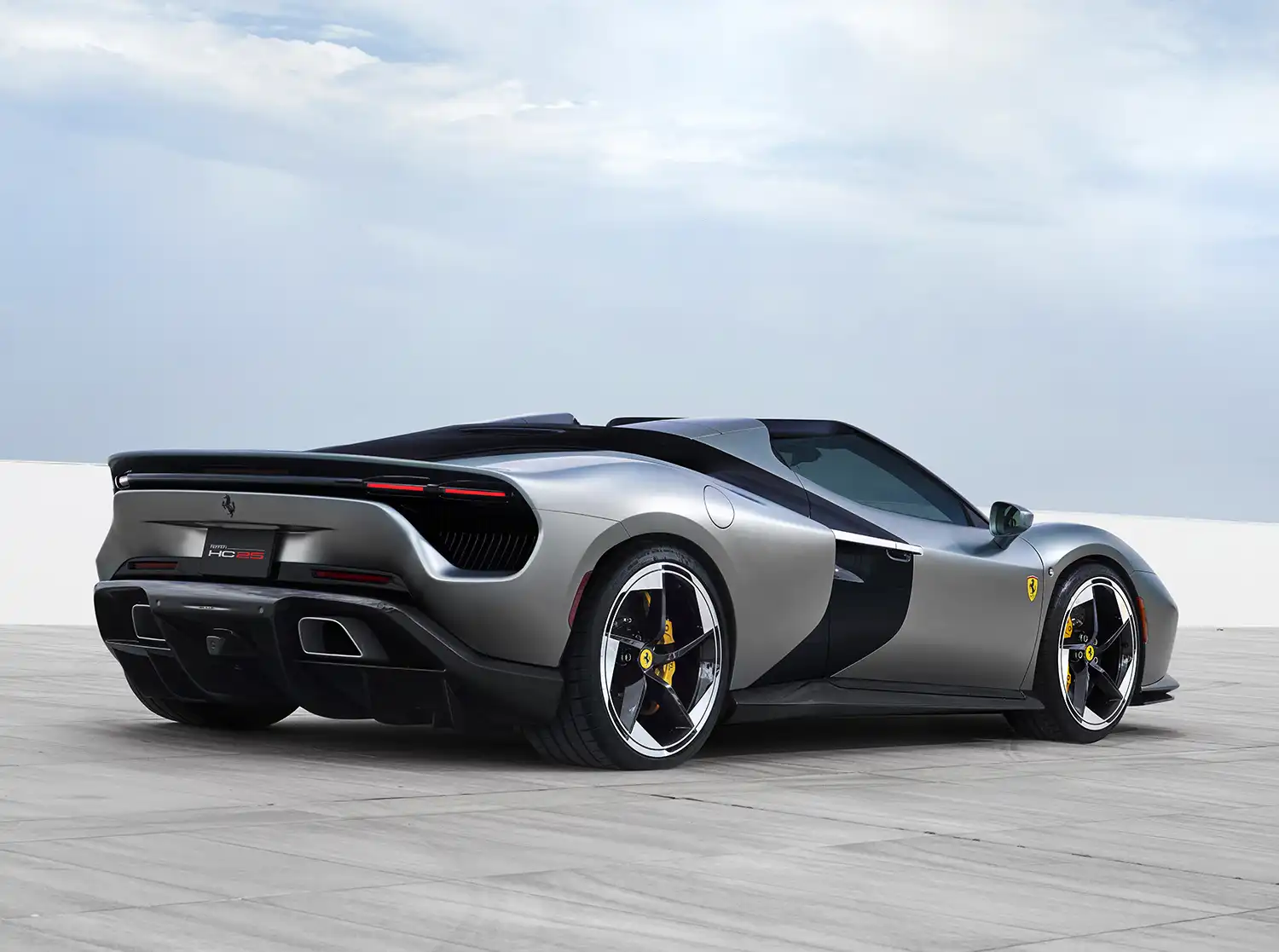
The HC25 and the new grammar of Maranello. What makes this commission genuinely significant is not its exclusivity — Ferrari builds one-offs regularly — but its critical position within the brand’s current formal evolution. The Ferrari 12Cilindri and the F80 have established a new visual language at Maranello: sharper, more geometric, less reliant on the organic surface transitions that defined the V8 mid-engine era. The HC25 stands exactly at the seam between those two worlds, its voluptuous flanks and sensual volumes still legible as descendants of the classic spider tradition, while its graphic identity — the black band, the boomerang DRLs, the split lighting logic — speaks entirely in the new dialect. For those following Ferrari‘s formal evolution on urdesign, the contrast with the Ferrari 12Cilindri Tailor Made Korean collaboration — where cultural narrative was layered onto the platform — is instructive: the HC25 strips that conversation back to pure form, asking what the body alone can say when every detail answers to the same compositional logic.