



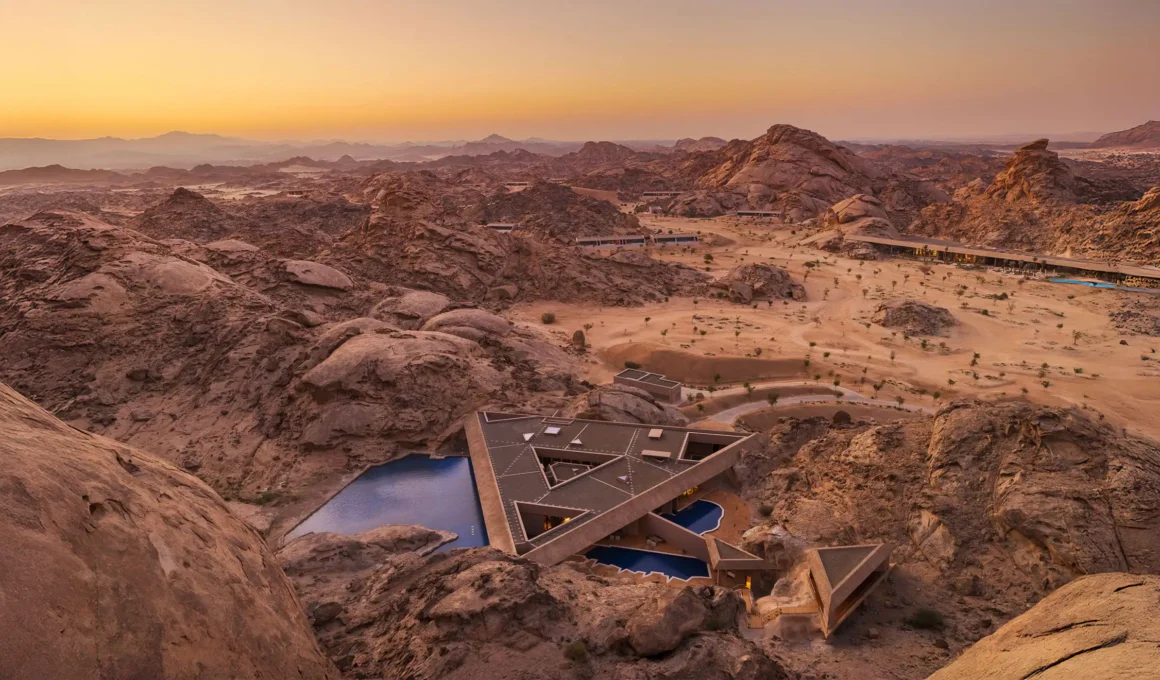
In the stark, majestic expanse of the Hejaz mountains in Saudi Arabia, a revolutionary approach to luxury hospitality is emerging from the ancient rock itself. Oppenheim Architecture has unveiled designs for Desert Rock, an ambitious eco-tourism resort conceived not as an imposition on the landscape, but as a profound dialogue with it. This isn’t merely a place to stay; it’s an invitation to disappear into the elemental beauty of one of the planet’s most awe-inspiring desertscapes, setting an entirely new benchmark for sustainable tourism.

Part of a visionary development spanning 11,000 square miles of Saudi Arabia’s diverse terrain – encompassing islands, beaches, deserts, mountains, and volcanic areas – Desert Rock deliberately contrasts with coastal neighbours. Where others might curve, it engages directly with the raw power of granite mountains and the mythical silence of the desert. The design philosophy is radical in its simplicity and respect: buildings disappear within the tectonic landscape, drawing inspiration from the ancient Nabatean civilizations who once thrived in these harsh yet beautiful lands.

Working meticulously with the language of the earth, Oppenheim has carved spaces into the very fabric of the mountains. Guest accommodations and facilities nestle within natural crevices and caves, or rest upon shaded slopes, strategically harnessing cooler microclimates and drastically minimizing solar gain. This camouflaged architecture achieves near-invisibility by day, its forms echoing the surrounding geology, crafted from recycled materials sourced directly from the site. Come nightfall, a magical transformation occurs – these hidden dwellings glow like small lanterns, casting a soft, welcoming light across the monumental massif.

Sustainability is the cornerstone of Desert Rock, meticulously integrated across planning, construction, and operation. The commitment extends far beyond energy efficiency. By utilizing local stone and earth, the resort ensures new structures embody the same colors and minerals as their ancient surroundings, creating a seamless visual and environmental harmony. Crucially, the resort’s facilities are dispersed, deliberately minimizing its footprint while actively encouraging exploration, adventure, and discovery. Guests are invited to intimately engage with the site’s rich cultural, archeological, and geological dimensions, transforming a stay into a profound journey of connection.

Desert Rock represents far more than an ultra-luxury escape; it’s a pioneering statement. Oppenheim Architecture envisions it delivering a net positive conservation benefit – actively enhancing the environment it inhabits. By proving that deep ecological sensitivity and world-class luxury hospitality are not just compatible but intrinsically linked, Desert Rock is poised to become an internationally recognized place brand and a definitive blueprint for the future of sustainable hospitality not only in the Gulf region, but globally. It’s architecture that doesn’t shout, but whispers – a testament to building with the land, not merely upon it.