



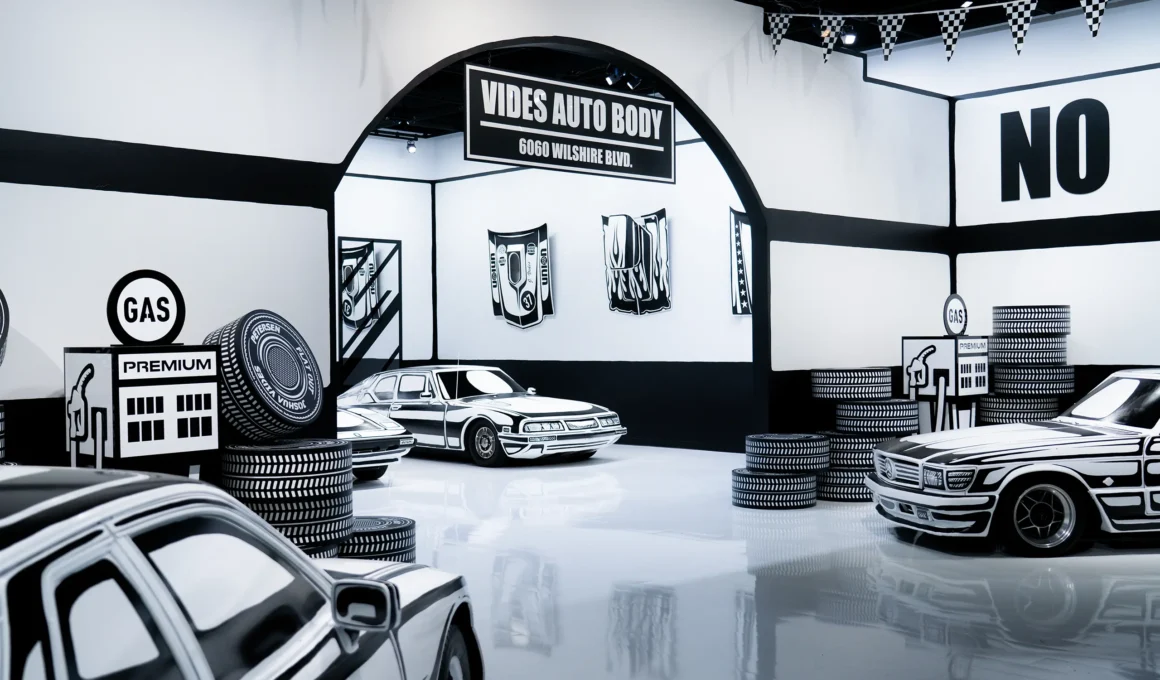
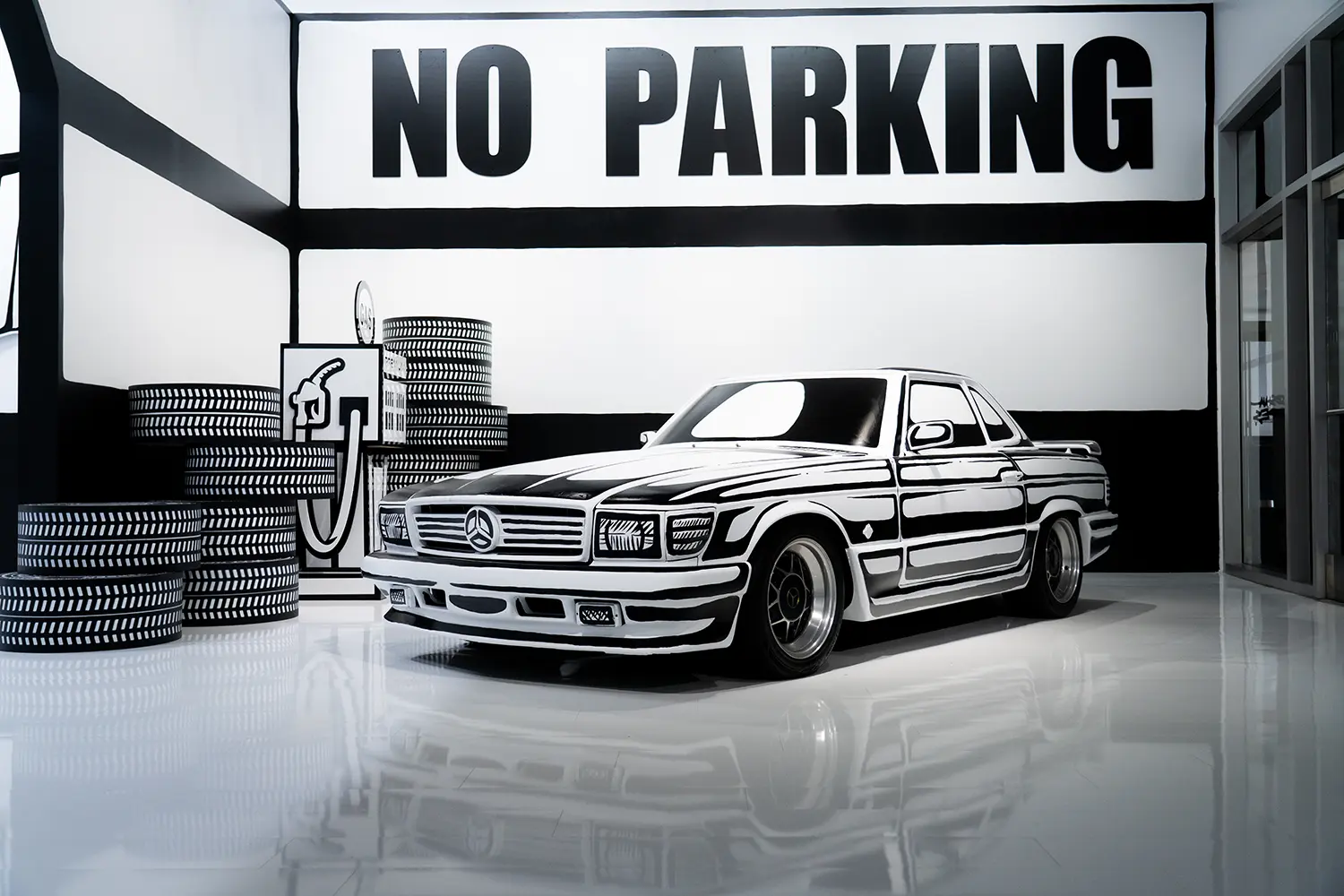
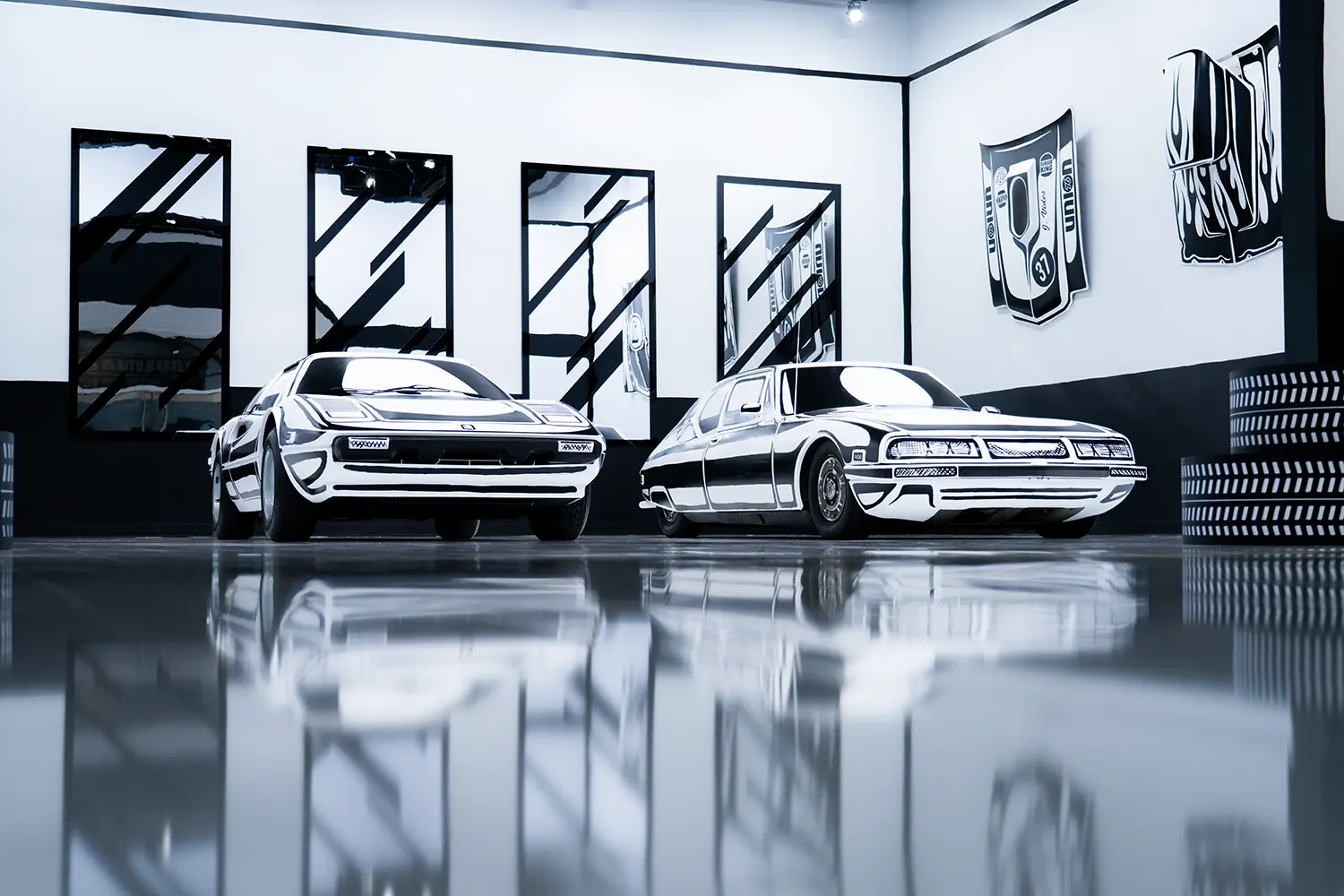
Joshua Vides has spent nine days convincing five real cars that they are drawings of themselves, hand-painting the Petersen Automotive Museum‘s Armand Hammer Foundation Gallery into a monochrome mechanic’s garage for Flat Out: The Art of Joshua Vides. The exhibition applies his signature Reality to Idea technique — flattening three-dimensional objects into crisp black outlines on white surfaces — not just to the vehicles themselves but to the walls, tools, and architecture around them. The result asks a genuinely strange question: what does a garage look like once every surface in it agrees to stop being three-dimensional.
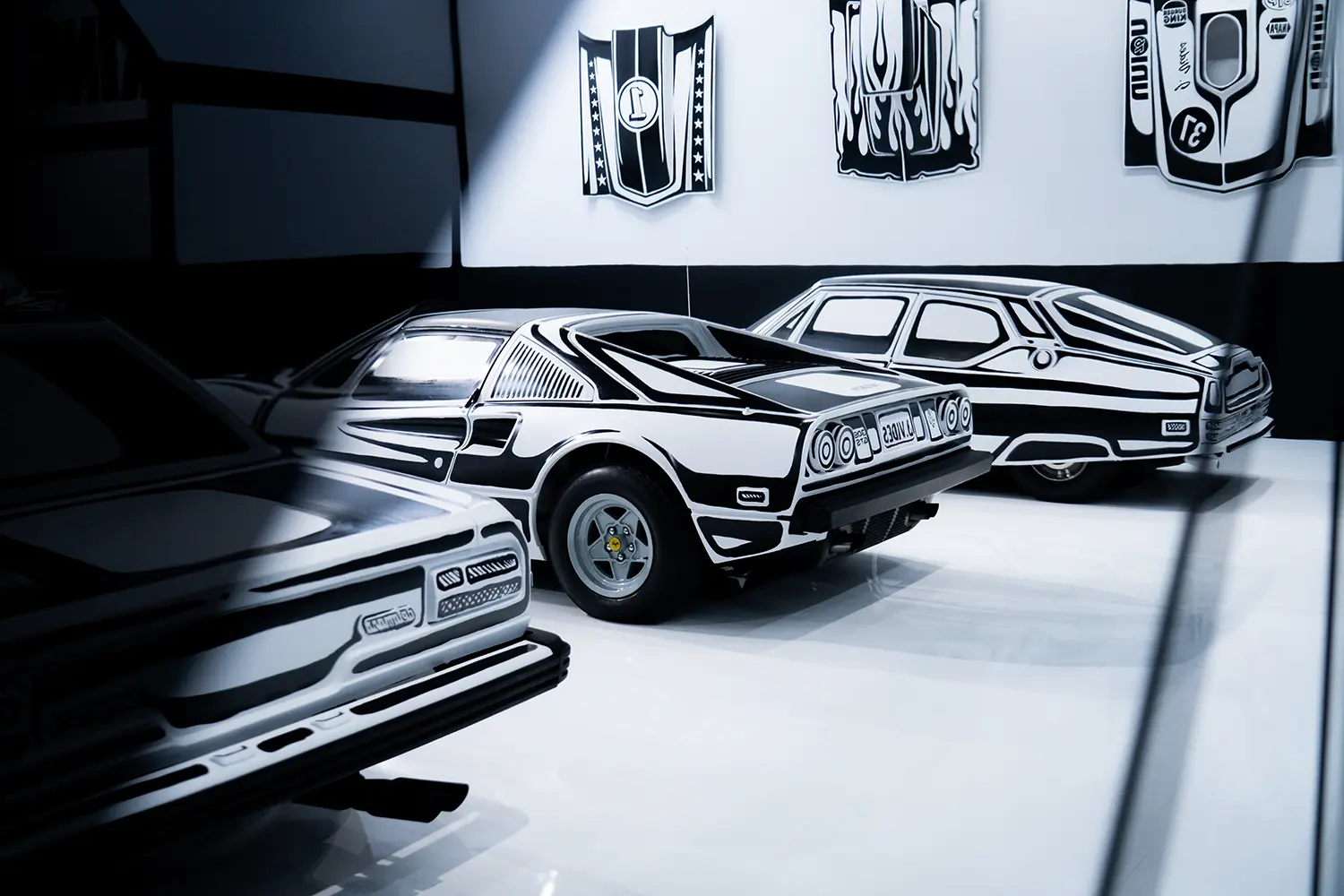
The Reality to Idea technique is deceptively simple to describe and punishing to execute. Joshua Vides paints crisp black lines onto all-white surfaces until real objects read as flat, comic-book illustrations of themselves — a style he has already applied to sneakers, mirrors, guitars and, repeatedly, cars, in collaborations with Nike, Converse, Fendi, Google and G-Shock. The gag only works because the execution is exact: a wavering line breaks the illusion instantly, so the entire aesthetic lives or dies on hand control.
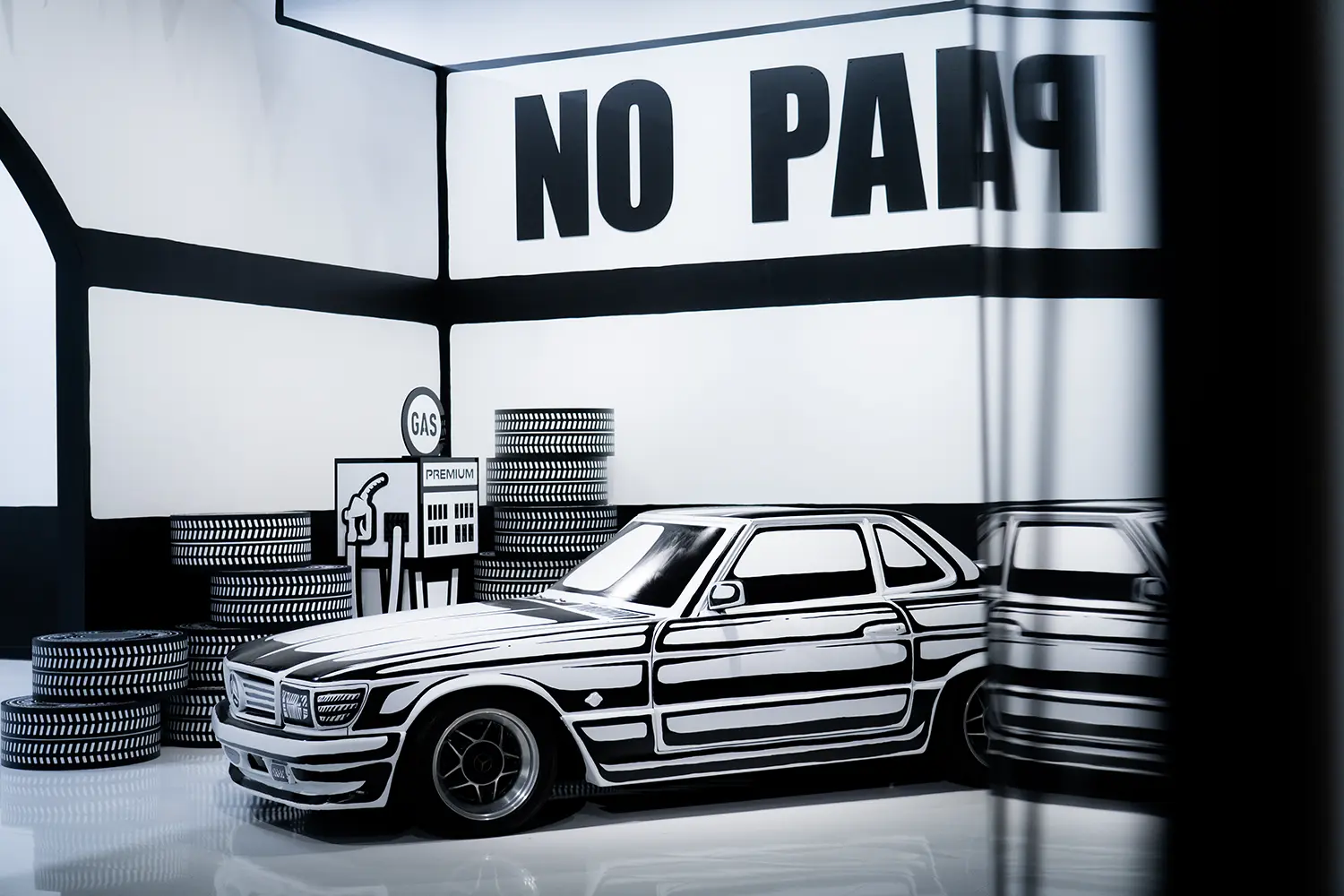
Five vehicles anchor the gallery, each treated as what the artist calls a unique canvas rather than a uniform surface. Applying one graphic language across five different bodies, with five different panel geometries and proportions, is a harder brief than painting five identical outcomes — the line work has to read as consistent style while responding to whatever curve or crease each car actually offers.
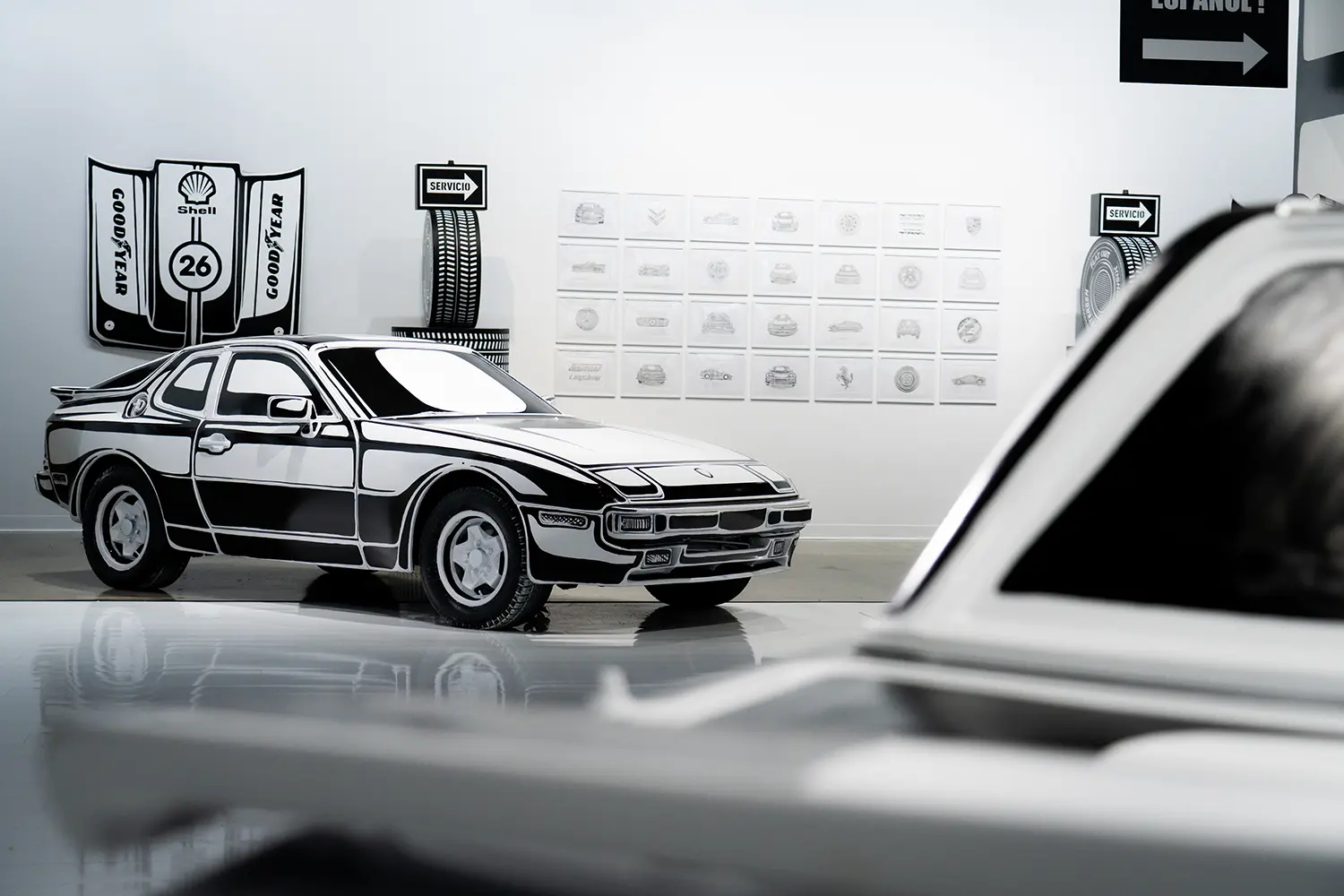
Painting the room as well as the cars is what separates this show from a static display of finished objects. Vides extended the black-and-white treatment to the walls and surrounding elements of the gallery, turning the entire space into what the museum describes as a real-life sketchbook rather than a backdrop. Removing colour from an entire room, not just its centrepieces, removes the visual cue that usually tells a viewer where the art stops and the architecture begins.
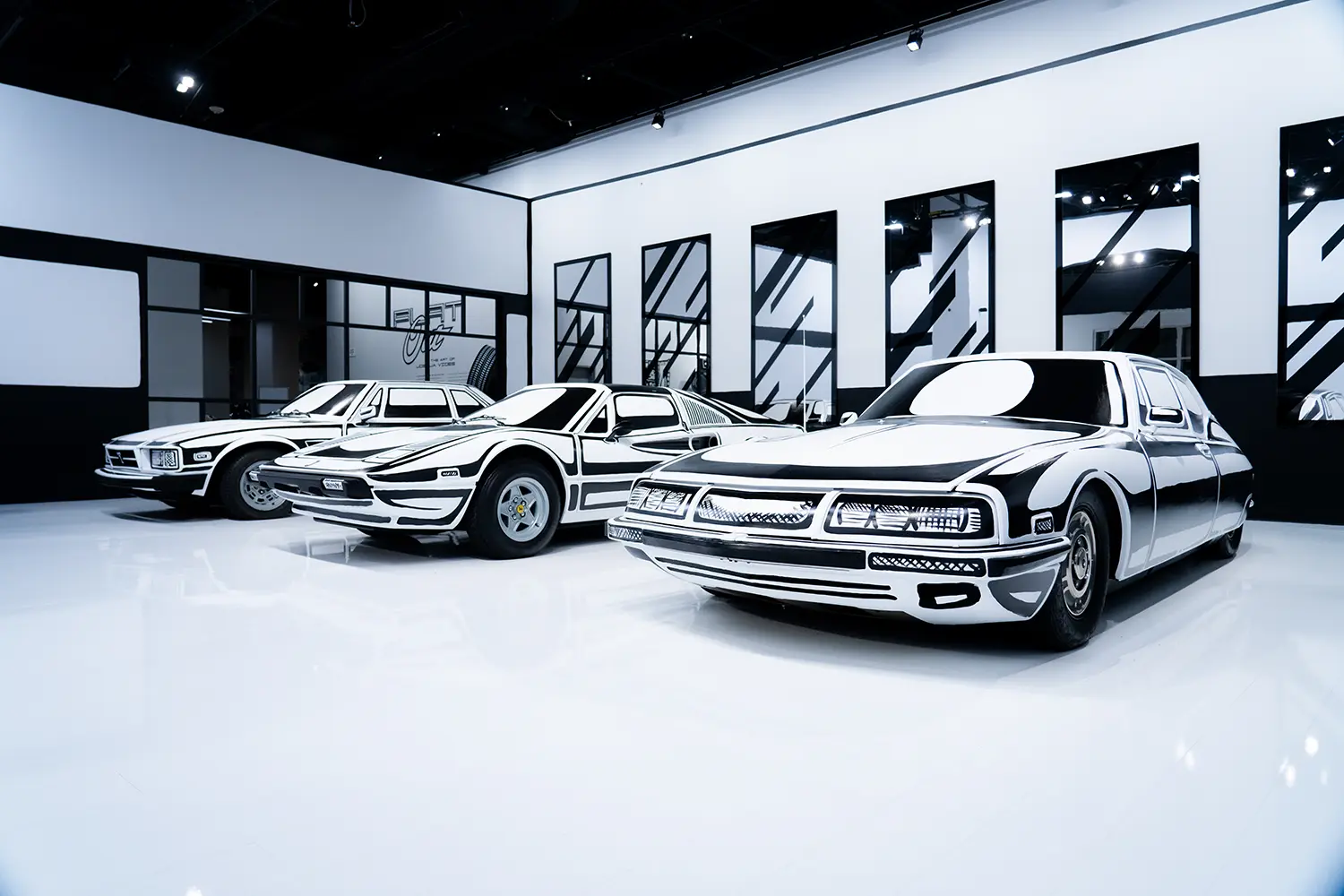
Nine days of continuous hand-painting produced the finished monochrome installation — a schedule that leaves little room for correction once a line goes down wrong on a full-size vehicle. That timeline matters more than it might elsewhere: monochromatic line work has no shading to hide behind, so speed and precision have to coexist rather than trade off against each other.
A comparable instinct toward stripping automotive colour down to something more conceptual than decorative recently surfaced in Bugatti’s Blanc Éternel, which translated a car’s surface into porcelain rather than paint. Where Bugatti removed colour to evoke permanence, Vides removes dimension to evoke illustration — both projects treat the car body as a material problem rather than a fixed given.
“Every vehicle provides a unique canvas,” said Vides of the commission, according to the museum. The scale of the undertaking — five full vehicles plus a room built around them — pushes Reality to Idea further than his past gallery work, which has typically centered on fewer cars in smaller footprints.
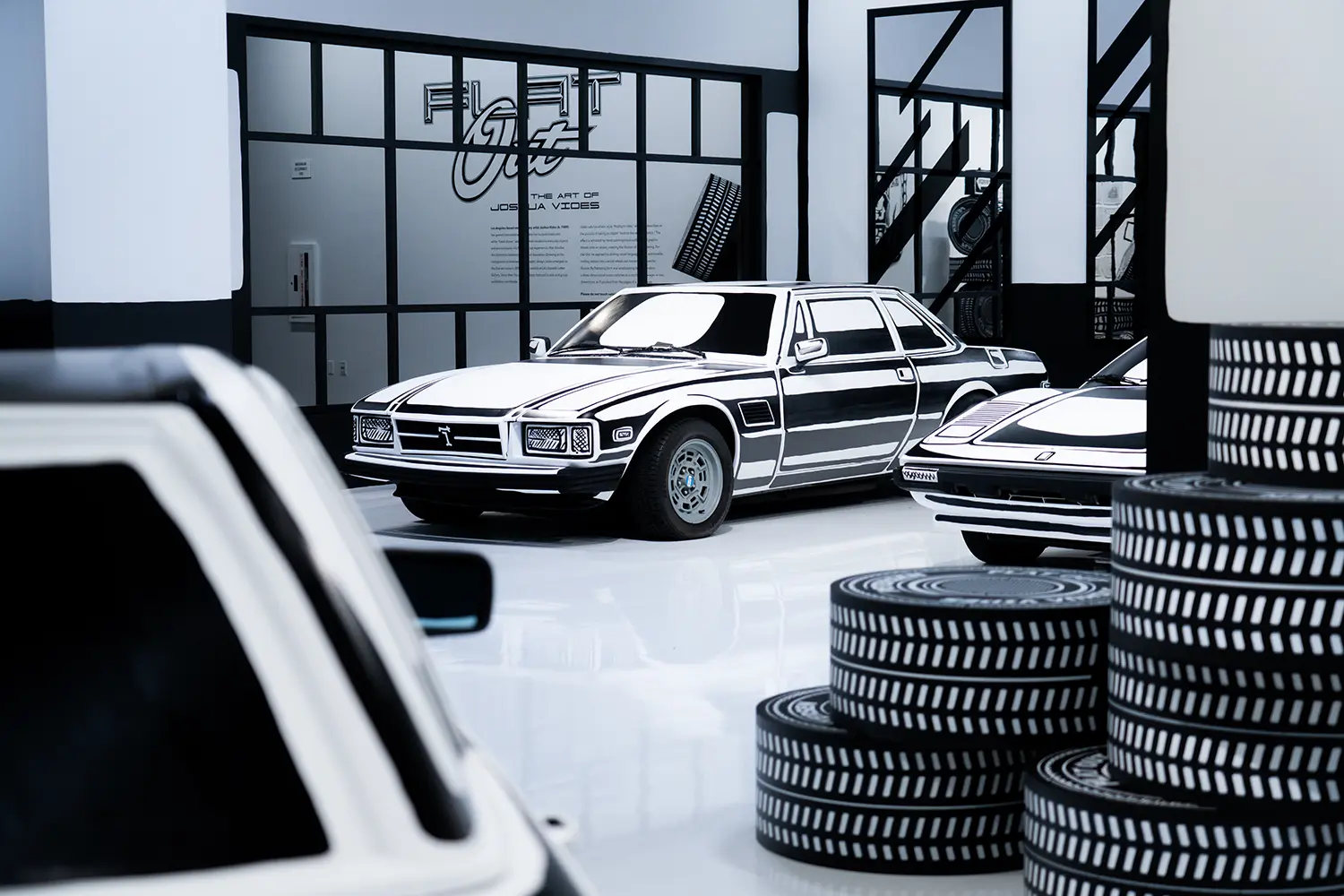
Terry L. Karges, executive director of the Petersen Automotive Museum, said the transformation of the gallery into “a real-life sketchbook” gave the museum something it had not staged before. That claim is worth taking at face value: the Petersen has hosted plenty of exhibitions built around finished, static vehicles, but rarely one where the room itself has been redrawn to match.
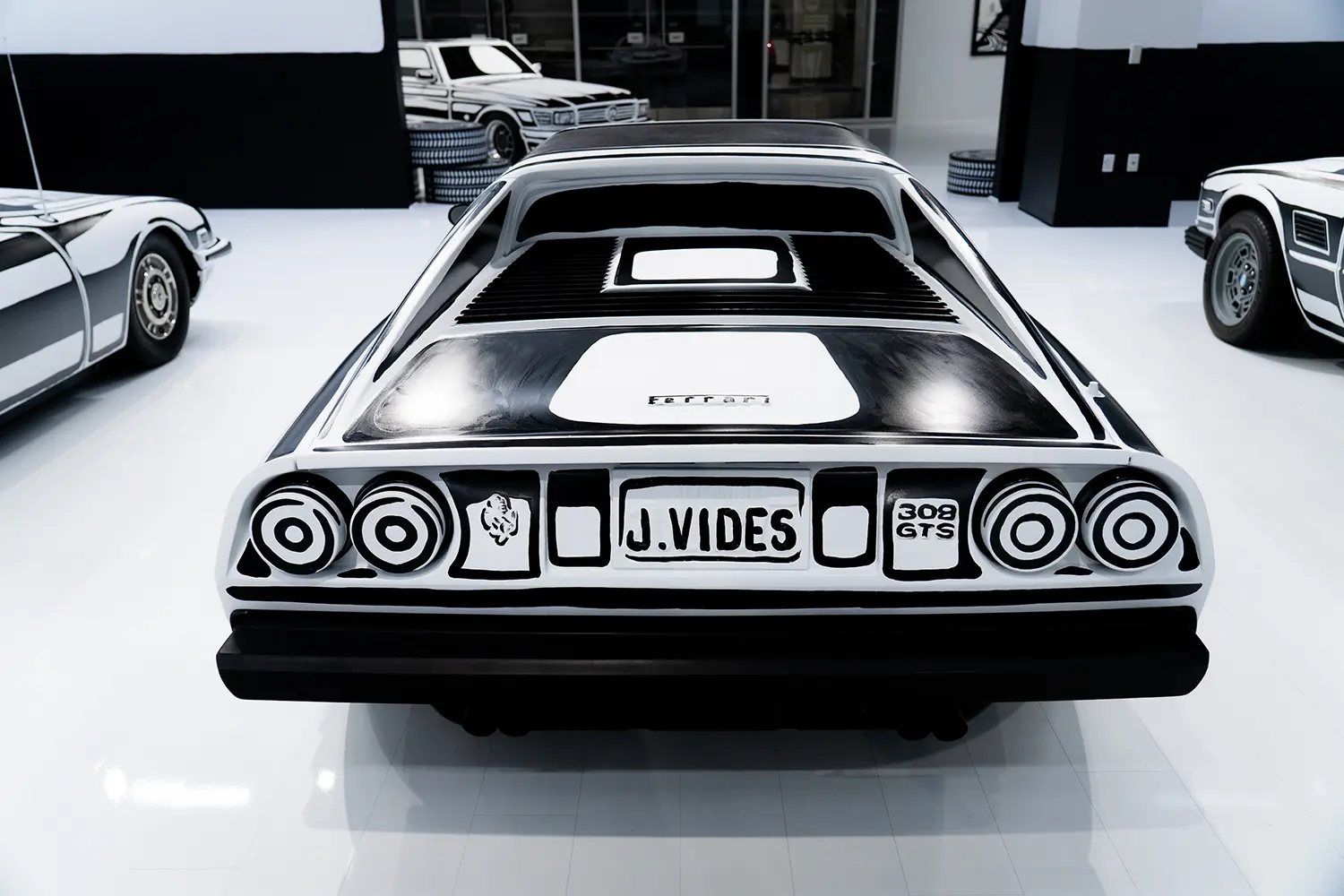
What makes the show worth a visit isn’t the novelty of seeing cars turned into cartoons — Vides has done that consistently for years — but the decision to apply the same flattening logic to architecture. A single illustrated car is a trick. An illustrated room built to hold five of them, walls included, is closer to a proposition about where an object ends and its setting begins, and that proposition is more interesting than the individual vehicles it’s made of.
Flat Out: The Art of Joshua Vides by Joshua Vides | Where: Petersen Automotive Museum, 6060 Wilshire Blvd, Los Angeles, CA 90036 — When: On view through July 5, 2027