



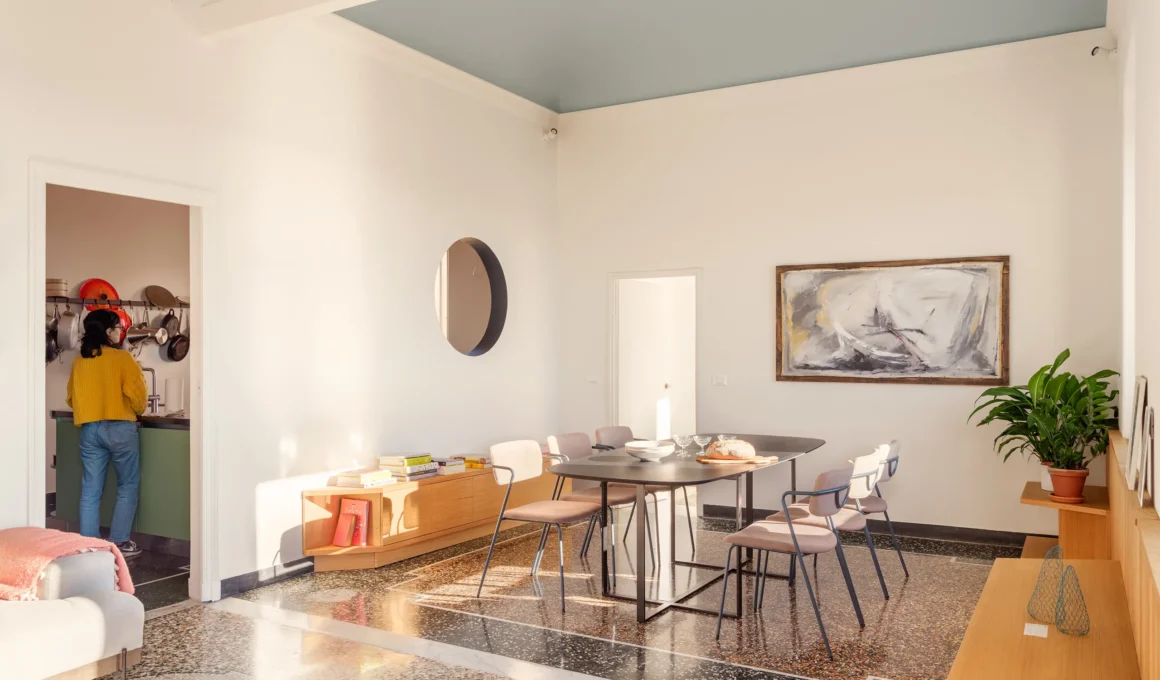
Italian practice llabb has transformed a duplex perched atop Genoa’s ancient sea walls into The Watchtower (La vedetta), a domestic viewpoint where historical stratification and industrial panoramas converge to define a young couple’s narrative.
A nautical dialogue with history defines the essence of this project, situated on the sixth and seventh floors of a building that once looked out upon the wooden masts of the Genoese fleet. Today, those masts have been replaced by the skeletal, hardworking silhouettes of shipyard cranes and dry docks. The studio has avoided the temptation of the “polished” aesthetic found in the nearby Porto Antico, choosing instead to embrace the raw, kinetic energy of the industrial port. The interior acts as a private observatory, mirroring the height and perspective of a crane operator’s cabin, yet softened by a deeply personal and human-centric approach to living.

The conceptual vision is grounded in a circular interior layout on the lower level, creating a sequence of planes that force a constant interaction between the inhabitant and the horizon. This is not a static home; it is a rhythmic progression of spaces. The entrance leads immediately into the kitchen, the operational heart of the house. Here, a green peninsula stands in vibrant contrast to a pink vaulted ceiling, while a professional stainless steel countertop serves as a tactile reminder of the client’s former life as a chef. A circular porthole—a literal and metaphorical lens—visually connects the culinary workspace to the living area, framing the southern light.

Material memory and scars are celebrated throughout the living quarters, which were formed by merging two distinct rooms. The studio chose to leave the original separation legible, preserving two different terrazzo floors that tell the story of the building’s survival through the bombings of the Second World War. These healed fractures in the flooring serve as a map of the past. Above the fireplace, llabb has “framed” the stratification of centuries-old wall colors, creating a domestic gallery of textures that speaks to the various souls who have inhabited these walls before the current residents.

Bespoke craftsmanship and playful references characterize the furnishing strategy, with almost every element—save for the seating—designed specifically for the space by the studio. In the walk-in wardrobe, warm pink tones reappear to echo the brick-colored fragments found in the terrazzo, creating a cohesive chromatic language. The entrance hall features dark, early 20th-century flooring offset by playful storage units shaped like beach cabins. This is a sophisticated nod to the shoreline that once existed below the walls and a tribute to dopamine decor and the postmodern legacy of Aldo Rossi.

Technical ingenuity is revealed in the transition between levels. The ascent to the upper floor mimics the winding movement of a Genoese crêuza, leading to a space where the original red and white cement tiles remain intact alongside a traditional marble and slate sink. Perhaps the most striking technical detail is found tucked among the wardrobes: a small window looking out onto the extrados of the reed vaults. This reveals the ancient, lightweight structural techniques used to avoid heavy masonry, a hidden testament to the Mediterranean building vernacular that prioritizes agility and structural intelligence.

The sensory experience of the bathrooms provides a curated shift in atmosphere. On the lower floor, the space unfolds in a “sugared” sequence of geometries, where terrazzo flooring meets the handmade texture of pink Moroccan zellige tiles. This blend of contemporary reinterpretation and traditional craftsmanship creates a tactile, shimmering environment that feels both rooted and refreshingly modern. It is a space designed for pause, contrasting with the busy, industrial vista just beyond the windowpanes.

A climb toward the horizon culminates in the bedroom, where a clever system of storage steps leads the inhabitant out onto a walkway. This path transitions into the terrace, the crowning feature of the project. Given its elevated position above the ancient defenses of the city, the outdoor space functions exactly like a fort’s lookout. It offers a panoramic view that spans from the first historical settlements on the hills to the contemporary logistics hubs that drive the city’s economy today, placing the residents at the center of Genoa’s temporal evolution.

Contextual impact and urban identity are the final elements that make The Watchtower more than just a renovation. By honoring the “hard work” of the port—the sirens, the slow-moving containers, and the industrial grit—llabb has created a home that does not hide from its environment. It is a project that understands the city is a living organism, built from layers of wood, stone, and steel. The apartment stands as a bridge between the maritime history of the 1800s and the industrial reality of 2026, serving as a private vessel for a young couple navigating the tides of modern life.