



Nestled into the steep, verdant slope of Forêt-Fouesnant in Brittany, a new house by Mesure Studio offers a quiet but profound architectural statement. The project, a contemporary family home, emerges not as an alien imposition but as a thoughtful dialogue with its rugged, seaside context. Instead of replicating the traditional granite masonry typical of the region, the architects have chosen to reinterpret its essence, crafting a dwelling that is both firmly grounded and seemingly weightless, a modern belvedere overlooking the pond and ocean beyond.

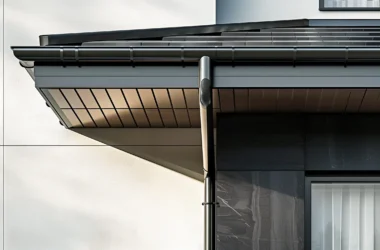
The defining architectural gesture is a masterful reinterpretation of the traditional lean-to roof. Confronted with the desire for generous upstairs bays, a conventional dual-pitched roof was impossible. The solution was to lift a single, sloping plane from the earth, detaching it from the main gable. This clever manoeuvre does more than solve a structural puzzle; it creates a sheltered, protected garden beneath the building’s volume while framing panoramic views from above. The garden, in effect, slides under the house, blurring the boundary between the built and the natural.

This sense of permeability is enhanced by the use of large exterior curtains that cloak the facade. These operable fabric veils serve a dual purpose: they filter solar gain to manage the interior climate and introduce an element of ephemeral lightness. When drawn, they cause the substantial concrete volume to appear as if it is floating amidst the trees, a dynamic and responsive envelope that changes the building’s character with the weather and time of day.

The materiality of the house is a testament to a deeply considered low-carbon concrete approach. The exposed concrete was poured in place and finished with remarkable variety—sanded, bush-hammered, raw, and smooth—creating a rich, tactile surface that echoes the nobility of local stone. In a striking detail, sheets of mirror-polished stainless steel are inlaid into the concrete, their mineral silhouettes catching the light and reflecting the surrounding greenery, further dissolving the building’s solidity.

Durability in the face of Brittany’s salty coastal air was a critical concern. Externally, the architects specified a special XS2 concrete mix formulated to withstand the corrosive marine environment, eliminating the need for less durable claddings and simplifying the building’s lifecycle. This commitment to robust, honest materials continues inside, where one of the project’s most distinctive features is revealed: exposed cork insulation.

The interior walls and ceilings are lined with thick panels of exposed cork, a material choice that is as aesthetic as it is functional. The cork extends the vegetal spirit of the garden into the living spaces, contributes to superior acoustics, and provides a warm, tactile counterpoint to the cool concrete. This strategy also allowed the designers to save on conventional linings like plasterboard and paint, streamlining construction and contributing to the project’s optimized timeline and ecological footprint.

Ultimately, the House in Forêt-Fouesnant is a sophisticated exercise in contextual and sustainable design. Mesure Studio has crafted a home that is deeply connected to its site, not through mimicry but through intelligent abstraction. It is a house that provides shelter and prospect in equal measure, a private observatory where the boundaries between interior and exterior are continually negotiated by sliding curtains, a lifted roof, and a material palette drawn from the very essence of its place.