



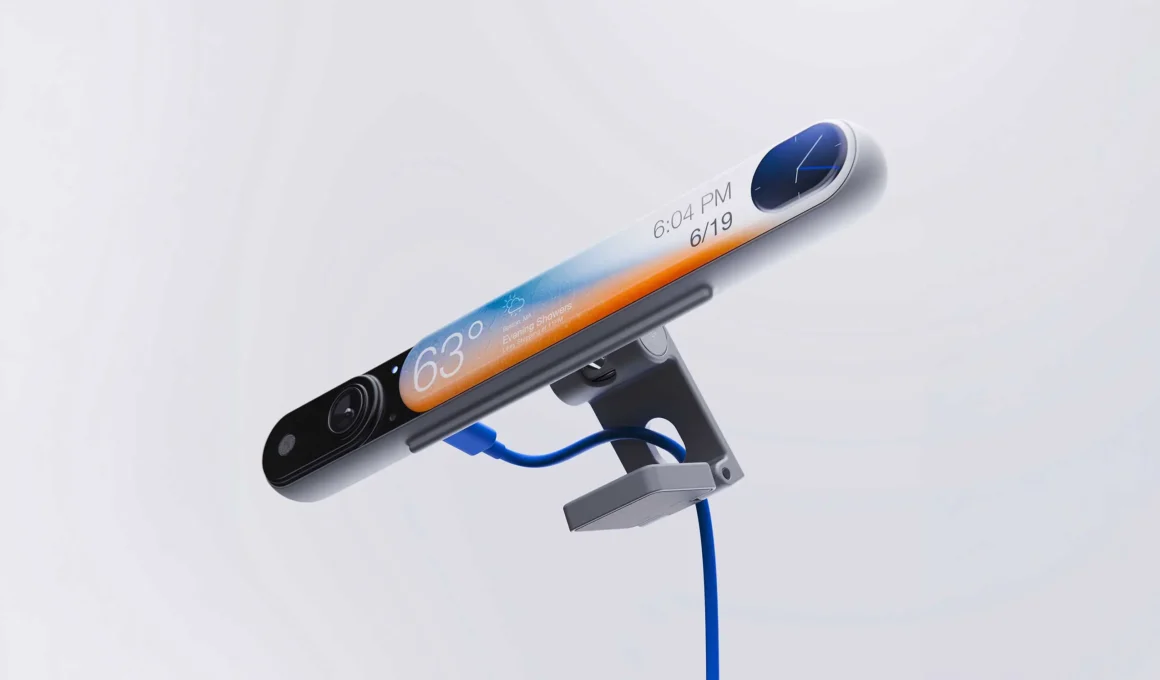
Connor Grady turns a desktop webcam into a second screen, giving IRIS its own display strip that shows the time, weather, and meeting reminders above the monitor instead of inside it. The unofficial concept borrows Logitech’s own visual language without being a real product from the company. It asks a small but real question: if a camera already sits at the top edge of every monitor, why should that space stay dark the rest of the time?

The housing reads as a straight extension of Logitech’s existing hardware line — a slim, metallic-toned bar with a camera lens and microphone dot at one end, clipped to the top of a monitor with the same folding bracket Logitech already uses on its webcams and light bars, cabled in with a visible blue USB-C lead.

Most of that bar, though, is screen. A resting interface runs along the strip showing date, weather, and time in a gradient display, styled deliberately close to a computer lock screen — a familiar visual language repurposed for hardware that usually has no screen at all.

For Grady himself, the intent centers on workspace integration. “The UI of IRIS is meant to be an extension of the user’s workspace, allowing for a separate, yet visually assistive screen at the user’s eye level,” Grady tells urdesign. “IRIS functions similarly to that of a desktop monitor, with its own visual constraints.”

That eye-level position is doing real work for IRIS. Mounted above the primary display rather than inside it, the concept keeps ambient information out of the way of whatever’s on-screen, without requiring a second physical monitor or a phone glanced at sideways.

Grady built the concept around specific productivity use cases — meeting reminders, verbal notes, even a teleprompter function — rather than treating the display as decorative, describing it to urdesign as closer to a UI sandbox that lets each user customize IRIS to their own workflow.

A comparable premise — folding a dedicated interface into a piece of peripheral hardware rather than routing everything through a phone or laptop screen — shaped Microsoft’s Project Solara badge device, which explores agent-first computing through a wearable rather than a desk accessory. IRIS applies the same instinct to the one piece of hardware already fixed to every monitor.

Ambient AI objects built to sit quietly inside a workflow, rather than demand a dedicated app or screen, also drove Layer’s PIA AI ecosystem — a different category of device chasing a similar goal: computing presence that doesn’t compete for attention.
As a student project, IRIS exists only as render — a conceptual industrial design exercise built to test reflective surfaces and convincing digital displays, not a manufacturing brief. That’s precisely what makes it interesting: a camera bar with its own screen is a genuinely simple idea, and the fact that no major webcam maker has shipped one yet says more about category habits than about technical difficulty.