


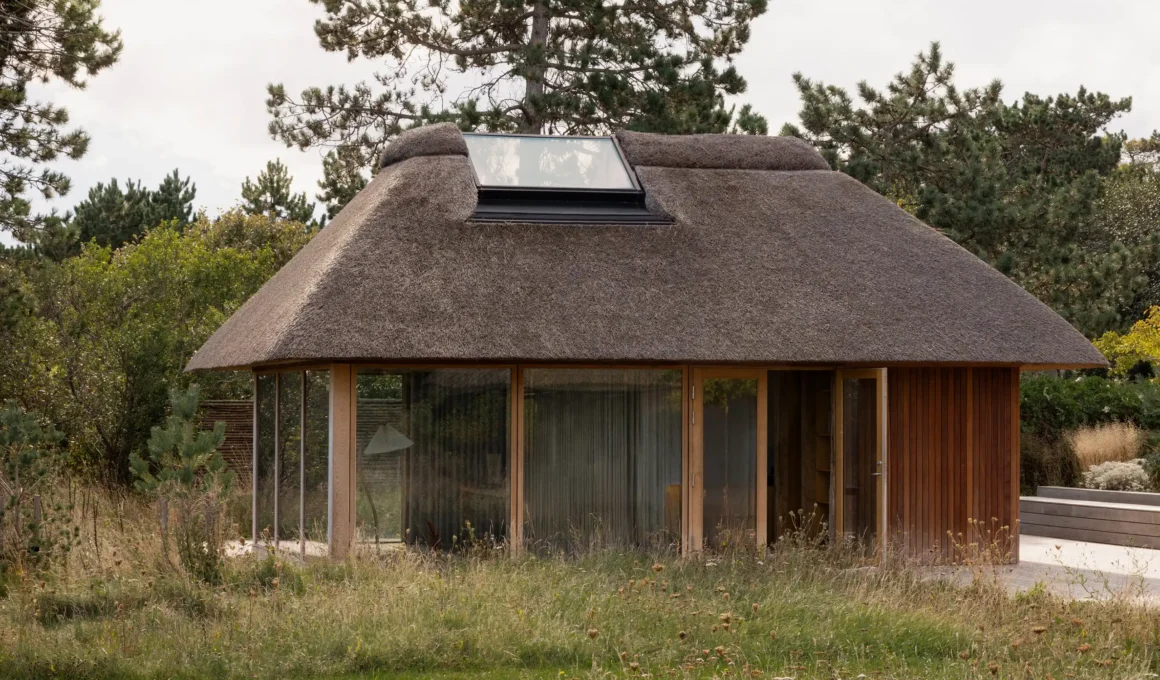
By reinterpreting the traditional Danish summerhouse through the lens of Japanese spatial sequencing, Norm Architects has constructed Shoreline Studio, a coastal atelier in Denmark that functions as a silent mechanism for creative focus rather than a mere seasonal retreat. The structure rejects the contemporary impulse for expansive glass and sweeping panoramic views, opting instead for compressed thresholds and calibrated openings. This deliberate architectural restraint forces the inhabitant’s attention inward, transforming the relationship with the surrounding windswept landscape from a passive visual spectacle into a tactile, acoustic reality.

The material dialogue between the new intervention and the pre-existing brick summerhouse relies on shared vernacular weight rather than superficial stylistic mimicry. By utilizing a thatched roof, local timber framing, and heavy reclaimed beams, the studio anchors itself firmly within regional building traditions. However, the true intelligence of the plan lies in how these archetypal elements are deployed to achieve a near-sacral verticality, subverting the typical horizontal sprawl of coastal cabins to create a volume that feels unexpectedly monumental despite its modest footprint.

Flooring choices dictate the physical pacing of the transition from the main residence to the workspace, creating a continuous plane that erases structural boundaries. The raw brick flooring extends seamlessly from the interior out onto the shared terrace, grounding the feet on a rough, earthy texture that retains solar heat long after the coastal sun dips below the tree line. This persistent material continuity ensures that arrival is felt through the changing temperature and friction underfoot, demanding physical awareness before one even crosses the threshold.

Light operates as a dynamic drafting tool within the main volume, filtered and shaped by integrated architectural elements. A single overhead skylight acts as a primary aperture, casting a sharp, slowly moving beam of daylight across the textured brick floor to mark the passage of hours without the distraction of a changing horizon. Along the perimeter, custom wooden louvers slice the horizontal coastal light into soft, rhythmic bands of shadow, shielding the desk from glare while maintaining a fluid connection to the moving grasses outside.

Acoustic dampening inherent to the thick thatch overhead radically alters the internal atmosphere, isolating the occupant from the harsh North Sea winds. Inside, the roar of the coastal breeze is reduced to a faint, rhythmic murmur, creating an environment of profound sensory calm that sharpens the senses. This soft, absorbent overhead canopy stands in direct tactile contrast to a massive, custom-designed stainless steel wash basin, an industrial insertion whose cold, reflective surface and sharp geometry break the monochrome warmth of the timber surfaces.

Spatial hierarchy within the property cluster is maintained through a calculated layout that respects existing sightlines while establishing a distinct professional boundary. The atelier stands independently from the main home, positioned at an angle that preserves open views of the dunes for both structures without allowing either to impose on the other’s privacy. It is an arrangement that understands proximity not as a source of friction, but as an opportunity to frame the empty space between buildings, turning the wild landscape into a shared interior courtyard.

Finely detailed timber surfaces and integrated furnishings reinforce this sense of structural order, concealing secondary utilities to leave the creative workspace entirely uncluttered. This structural discipline mirrors the clean lines and material honesty that define the studio’s broader portfolio, reminiscent of the restrained domesticity seen in recent residential projects like the Kolon House in Copenhagen or the dune-facing geometries of the Heatherhill Beach House. In each instance, the architecture acts as a quiet framework that allows the organic vitality of the site to exist in a state of controlled equilibrium.

The enduring relevance of Shoreline Studio lies in its refusal to treat regional heritage as a static museum piece or Japanese minimalism as a trendy aesthetic veneer. Instead, Norm Architects has demonstrated how the core principles of both traditions—honesty of materials, clarity of form, and reverence for natural light—can be synthesized to address the contemporary need for psychological decompression. As the boundaries between domestic life and professional production continue to blur global housing typologies, this small coastal structure suggests that true separation is achieved not through distance, but through a rigorous commitment to spatial transition.