



Christian Dior: Designer of Dreams has arrived in Seoul, transformed by OMA into a mesmerizing dialogue between French haute couture and Korean heritage. Housed within the undulating concrete curves of Zaha Hadid’s Dongdaemun Design Plaza, this fifth collaboration between OMA and Dior dissolves the boundaries of traditional fashion exhibitions, instead crafting an immersive journey where nearly 80 years of design history intertwine with Korea’s artistic traditions. The exhibition runs until May 25, 2025, offering visitors a limited opportunity to experience this unique cultural synthesis.
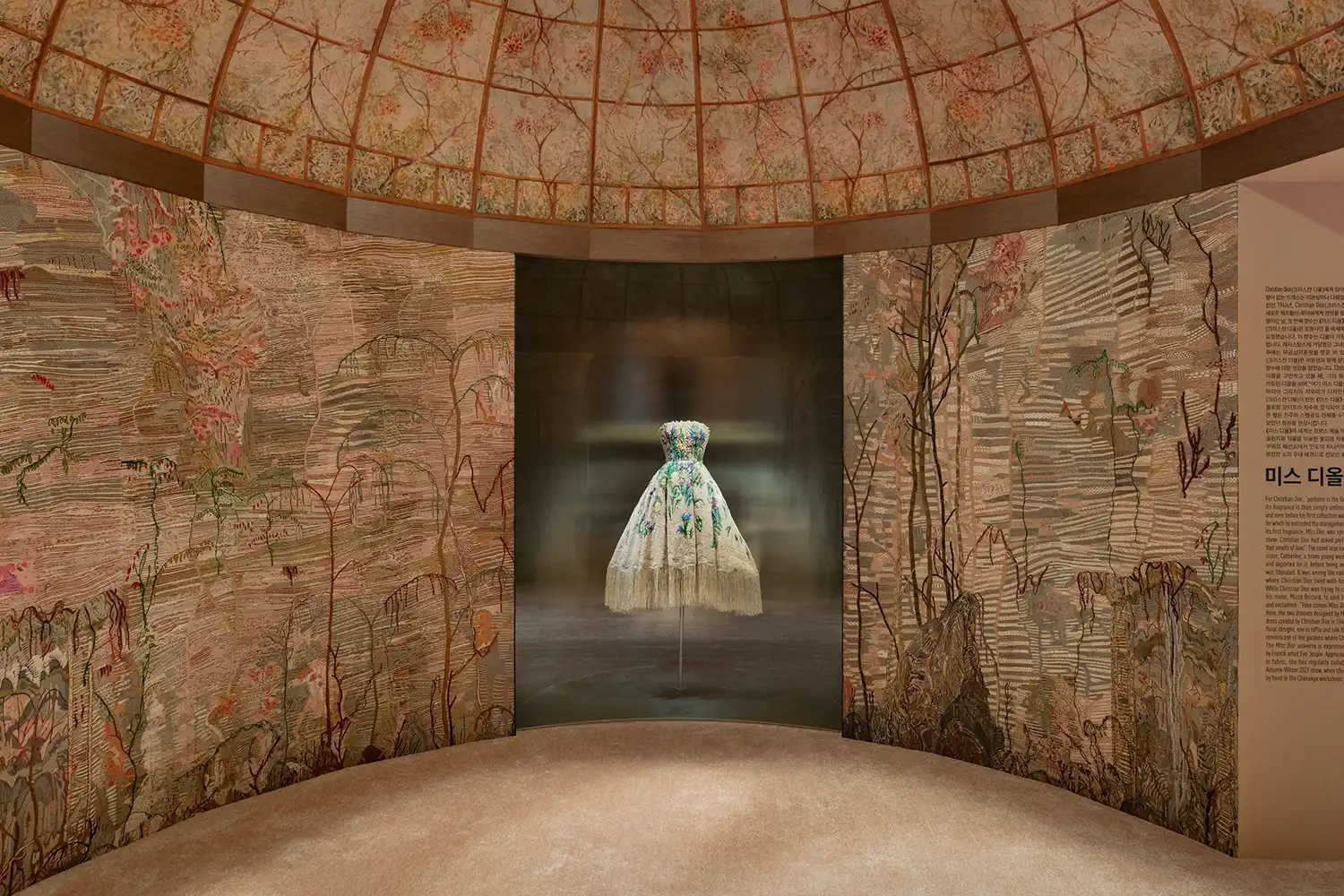
The exhibition unfolds as a single, fluid composition rather than a series of disconnected rooms, taking full advantage of DDP’s vast, column-free Art Hall. At its heart lies The Garden, a breathtaking reinterpretation of the Korean moon jar—that iconic white porcelain vessel formed by joining two hemispherical halves. Within this 12-meter-tall architectural interpretation, visitors find themselves enveloped in an ethereal universe where artist Hyun Joo Kim’s hanji paper forest merges with projected imagery across a domed ceiling, creating a dreamlike space that bridges nature and craftsmanship.
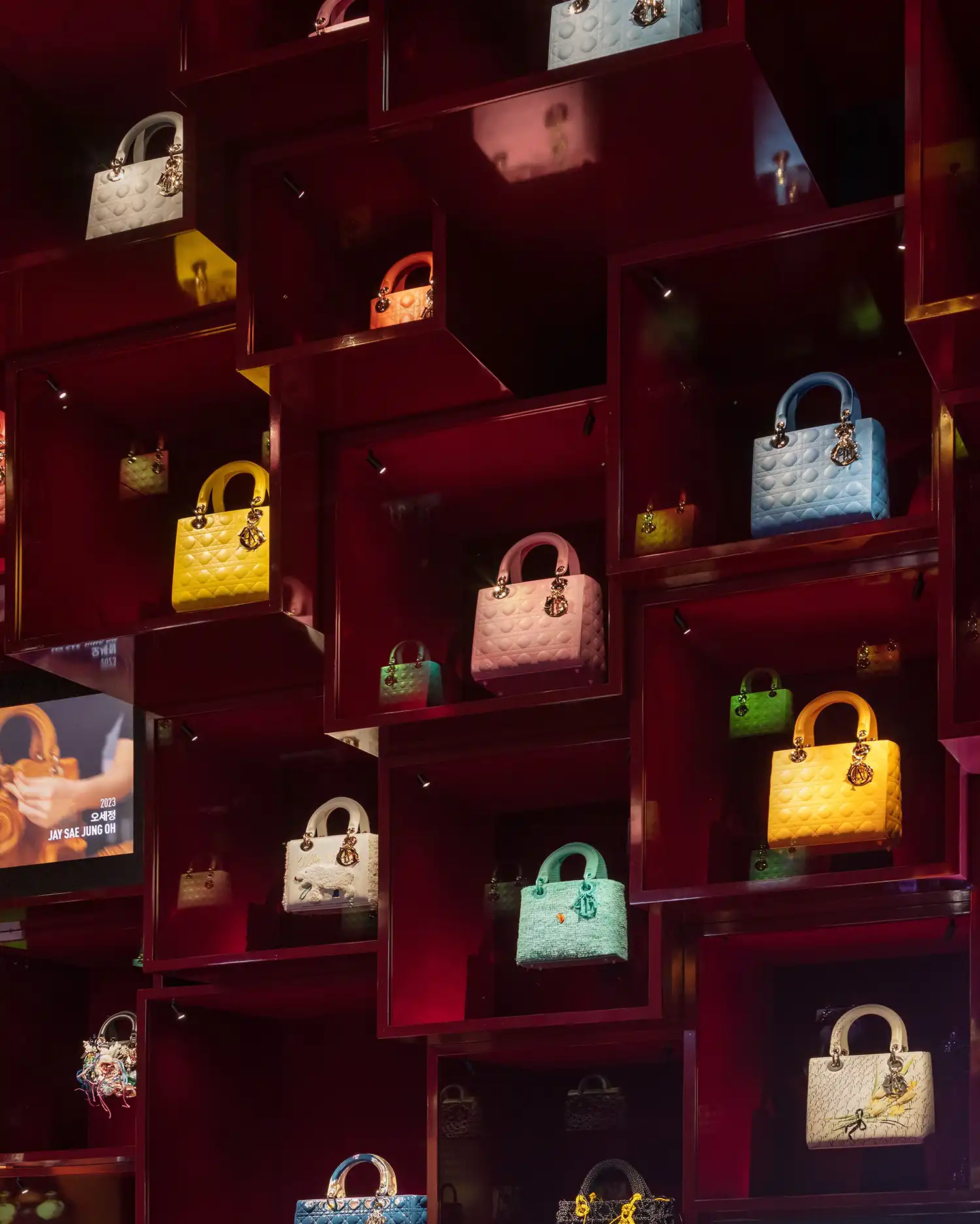
Korean cultural references permeate every aspect of the scenography, from structural concepts to material choices. The Dior Legacy room abandons conventional timelines in favor of a single, continuous ribbon crafted using jogakbo, the traditional Korean patchwork technique, its flowing form creating niches for each creative director while emphasizing the uninterrupted thread of Dior’s evolution. Nearby, the Lady Dior installation reimagines traditional red lacquerware cabinetry as a modular, three-dimensional display system housing contemporary Korean artists’ interpretations of the iconic bag.
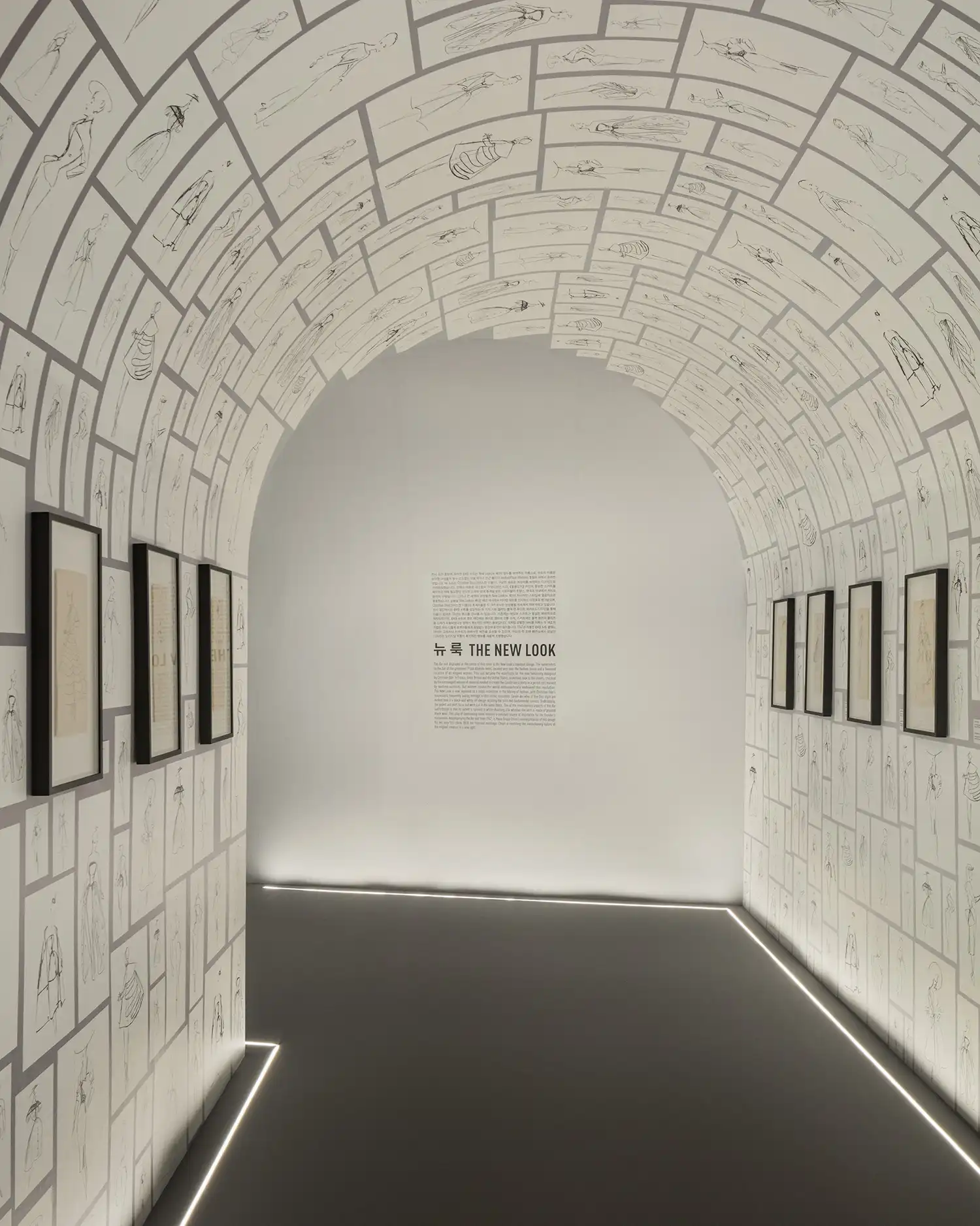
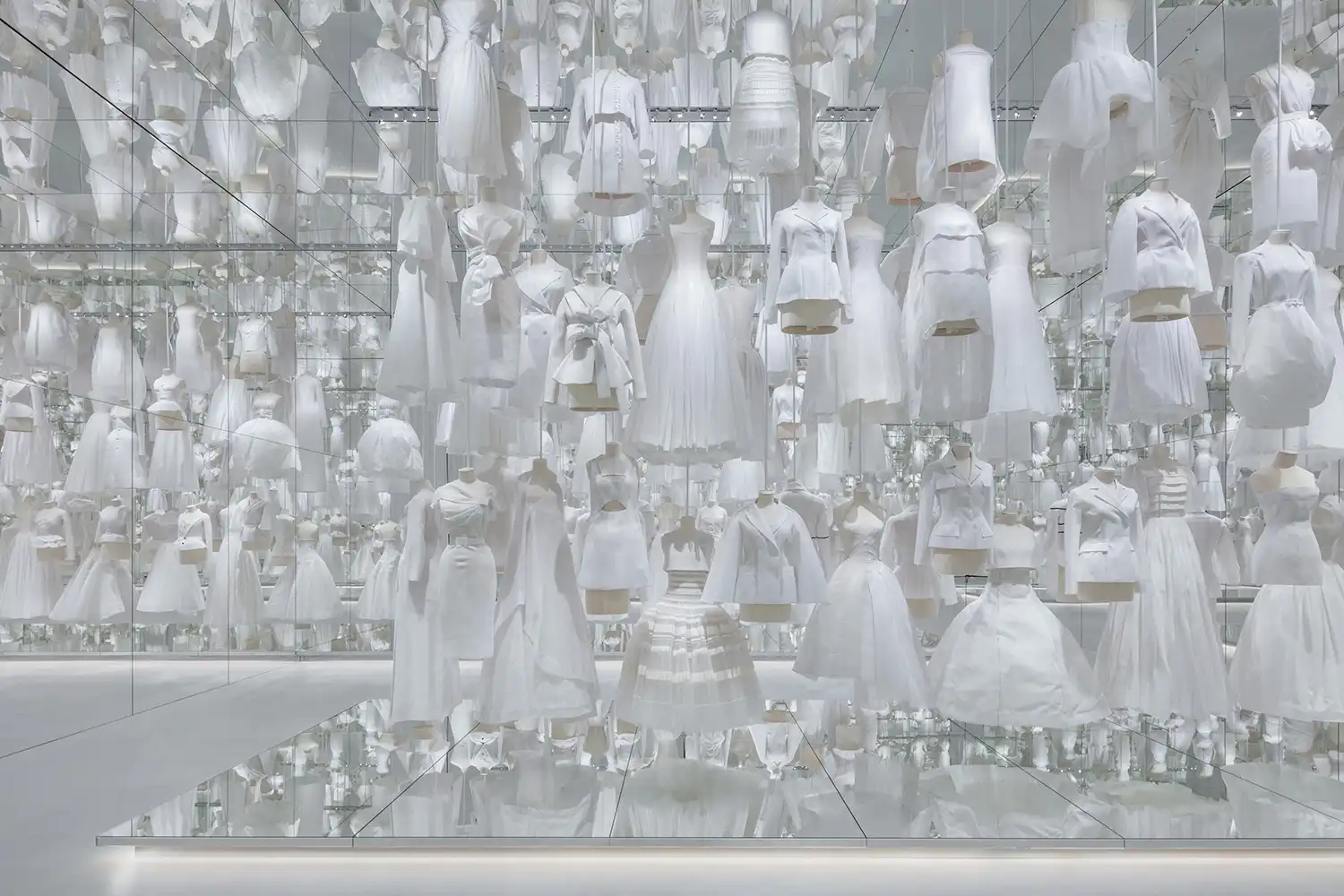
Material innovation creates unexpected dialogues throughout the exhibition. In The Dior Ateliers, the brand’s signature white toiles—typically displayed flat against walls—hang suspended from the ceiling, their translucent forms multiplied to infinity by mirrored surfaces that transform the space into an endless landscape of garment prototypes. The Colorama room abandons linear color progression for a circular spectrum, with mirrored louvers reflecting garments and artifacts to reveal hidden chromatic relationships. Even the classic New Look silhouette finds architectural expression through an 8-meter-tall curved metal structure that mimics the drape of Dior’s revolutionary corolle skirt.

Contemporary interventions punctuate the historical narrative. A surreal, twisting staircase in The Dior Ball room distorts the proportions of 30 Avenue Montaigne’s famous stairway, displaying gowns in midair alongside a kinetic sculpture by artist Soo Sunny Park. The J’Adore installation elevates fragrance to architectural scale with a gilded hall of mirrors reflecting endless iterations of perfume bottles, while Stars in Dior suspends celebrity-worn garments beneath a constellation of illuminated metal cables that dissolve solid surfaces into pure light.
What emerges is not merely a fashion retrospective but a living conversation between disciplines and cultures. By embedding Korean craftsmanship techniques into display structures and reinterpreting Dior’s legacy through local materials and spatial concepts, OMA has created an exhibition that feels simultaneously timeless and urgently contemporary—a testament to fashion’s enduring power to bridge histories and geographies through the alchemy of design.