

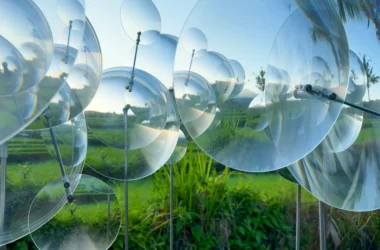

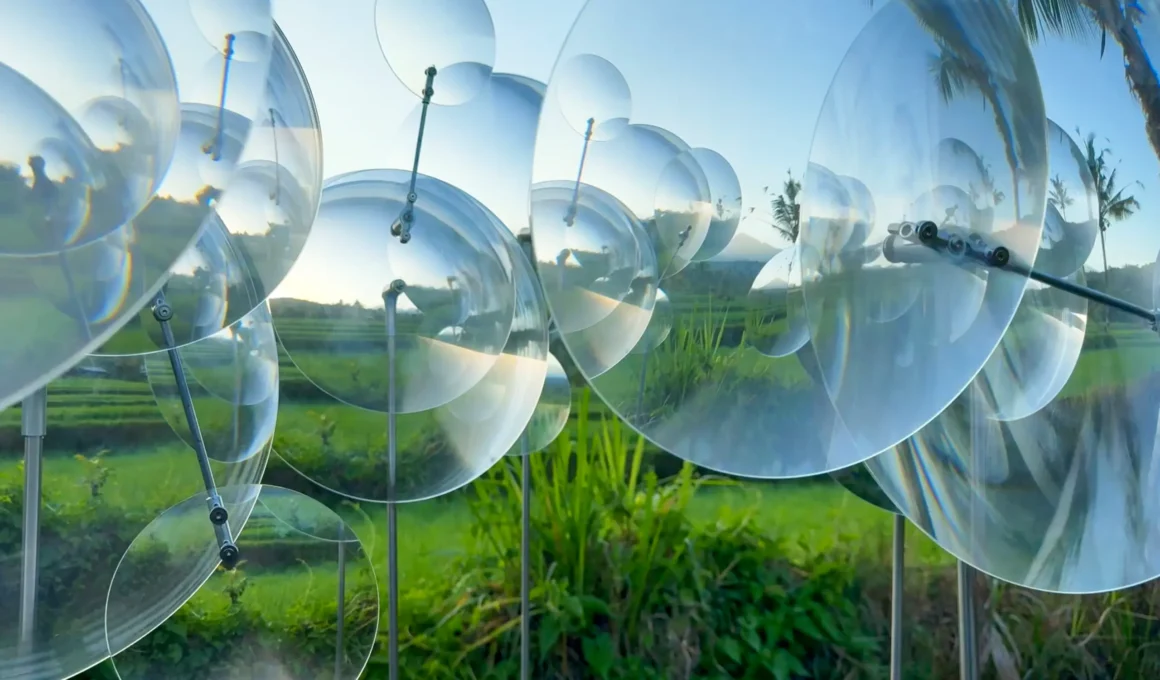
Every lens in Eccentric Lenses turns around an axis that is not its own center, which is why the work can never show the same landscape twice. French artist Vincent Leroy has installed the kinetic sculpture in the hills of Munduk, in northern Bali, where a constellation of Fresnel lenses stands against the mountains and rice fields and moves only when the air does. Nothing about the piece resets, which means no visitor sees the version anyone else saw.
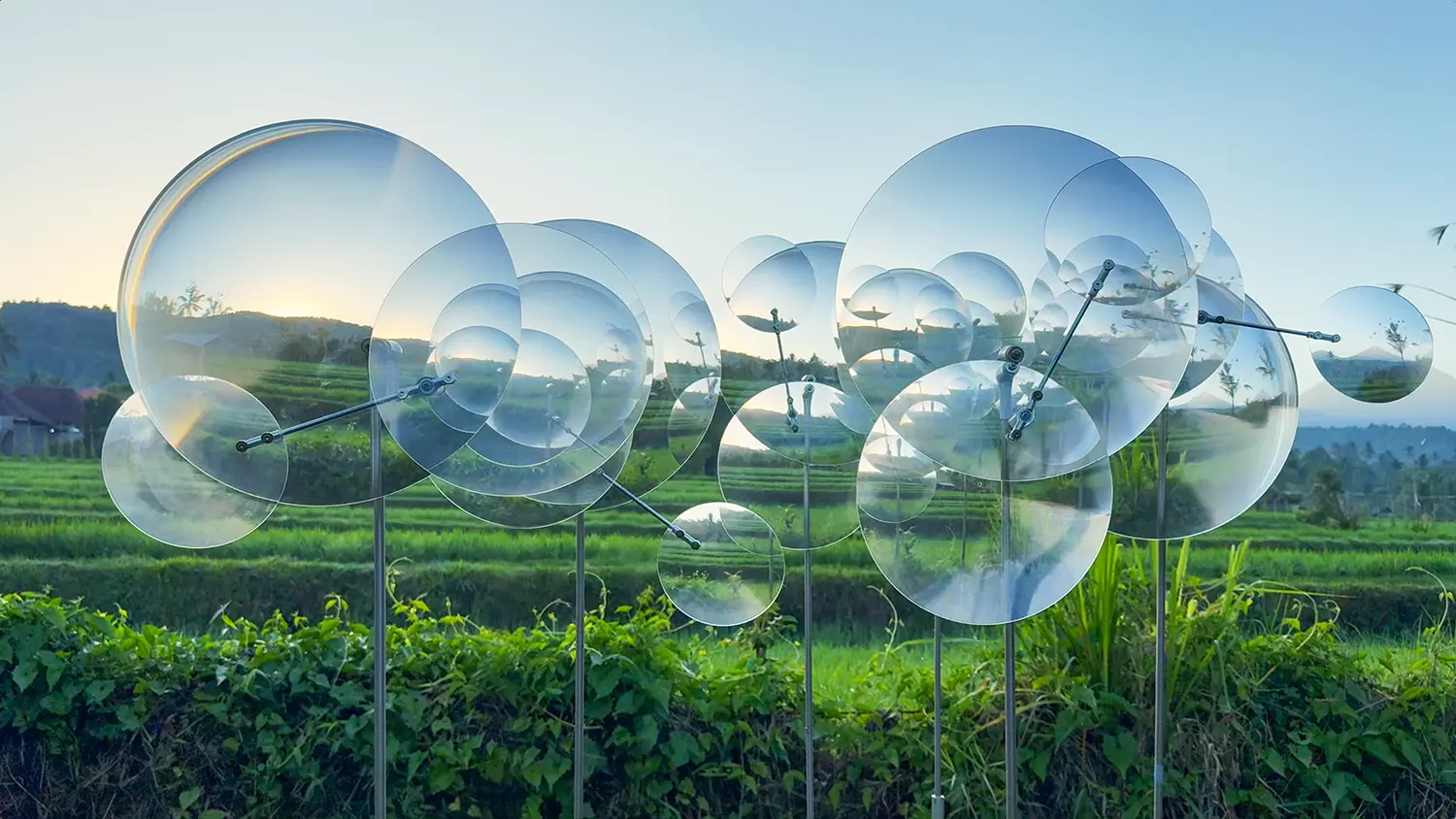
Off-center by design, each element rotates around a displaced axis, following an eccentric trajectory that makes the motion read as a slow drift through space rather than a mechanical turn. A lens spinning on center returns to where it started and repeats itself; a lens spinning off-center never quite closes the circle. According to the artist’s statement, the mobile is “never entirely still and never repeats the same configuration.” The wind-activated kinetic sculpture has no loop because its geometry does not allow one.
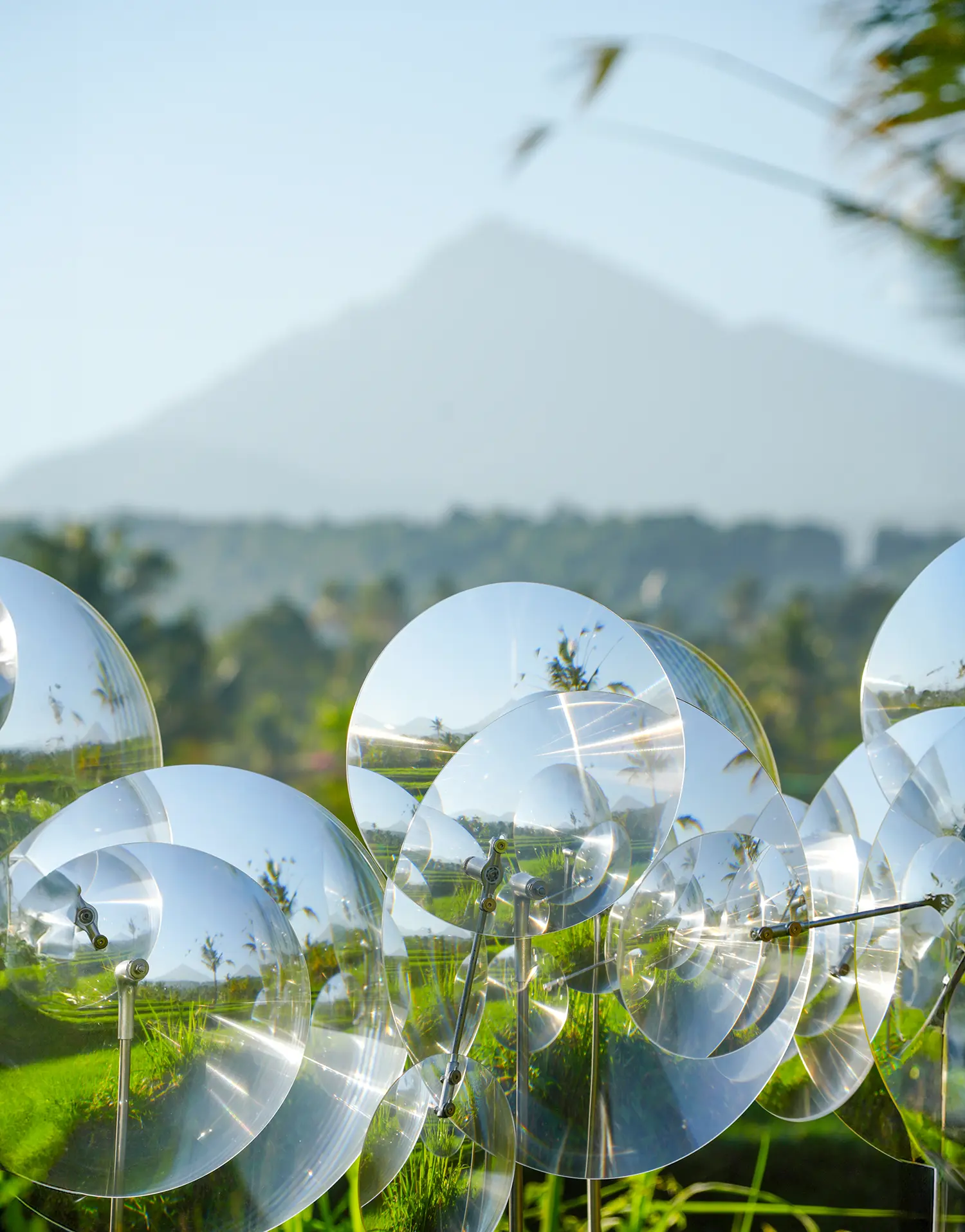
What the lenses return is the valley, taken apart. Mountains, rice fields, trees and sky are inverted, fragmented and pulled into unexpected proximity, so that what reads as stable beyond the sculpture turns fluid the moment it passes through. Distant ridgelines arrive in the same frame as nearby foliage, brought into proximity by nothing but curvature.
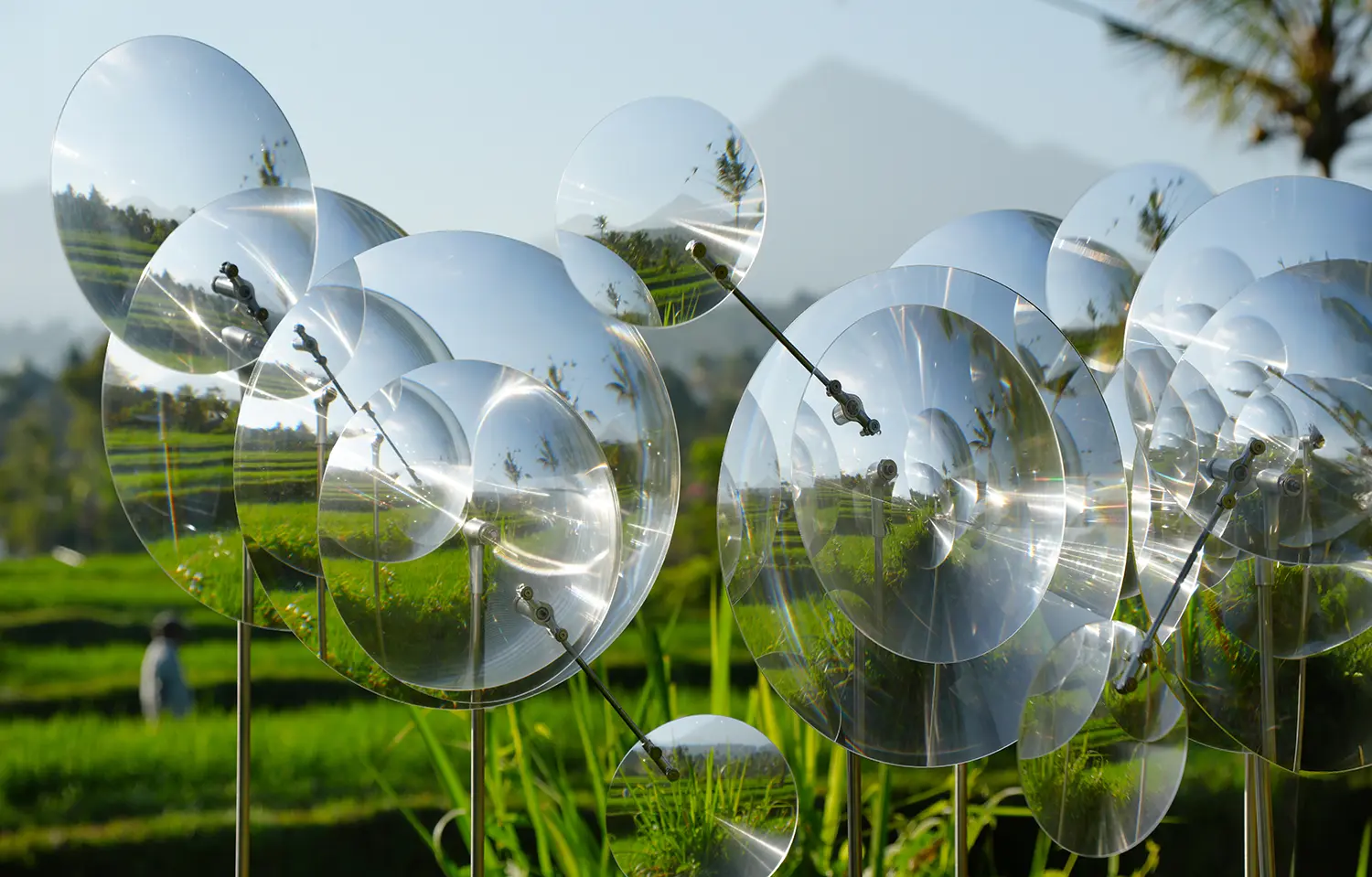
Wind as the mechanism leaves the piece without a score or a sequence, only the local air. The artist’s statement describes the wind as “an invisible collaborator,” continuously activating the sculpture and reshaping how the surroundings are perceived. That hands every individual composition to conditions no one in the studio controls, and ties the rhythm of the work to the weather of a specific ridge on a specific afternoon.
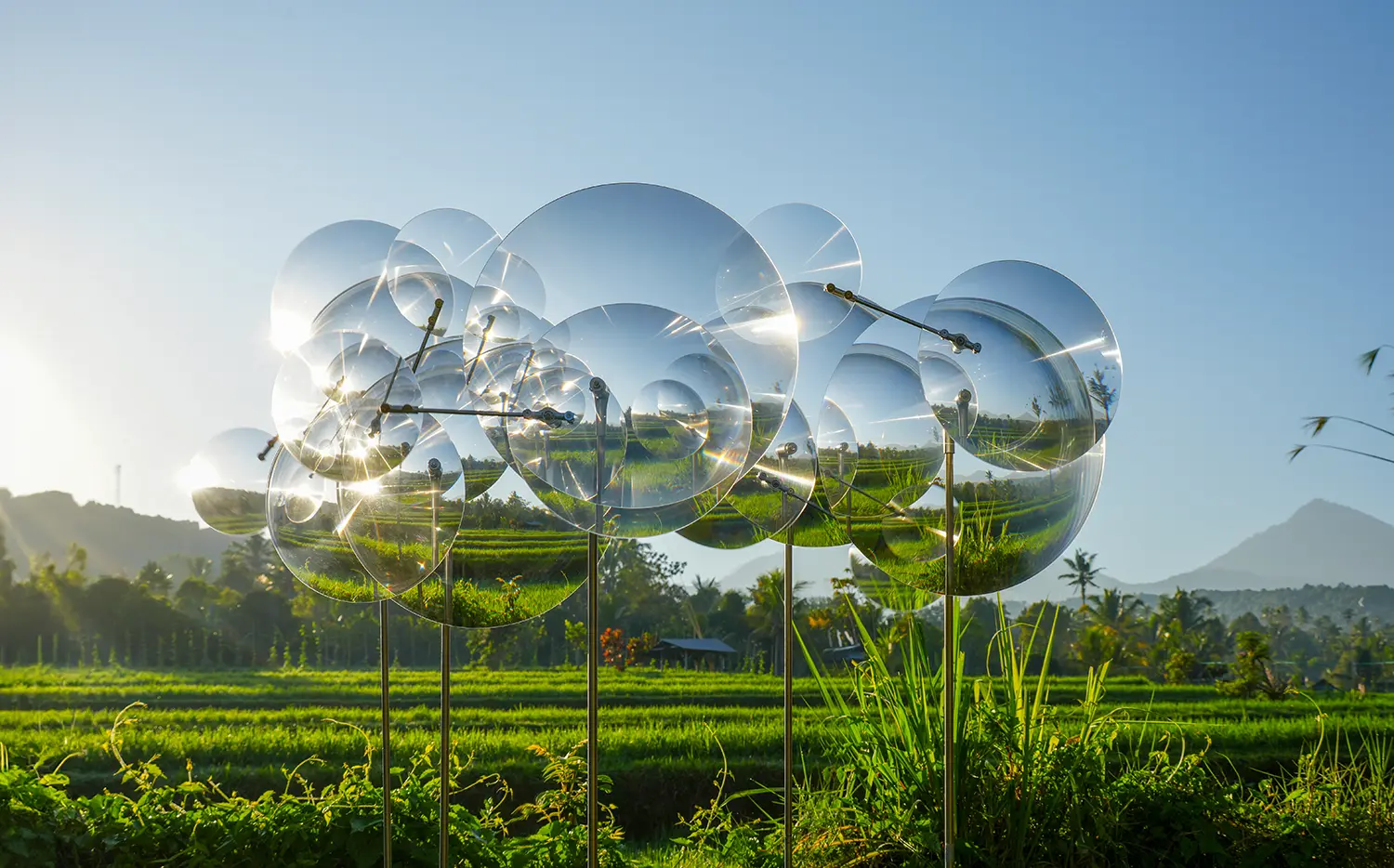
Three meters of hardware hold the entire constellation: the mobile measures 3 x 1 x 1.9 m (9.8 x 3.3 x 6.2 ft), built from aluminium, carbon fiber and 3D-printed parts. It is a small object set against a valley that runs to the horizon, which works because a lens only has to be near the eye to take over the view. Moving one step to either side of the optical art installation swaps which peak lands in which lens and at what angle. There is no correct vantage point, and no complete one.
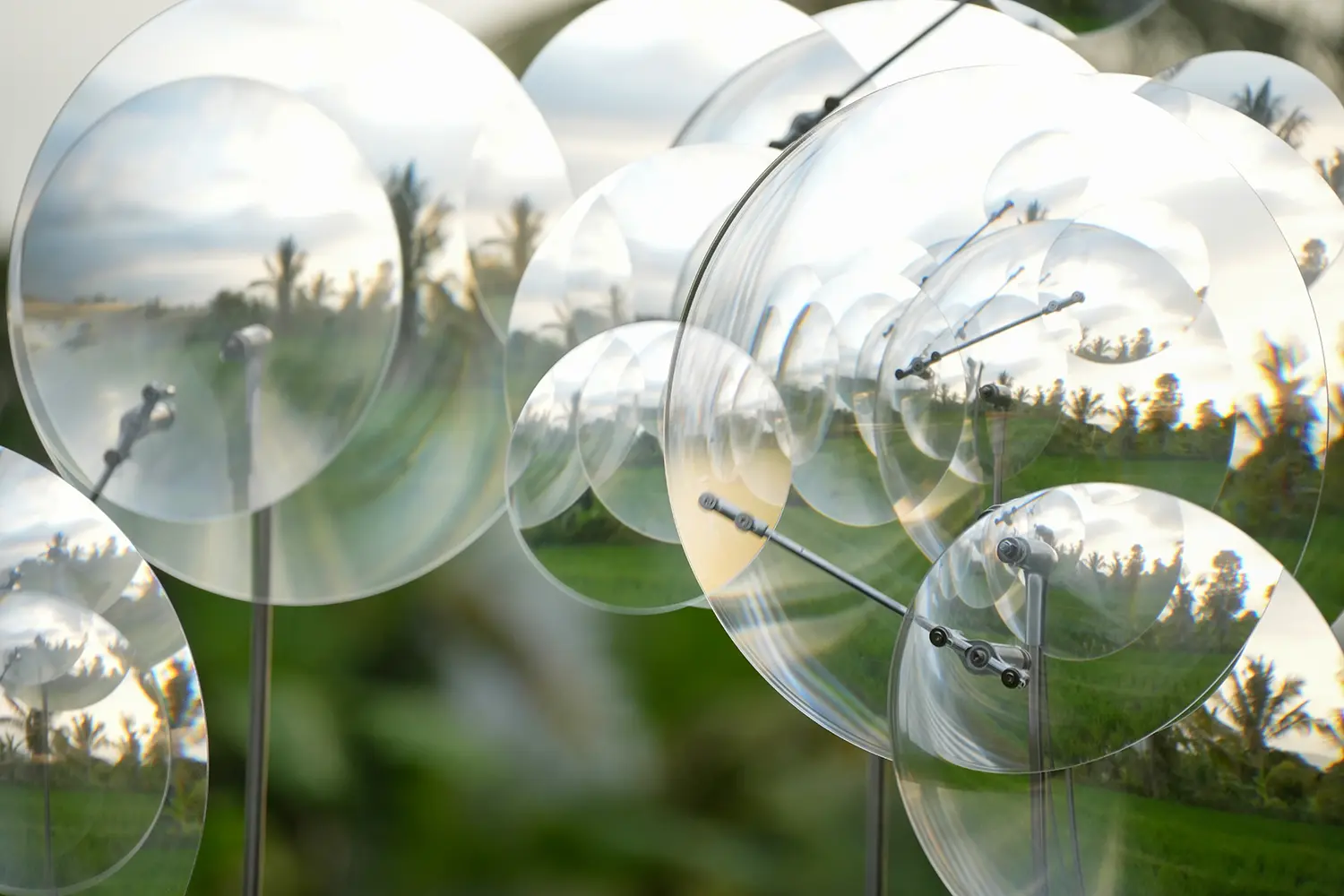
Munduk as the site matters more than it would almost anywhere else. The village sits in Buleleng Regency in the mountains of northern Bali, planted with coffee and clove and within reach of the crater lakes of Buyan and Tamblingan — an area that arrives pre-photographed, on an island that recorded more than 6.3 million foreign arrivals in 2024. An art installation in Bali that structurally cannot produce a repeatable image is an unusual thing to point at that particular horizon.
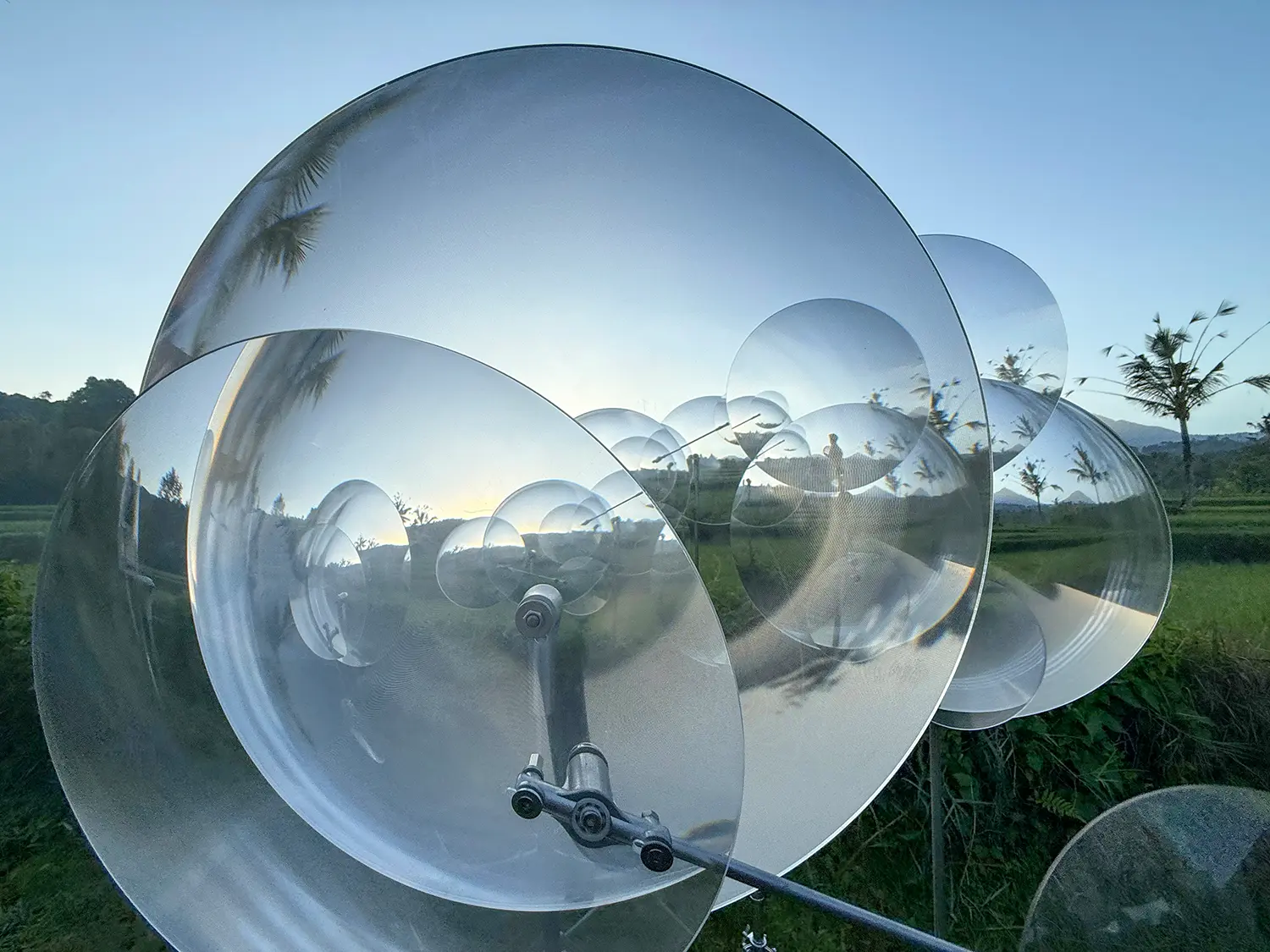
Borrowed from lighthouses, the Fresnel lens Leroy works with was designed in 1822 to throw a beam outward and give sailors a fixed point to steer by. Here the same component runs in the opposite direction, gathering the landscape instead of projecting light into it, and the fixed point is exactly what it withholds. It is a navigation instrument used to make a place harder to locate.
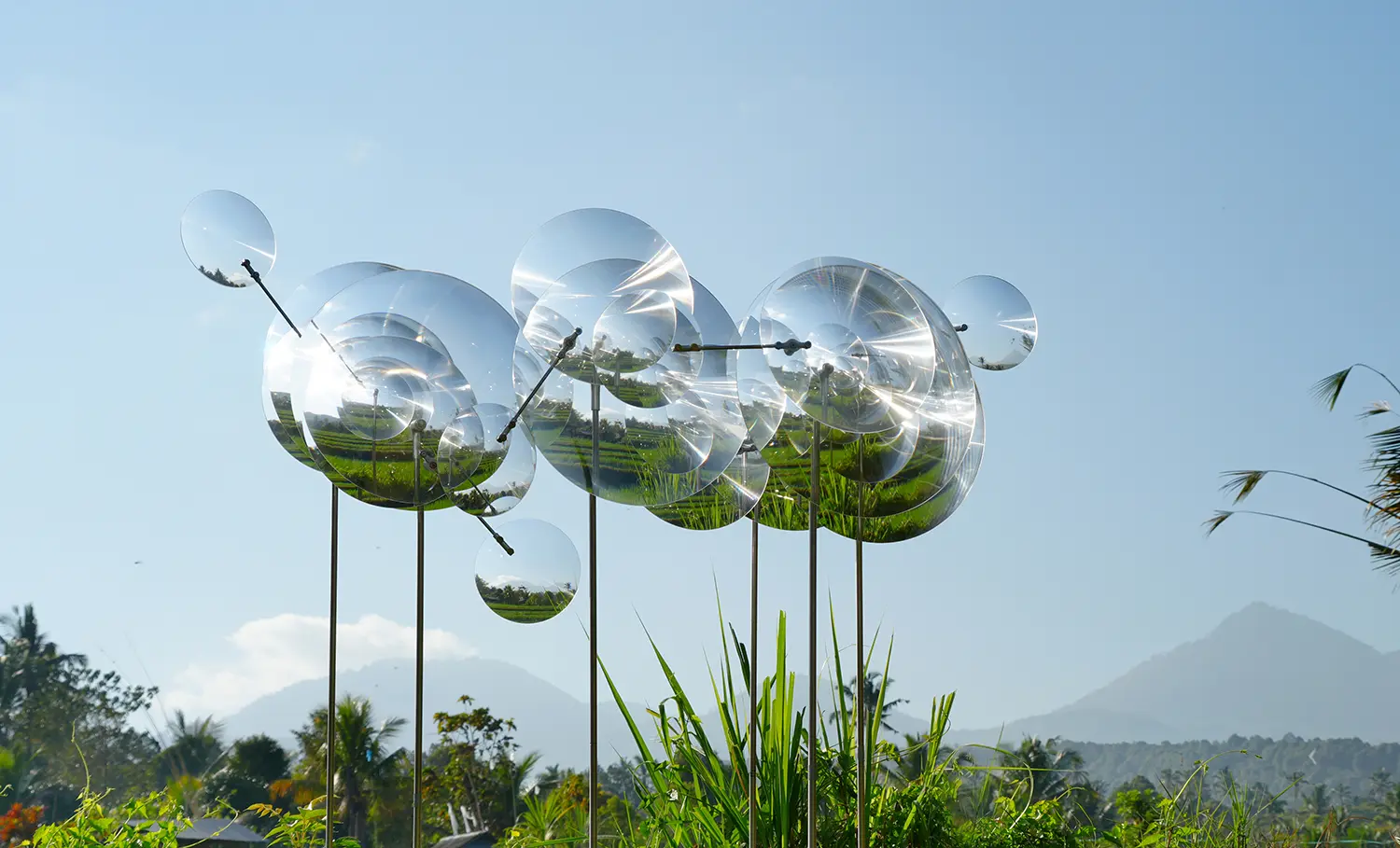
Within Leroy’s body of work, Eccentric Lenses continues a run of kinetic sculptures in natural landscapes already saturated with cameras — and it does so with the same construction vocabulary. In Cappadocia, his Floating Lenses suspended concentric Fresnel lenses on a carbon and 3D-printed frame above the valleys as the morning balloons rose, multiplying and dissolving them mid-flight. The Bali mobile adds aluminium to that carbon and 3D-printed armature, keeping the weight low enough for wind to remain the only actuator. At Sarakiniko in Greece, his Molecular Cloud did comparable work with a different material set entirely. In Bali the variable is not the material but the axis.
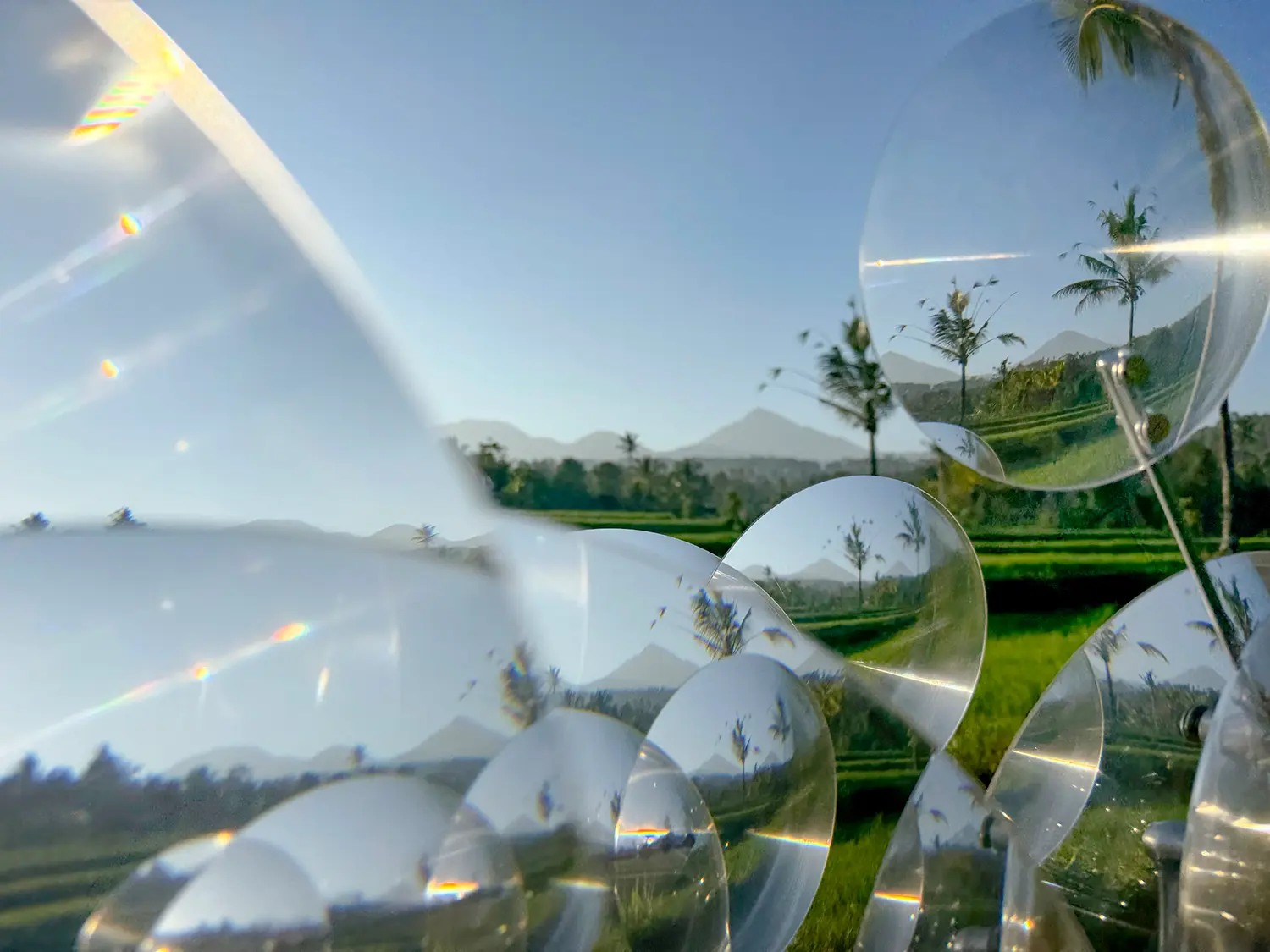
The last image in the artist’s own sequence is captioned as light rather than landscape: “the last light, scattered across the lenses.” By that point the subject has quietly changed. The earlier frames show a mountain being dismantled and reassembled one lens at a time; the closing one shows the lenses no longer dividing the valley but dividing what is left of the day, until there is nothing bright enough to rearrange.
Eccentric Lenses by Vincent Leroy | Location: Munduk, Bali, Indonesia — Year: 2026 — Key materials: Fresnel lenses, aluminium, carbon fiber, 3D-printed components