


At Resonancia, PPAA adds nothing to the plaza in front of Rafael Moneo’s City Hall in Logroño — instead, the studio extends the building’s own geometry into the empty space until the void itself becomes the architecture.Mexico City-based studio PPAA completed the installation in 2026, working directly with the alignments, rhythms and proportions already embedded in Moneo’s building rather than introducing an autonomous structure. The result reads less like an object placed in the square than a continuation of the building that already stood there.

The starting point was recognizing value in the plaza’s emptiness rather than treating it as a surface waiting to be filled. Instead of following the common tendency to intervene in public space through the addition of new objects, the project set out to reveal the spatial forces already shaping the site, understanding the void as active material rather than passive ground.

A three-dimensional grid carries that idea into built form. Like a sound that continues to travel beyond its source, the geometry of Moneo’s City Hall propagates outward into the plaza through a grid derived from the building’s own alignments and proportions, making visible a structure that was already implicit in the site.

Aluminum stakes materialize that grid as a light, permeable lattice. Rather than establishing a boundary, the aluminum lattice constructs a field of relationships: not an isolated object dropped into the square, but a minimal infrastructure capable of transforming how the plaza is experienced, altering scale, movement and the possibility of encounter.

Density varies as the lattice extends outward from City Hall toward the surrounding city, creating zones of compression and openness that invite both movement and pause. Its open condition leaves the way it’s inhabited up to each visitor — passing through it, lingering inside it, or simply watching how it shifts with the movement of people and the changing light through the day.

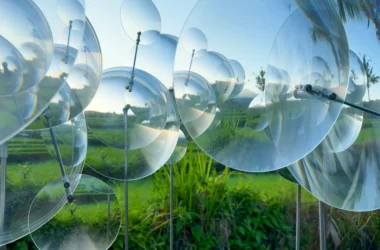
The material itself reinforces this double condition of presence and absence. Built from aluminum profiles, the structure holds a precise, recognizable form in the plaza, while its reflective surface captures light, sky and passing movement, partially dissolving its own edges. That reflectiveness folds both the plaza and Rafael Moneo’s City Hall into the work itself, continuously pulling the surrounding context into the experience.

Lightness guided the engineering as much as the concept behind PPAA‘s installation. It is a self-supporting system of modular elements, assembled without permanent fixings, built specifically so it can be dismantled without leaving a lasting trace on the square — a form of reversible architecture where nothing outlives its usefulness by staying fixed in place.

That same interest in structural lightness recurs across PPAA’s practice: in 2025, the studio suspended a 24-metre wood beam on rotating panels for Resonancia Suspendida at Mextropoli in Mexico City, another installation built around the idea that structure could disappear as easily as it appears.

The plaza stays open throughout, its geometry unchanged on paper even as its experience shifts underfoot. What Resonancia adds isn’t visible as mass or volume — it’s the presence of people moving through a grid that was always latent in Logroño, Spain, waiting for someone to trace it back into the open air.
Resonancia by PPAA | Location: Logroño, Spain — Year: 2026 — Key materials: aluminum profiles