






URWERK‘s UR-120 Blue Planet closes a model line not with a commemorative edition but with a mechanical argument: that a leave-taking can be a complication. Limited to 20 pieces, the final iteration of the UR-120 transforms the Vulcan salute — a gesture borrowed from science fiction — into a genuine horological mechanism built to 175 components and controlled to the nearest micron. The result is a watch that conflates theatrical gesture with engineering precision in a way that only URWERK consistently attempts.
The two-part case construction returns as structural principle, a design logic co-founder and artistic director Martin Frei has pursued across multiple references. Upper shell locks onto base with an invisible seam, a technique Frei traces to Gerald Genta: “Technically, it’s remarkably clever. You find that idea of a carapace, of built-in protection. The seam vanishes, the assembly becomes invisible. At that point, construction is no longer just a technical constraint, it becomes an act of design,” he said in a statement. In the Blue Planet, that logic takes its deepest expression — a sandblasted steel case whose smooth upper surface, free of visible screws, reads as the hull of a space module rather than a wrist instrument.

Calibre UR-20.01 drives the display through a system of three hour satellites orbiting a central carousel, each advancing in turn along the minute track before retiring to reset. What distinguishes the Blue Planet from its predecessors is what happens at the left-hand edge of the case: as a satellite completes its arc, its two rectangular arms split apart. The Vulcan salute materialises beneath the sapphire crystal, holds for a moment, then retracts.

The mechanical complexity behind that gesture is disproportionate to its apparent simplicity. The carousel alone comprises 175 components; the satellites counter-rotate independently to remain legible as the carousel advances; each pair of arms pivots on its own axis. A lyre-shaped spring governs the opening and closing, while Maltese crosses sequence each phase with absolute precision. Master watchmaker and co-founder Felix Baumgartner said in a statement: “The UR-120’s carousel alone comprises 175 components, while the complexity of the satellites requires us to control their interactions to the nearest micron. Energy management is delicate and intricate.”
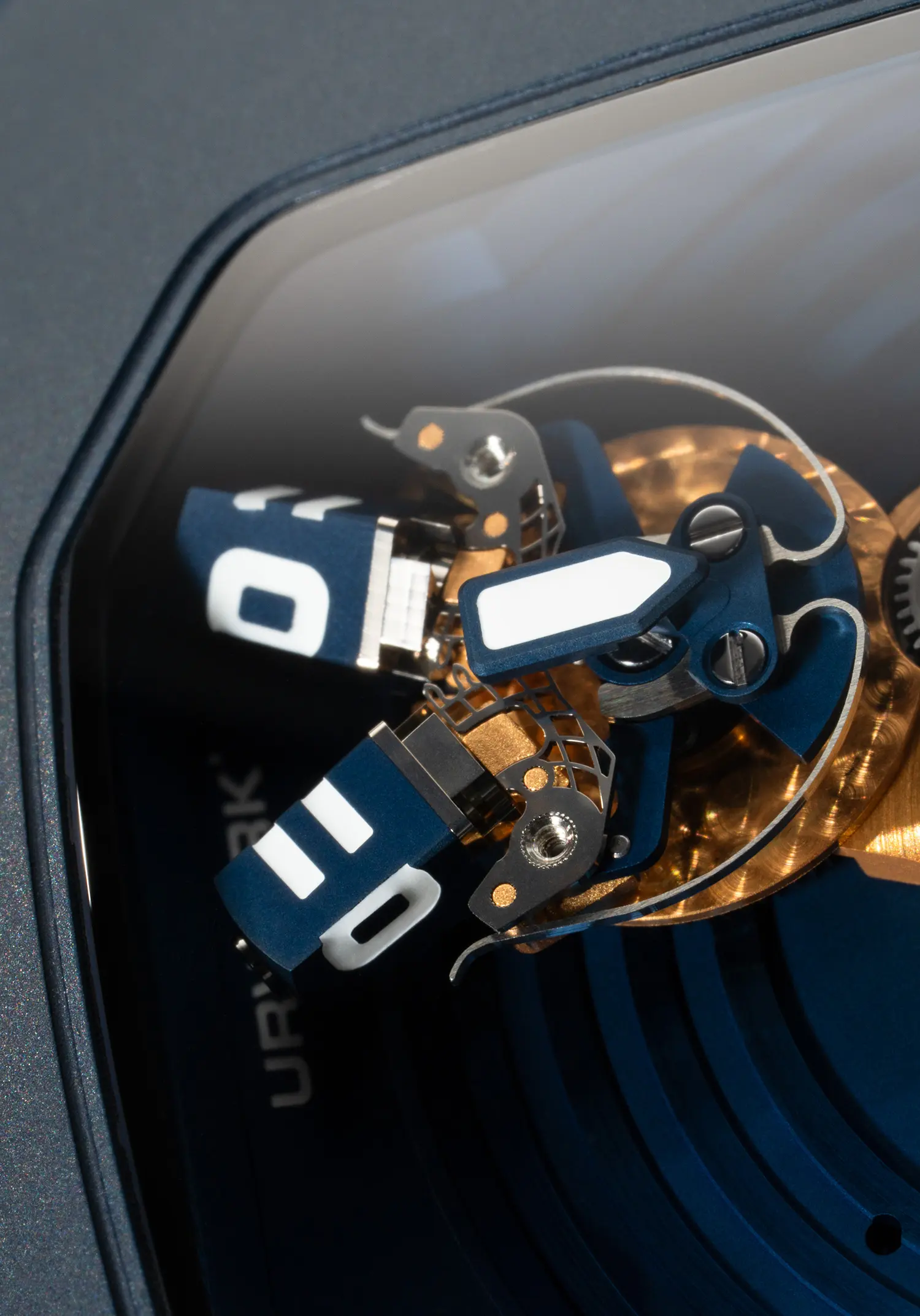
Gold as functional signal rather than ornament defines the finish. The lyre springs and Maltese crosses carry a 24K yellow-gilt PVD coating that draws the eye to the watch’s active components — the points of tension where energy is stored, released, and converted into motion. URWERK invokes the Bussard collectors of the USS Enterprise’s warp engines as a reference, and for once the science fiction analogy earns its place: the gilded elements read as concentrations of force rather than as decoration applied after the fact.

At 47mm wide and 15.8mm thick, the Blue Planet occupies wrist space with the deliberateness of an instrument. The domed anti-reflective sapphire crystal draws the eye into the display while articulated lugs — a rare feature in URWERK’s catalogue — extend the case with seamless continuity. A concealed spring within the 6 o’clock lug calibrates the fit on the wrist, an ergonomic refinement that sits appropriately alongside a CHF 115,000 (approx. €124,600 / $143,700) price point and a production run of 20 pieces.
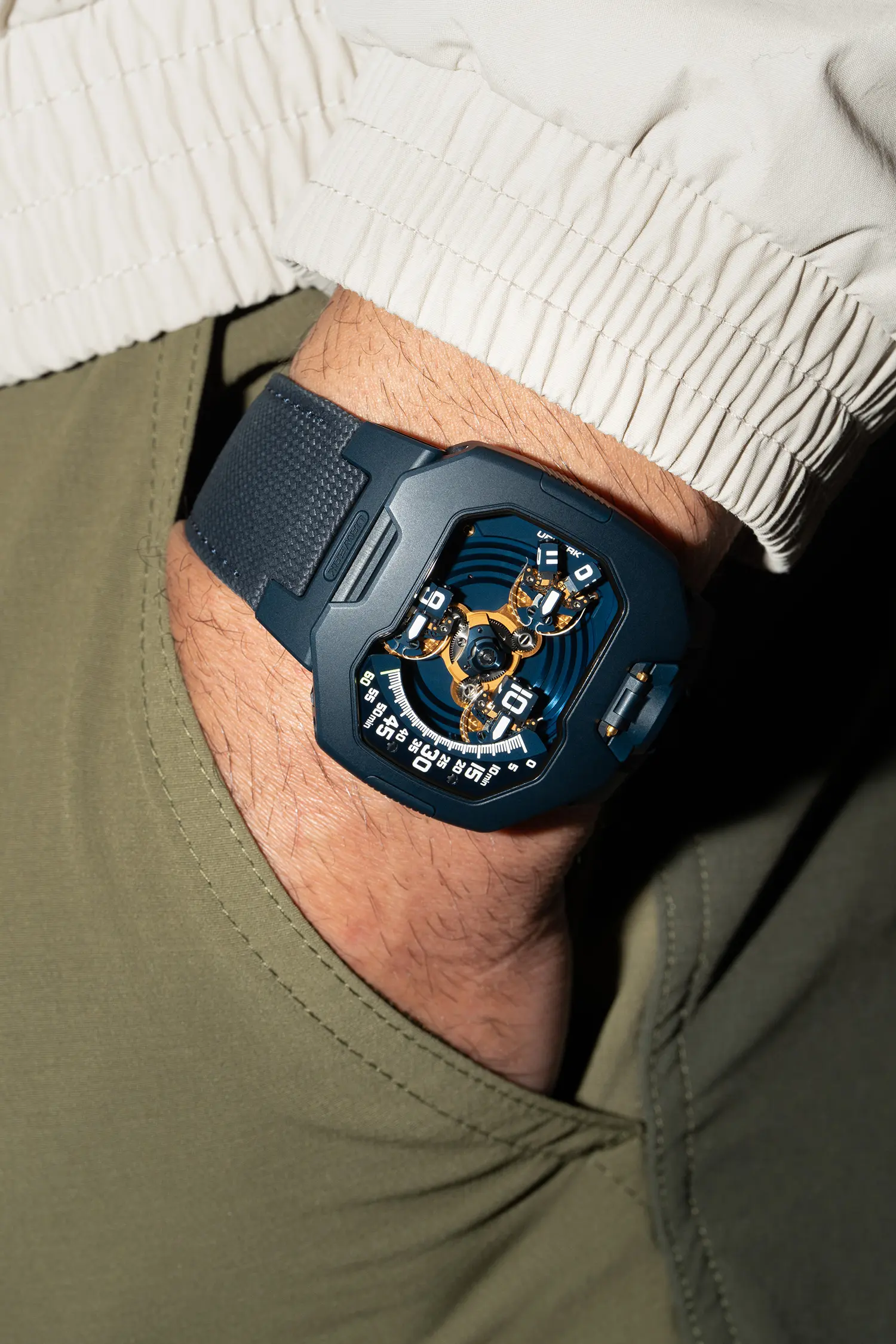
The space metaphor that runs through URWERK’s entire satellite watch collection is most explicit here, and the Blue Planet earns it more honestly than most. Where the UR-230 Black Star pushed into darkness, the UR-120 Blue Planet claims the opposite register — a deep, almost liquid blue of Earth seen from orbit — using color not as surface finish but as the atmospheric logic of the entire object. The LIGA-processed ALD-treated movement components and beryllium copper parts are not incidental material choices; they are what allows the watch to read as constructed for another atmosphere.

The closure of a model line by its originating studio — rather than through discontinuation or market pressure — is uncommon enough within independent watchmaking to register as an editorial act. URWERK frames it as a launch: the spacecraft lifts off, the hero casts off, the satellite collection continues its orbit without this particular vessel. The UR-120 does not take a bow; it soars.
The Blue Planet’s most honest quality is that its theatrical premise — the Vulcan salute as horological gesture — is not a concept applied to an existing mechanism but a mechanism engineered specifically to perform it. Most watches with cultural references carry them on the dial; URWERK built one into the movement’s kinetics. Whether that distinction justifies the complexity, the price, and the 20-piece ceiling is a question the next owner will have to answer alone, in the dark, watching the arms open.