


Unknown Architects has completed Villa Voorwerf, a large, custom-built family home near Amsterdam, that responds to the traditional Dutch architecture of the Zunderdorp landscape by breaking down its mass into two volumes and enveloping the entire structure in a subtly varied timber facade. The contemporary house, which sits within a vast, open peat polder, draws inspiration from the local ribbon development where properties often orient their yards perpendicular to the street, preserving long views over the fields—a characteristic the architects meticulously integrated into the new design.

The scale of the project necessitated a creative approach to massing. Instead of a single monolithic structure, the architects divided the brief into a pair of forms, each capped with a pronounced gable roof. The principal volume is centrally positioned, while the secondary, or rear, house is recessed, which neatly carves out a sheltered entrance courtyard. This strategy not only manages the building’s footprint but also defines an exterior threshold; the courtyard offers access to the main house and a separate guesthouse. Entering the home leads directly into a double-height hall, providing an immediate, dramatic showcase of the full vertical section of the interior.

A commitment to sustainable materials and efficient construction is evident in the choice to build the dwelling entirely from timber. The structure is prefabricated using a timber frame construction, a light-touch method that also allowed for the seamless integration of natural flax insulation within the wall cavities. The exterior cladding pays homage to the region’s historic timber houses. The main gable end is subtly cantilevered forward from the front facade and clad in a contrasting direction, establishing a visual rhythm that acknowledges its heritage without resorting to pastiche.

This thoughtful play with materials extends across the entire building envelope. While the exterior is uniformly clad in timber, the architects employed diverse rhythms and orientations to achieve richness and depth. Horizontal planks alternate with timber ribs on the roof and side walls, creating subtle nuances through shadow lines. The inclusion of shutters and vertical accents further contributes to a layered appearance, resulting in a rich simplicity intended to be enjoyed for generations while firmly establishing the house within its rural Netherlands setting.

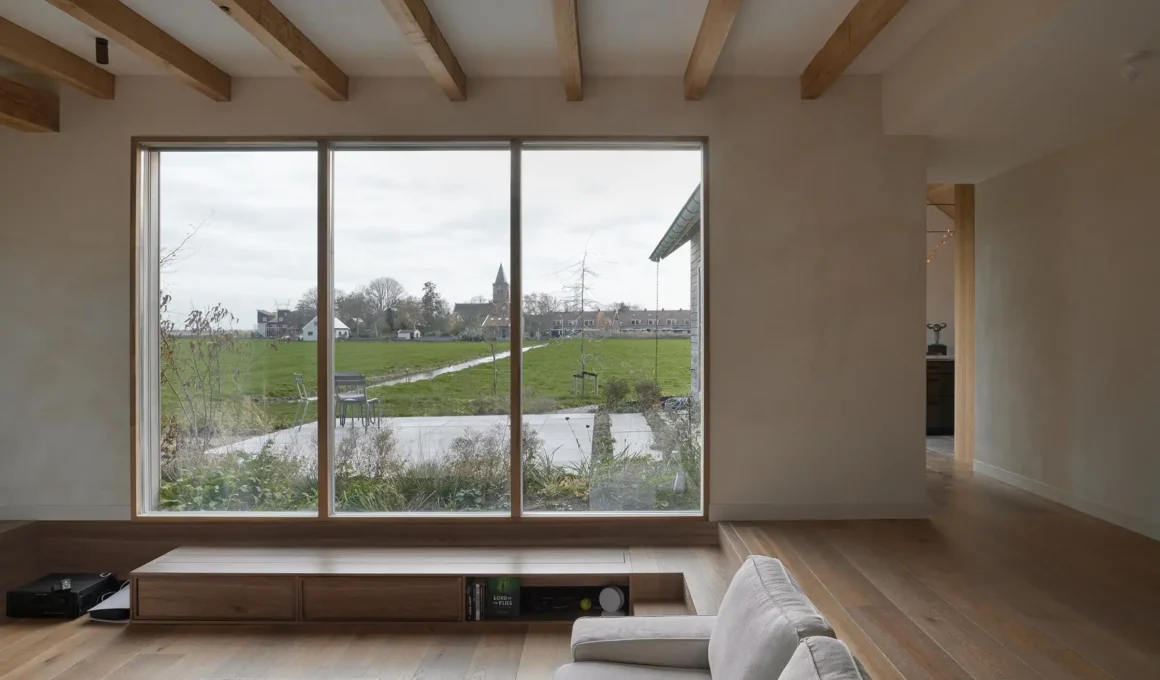
Inside, the plan consciously deviates from the standard configuration of isolated rooms and corridors. The main house is arranged as a collection of interconnected living spaces—including home offices, a tv-room, a dining room, and a living room—that seamlessly wrap around a central service core containing the staircase and utilities. This innovative interior design eliminates traditional hallways, encouraging a constant and flowing circulation path throughout the ground floor, enhancing the sense of movement and connection within the architecture.

The circulation is further emphasised by the structure’s exposed elements. Exposed timber beams are a defining feature of the interior, changing their character from room to room to signify a ‘journey’ through the dwelling. However, the most important communal space, the kitchen, is strategically segregated from this continuous loop and situated in the rear volume. This positioning grants the kitchen the best of both worlds: it can be fully opened up to the immediate garden while simultaneously providing expansive, framed views across the sweeping peat polder and back towards the village of Zunderdorp.