



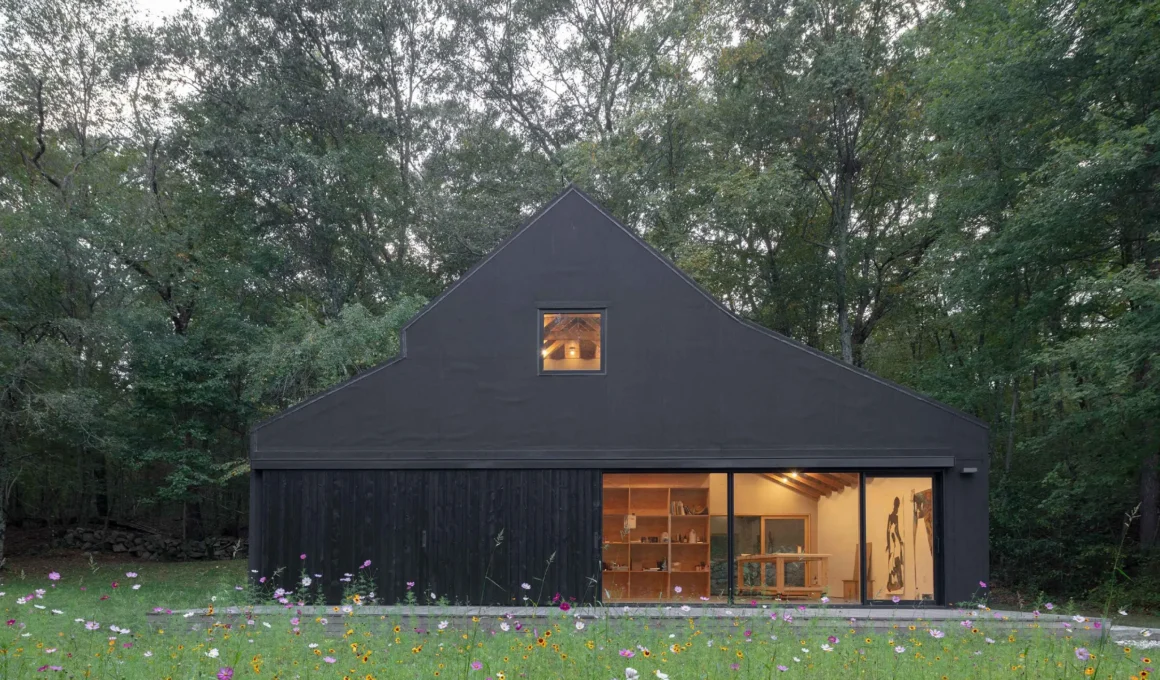
Nestled within a secluded, private, wooded site in Rhode Island, protected by rocky outcroppings and natural wetlands, sits the Studio Barn, a remarkable transformation of a modest 1980s stable into a highly functional art-making space. Conceived by Brooklyn-based architecture firm Worrell Yeung, this project for a renowned artist couple is a masterclass in adaptive reuse and material reinvention, demonstrating that architectural merit can be forged from the most unremarkable starting points. Separated from the main residence, the studio sits thoughtfully between the dense woods and a sunlit clearing, creating a purposeful, meditative walk for the residents through a meadow surrounding a natural vernal pool—a perfect transition into the creative retreat.

The original stable was an uninsulated, architecturally non-meritorious shell, yet it provided Max Worrell and Jejon Yeung with a compelling challenge: to creatively reinvent the structure through new openings and inventive materials. The firm’s initial, decisive move was a radical simplification of the form. They stripped away the eaves, trim, and cupola, honing the building down to an abstract shape and enhancing its silhouette against the landscape. As Max Worrell, co-founder and principal, noted, the architects eventually “came to love the odd profile of the barn, with its asymmetrical gable,” embracing the peculiar nature of its form after the strategic removal and addition of elements. This design philosophy speaks to a deep, conceptual engagement with architectural volume and form.

A central requirement for the artist clients was the capture of maximum diffuse natural daylight. Worrell Yeung expertly achieved this with a dramatic, 17-foot wall of glazing facing east on the main level. This massive opening can be secured when not in use by a sliding shutter barn door, a subtle nod to the site’s agricultural vernacular design. To harness essential northern light, a new dormer was inserted at the rear of the structure, simultaneously creating a striking double-height interior space with a 21-foot tall work surface, perfectly accommodating large-scale art creation.

Perhaps the most striking architectural design move is the exterior cladding. From a distance, the Studio Barn appears monolithically black, suggesting a simple stain or paint. However, closer inspection reveals a more sophisticated and cost-effective material strategy: a conventional, commercial-grade asphalt roofing material has been expertly wrapped around both the roof and walls. This unconventional choice creates a textural, almost skin-like effect that unifies the entire volume and shifts appearance dramatically depending on the weather and time of day. While the owners initially had reservations, Jejon Yeung stated they embraced the material’s association with “dilapidated sheds,” successfully subverting its conventional application into a refined modern architectural statement.

Inside, the under-1,300-square-foot floor plan is straightforward and highly functional, designed entirely around the creative process. The ground level maintains an open plan, with core utilities like a sink and water closet centralized. Storage is seamlessly integrated via a custom-built wall of Douglas Fir cabinets opposite the glazed facade, containing all necessary art supplies. The walls themselves are finished in practical materials—plaster for drawings and unfinished Homasote, a fibreboard valued for its acoustic qualities and resilience to pin-ups—underscoring a utilitarian aesthetic. Simple porcelain light sockets, evenly spaced, belie the complicated, seamless execution of the design.

An open stair at the center leads up to a loft, which functions as a part-time office and additional work zone. In its entirety, the Worrell Yeung Studio Barn project is an inspiring case study in transformation. By inventively deploying quotidian, economical materials and streamlining the design language, the firm has delivered a wholly original and light-filled studio out of the shell of an unremarkable building, providing a singular and focused Rhode Island retreat for its artist occupants.