



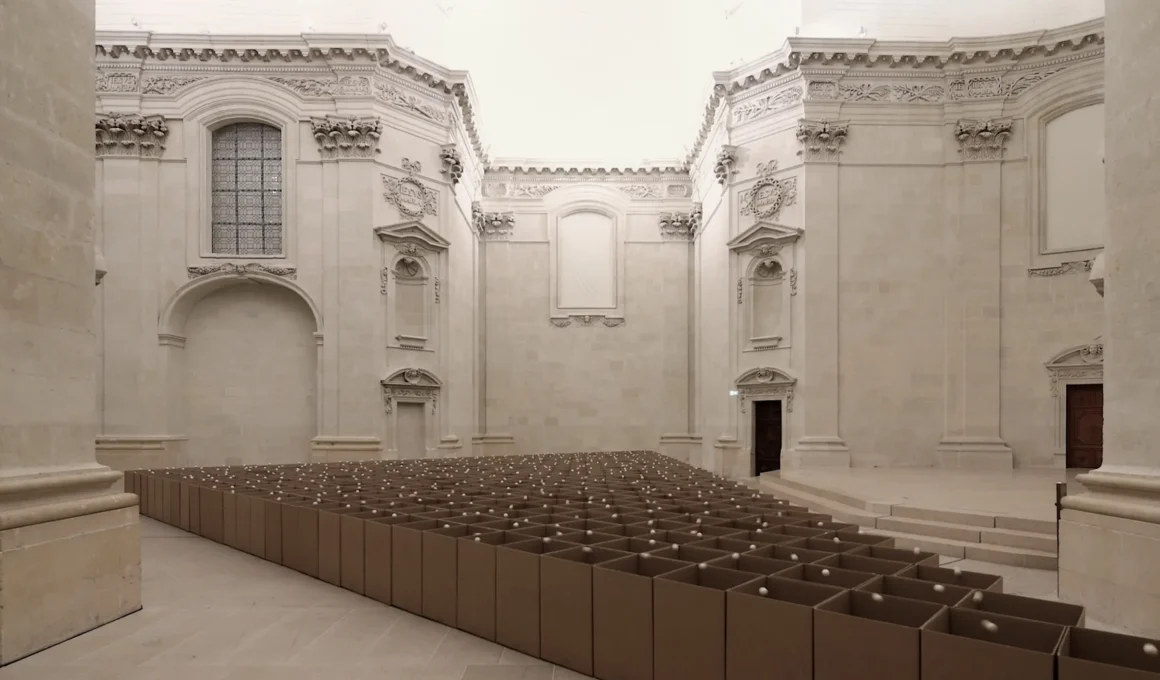
The enigmatic title, «528 prepared dc-motors, cotton balls, cardboard boxes 40x40x60 cm, 2025 (prototype)», reads like a construction manifest, yet it describes the powerful, site-specific installation recently unveiled by Studio Zimoun in France. Taking over the expansive chapel space at the Musée d’Arts de Nantes, the work transforms the historic architecture into an immersive, pulsating environment, merging technology with minimalist design.
Zimoun’s practice is rooted in translating industrial components into organic, large-scale sonic architecture. Here, the artist employs precisely 528 prepared dc-motors, setting them into a grid-like structure of cardboard boxes. The familiar, disposable nature of the cardboard boxes and cotton balls is instantly recognizable, yet their monumental deployment achieves a stunning visual and textural shift, challenging our perception of everyday materials.

These hundreds of units operate in concert, creating a pervasive three-dimensional soundscape. Each small motor is connected to a cotton ball, which in turn performs a subtle, repetitive action—scratching, vibrating, and colliding with the inner surface of its container. This orchestrated movement turns the chapel into a colossal resonator, proving that the most profound kinetic and sonic effects can be generated using the simplest of mechanical parts. It is a defining piece of modern Kinetic Art.

The conceptual framework guiding the installation is what Zimoun terms ‘primitive complexity.’ Despite the simple mechanical logic—the raw iteration of the motors—the resulting acoustic and visual field is intensely complex and layered. This repetition is a commentary on modern life itself, exploring uncomfortable themes related to automated processes, industrialization, and the pervasive advance of global robotization, offering a critical lens on our increasingly mechanized world.

The atmosphere inside the installation is condensed and hypnotic. Viewers are invited to stand amidst the relentless, persistent action, making them acutely aware of both the visual flicker and the shifting density of the sound. It’s a powerful sensory experience that transcends simple sound art installation, offering a meditative, almost psychedelic quality that belies the simplicity of the components, using low-tech means to achieve high-impact spatial design.

Furthermore, the work aligns with a strong commitment to environmental responsibility. Built predominantly from humble, recycled materials, the large-scale installation is designed to produce practically no waste. After the exhibition concludes in March 2026, all elements will be repurposed, either integrated into future artworks or returned to other contexts, emphasizing a sustainable methodology that should be standard practice in contemporary art and design.