

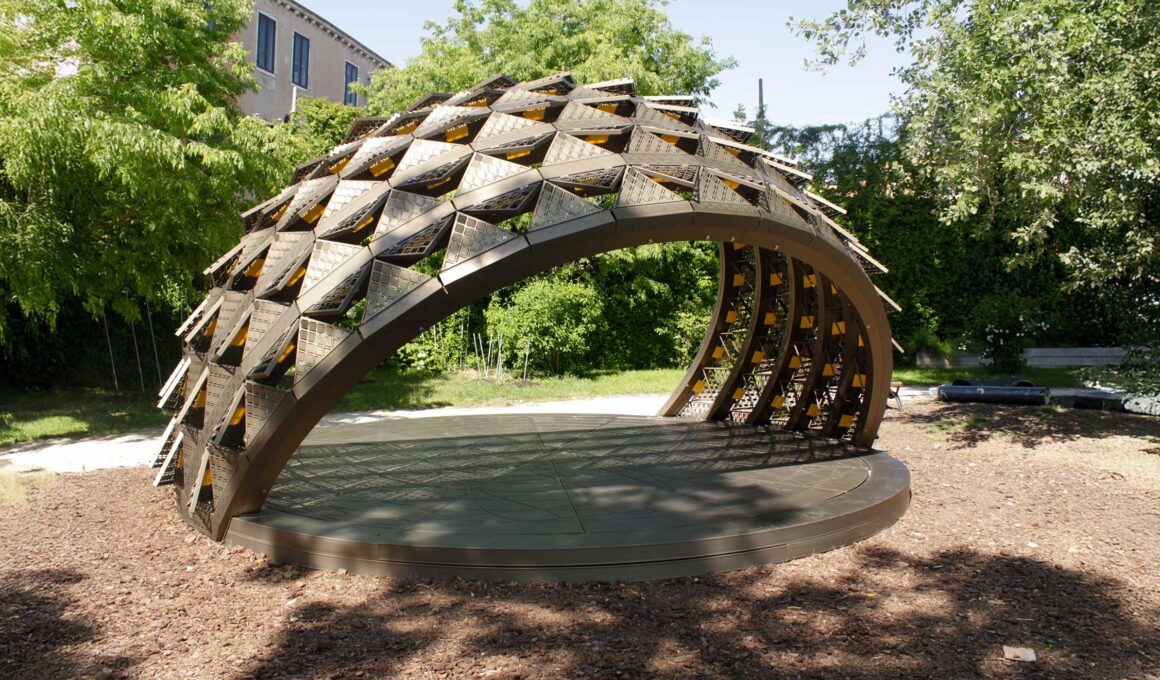
In a bold fusion of sustainable architecture, kinetic design, and passive technology, MVRDV’s SOMBRA Pavilion has emerged as a standout installation at the Venice Architecture Biennale 2025. Unveiled as part of the Time Space Existence exhibition, this innovative structure redefines the relationship between built environments and natural forces, operating entirely without electronics or motors.

Inspired by heliodon devices—tools used to simulate the sun’s path—the pavilion’s six arched ribs are strategically angled to correspond with the summer and winter solstices. Crafted from reused metal beams, these ribs support triangular panels made of perforated screens by Metadecor, which cast a dappled shade reminiscent of sunlight filtering through leaves.

What sets SOMBRA apart is its self-regulating shading system: hinged panels open and close in response to sunlight, driven by air pressure canisters hidden within the structure. When heated, the canisters inflate airbags that act like artificial muscles, gently pulling the panels shut—a marvel of soft robotics and zero-carbon technology.

“This is architecture that breathes,” says MVRDV partner Bertrand Schippan, comparing the pavilion’s movements to a living organism. “It’s about creating buildings that respond to their environment as organically as plants do.”

Beyond its technical ingenuity, SOMBRA is a poetic celebration of humanity’s universal connection to the sun. The circular floor is engraved with a polar sun path chart, while the arches bear the words “sun and shade” in over 200 languages—a nod to the pavilion’s name, a portmanteau of the Latin sol(sun) and umbra (shade).

Developed in collaboration with Airshade Technologies, Alumet, and research institutes like AMOLF, the pavilion is a testament to the potential of passive solar design. After its debut in Venice’s Giardini Marinaressa, SOMBRA is slated to tour globally, offering a scalable model for climate-responsive architecture.
For those eager to witness this kinetic pavilion in action, it will remain on display until late autumn. Visit timespaceexistence.com/events for updates on its journey—and prepare to rethink how buildings might one day dance with the elements.