


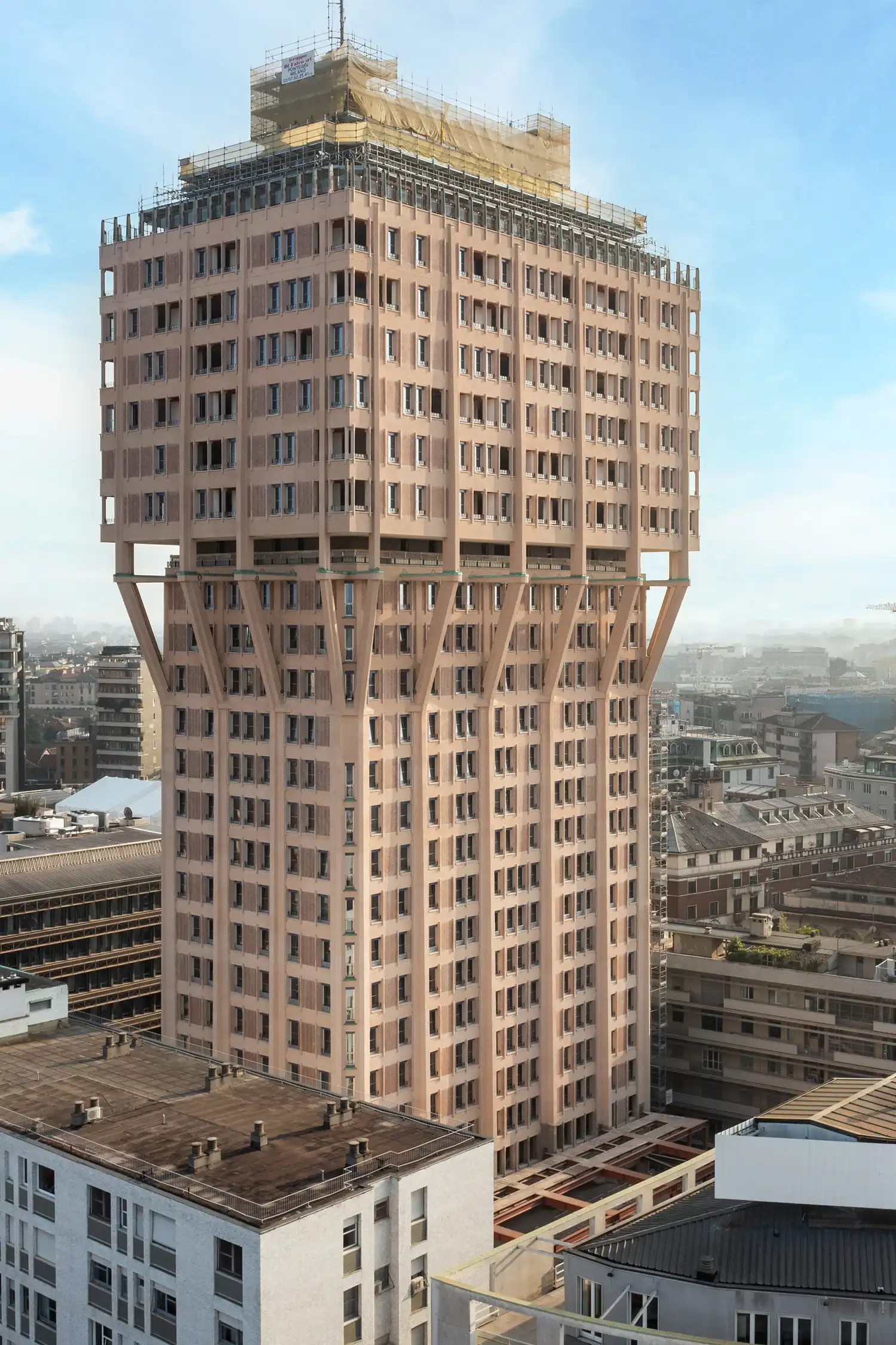
Once labeled one of the ugliest buildings in the world, Milan’s Torre Velasca has long been a polarizing landmark. Yet, with its recent restoration led by the original architectural firm BBPR, the brutalist skyscraper has re-emerged as a striking testament to mid-century modernism. The project, completed after years of meticulous craftsmanship, not only revives the tower’s original aesthetic but also challenges perceptions of its so-called “ugliness.”

The restoration sought to bring Torre Velasca back to its original image and color, emphasizing the raw, textured language of its brutalist façade. To achieve this, architects collaborated with Mapei to develop a custom binder—dubbed “Legante Velasca”—that replicates the tower’s historic hue while ensuring durability against high-altitude weathering. This specialized plaster not only restores authenticity but also reinforces the building’s structural resilience.

Beyond aesthetics, the project involved technical and material interventions to fortify the façade’s longevity. The process was executed with artisanal precision, employing 50–60 skilled workers daily, including laborers, foremen, and designers, from April 2021 until completion. The result is a “new skin” that honors the tower’s heritage while preparing it for future generations.
Inside, the restoration embraced the mid-century modern spirit, blending vintage elements with contemporary living. Original materials—such as handmade ceramic tiles, terrazzo flooring, and wood finishes—were carefully preserved or recreated. Offices feature period-accurate synthetic flooring, while custom-designed furniture complements retro-inspired interiors.
The design pays homage to the flexibility envisioned in the 1950s, allowing spaces to evolve with modern lifestyles. Each apartment now balances historical charm with modern functionality, proving that Torre Velasca was ahead of its time.

Spanning 29 floors (including two underground levels), the tower has been reprogrammed for contemporary use. The retail space has expanded from 500 to 3,700 square meters, while former office and technical areas have been transformed into restaurants on the 1st and 18th floors. This adaptive reuse ensures Torre Velasca remains a vibrant part of Milan’s urban fabric.
So, is it really ugly? Or was it simply misunderstood? With its restored façade and reinvented interiors, Torre Velasca stands as a bold rebuttal to its critics—a brutalist masterpiece that continues to provoke, inspire, and endure.