

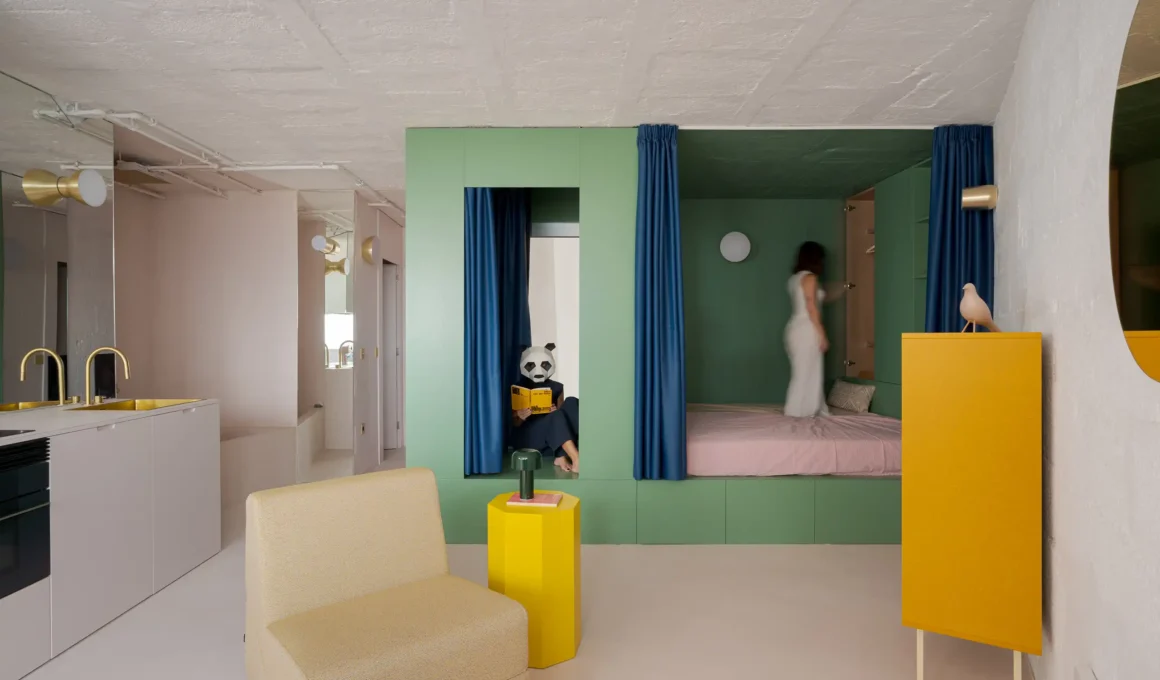
A conceptual liberation in Las Palmas. In the realm of contemporary urban living, the challenge of the “micro-apartment” has evolved from a puzzle of efficiency into a sophisticated exercise in spatial poetry. House C, a recent intervention by XSTUDIO in Las Palmas de Gran Canaria, Spain, serves as a masterclass in this evolution. Faced with a mere 32 square meters of irregular geometry, the architects chose not to subdivide, but to deconstruct. By stripping away non-essential partitions, the dwelling is reborn as a continuous, fluid void where the boundary between the domestic interior and the Atlantic horizon becomes intentionally blurred. It is a project that treats the horizon not as a view, but as a primary building material.
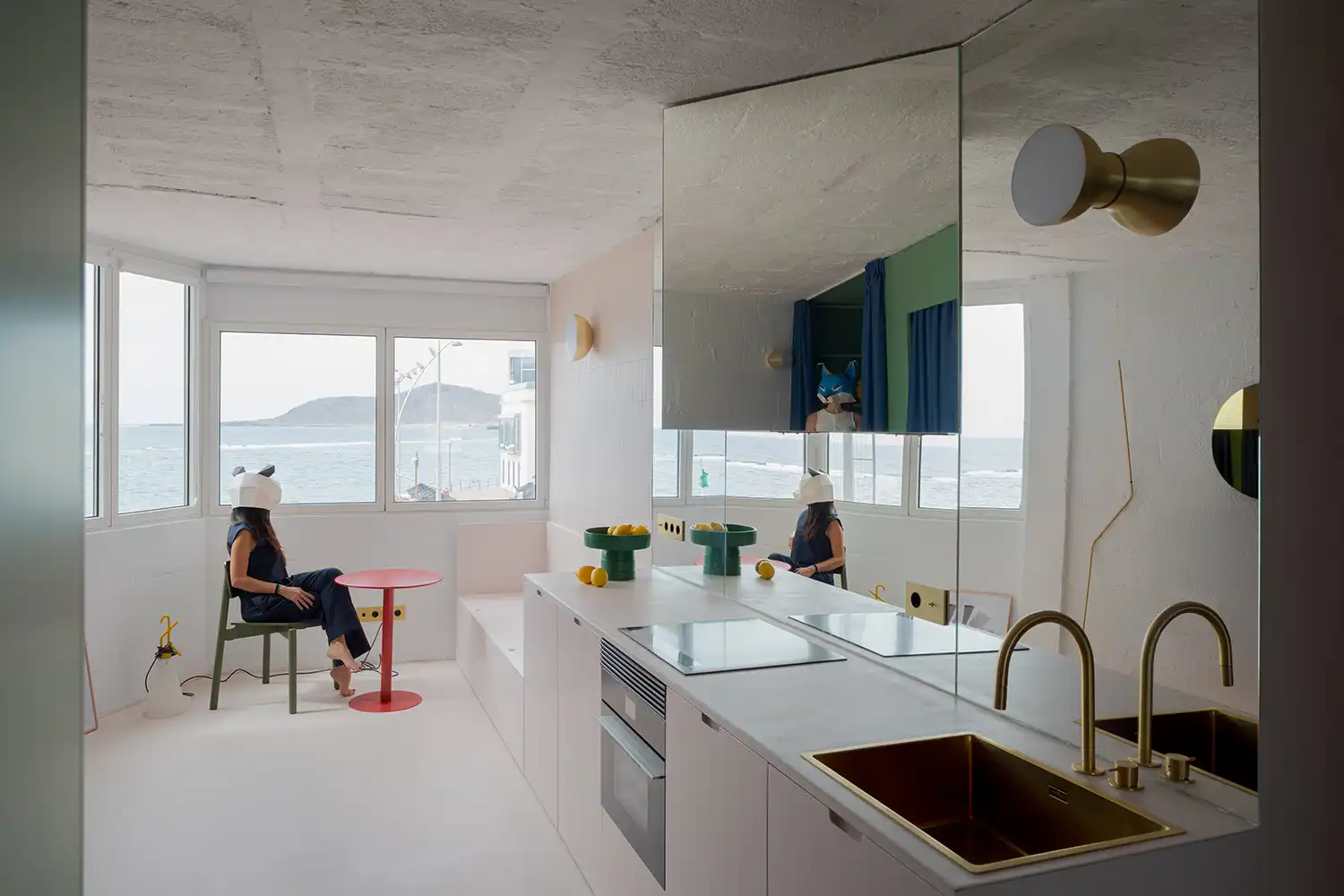
Sculpting the void with functional devices. To inhabit such a compact footprint without the clutter of traditional rooms, XSTUDIO introduced two distinct “architectural devices” that organize the rhythm of daily life. The first is a linear volume anchored to the party wall, a multifunctional spine that seamlessly integrates the kitchen, a contemplative exterior-facing bench, and a bathroom. Most evocative is the bathtub-shower, strategically positioned to allow the inhabitant to bathe while looking directly out at the sea. This approach echoes the clever spatial zoning seen in other European contexts, such as the I-T Small Apartment in Vilnius, where custom cabinetry is used to redefine the limits of a constrained floor plan.
The sanctuary of the green niche. Contrasting the open, social character of the living area is the second device: a dense, emerald-green niche that serves as the home’s private core. This monochromatic volume concentrates the resting area, housing the bed, integrated storage, and a reading nook. It functions as an intimate refuge—a “room within a room”—that provides a sense of enclosure without severing the apartment’s spatial continuity. This use of bold, structural color to define programmatic zones recalls the assertive aesthetic of the Blue Box apartment in Berlin, where a single hue is used to anchor the home’s identity and organize its flow.
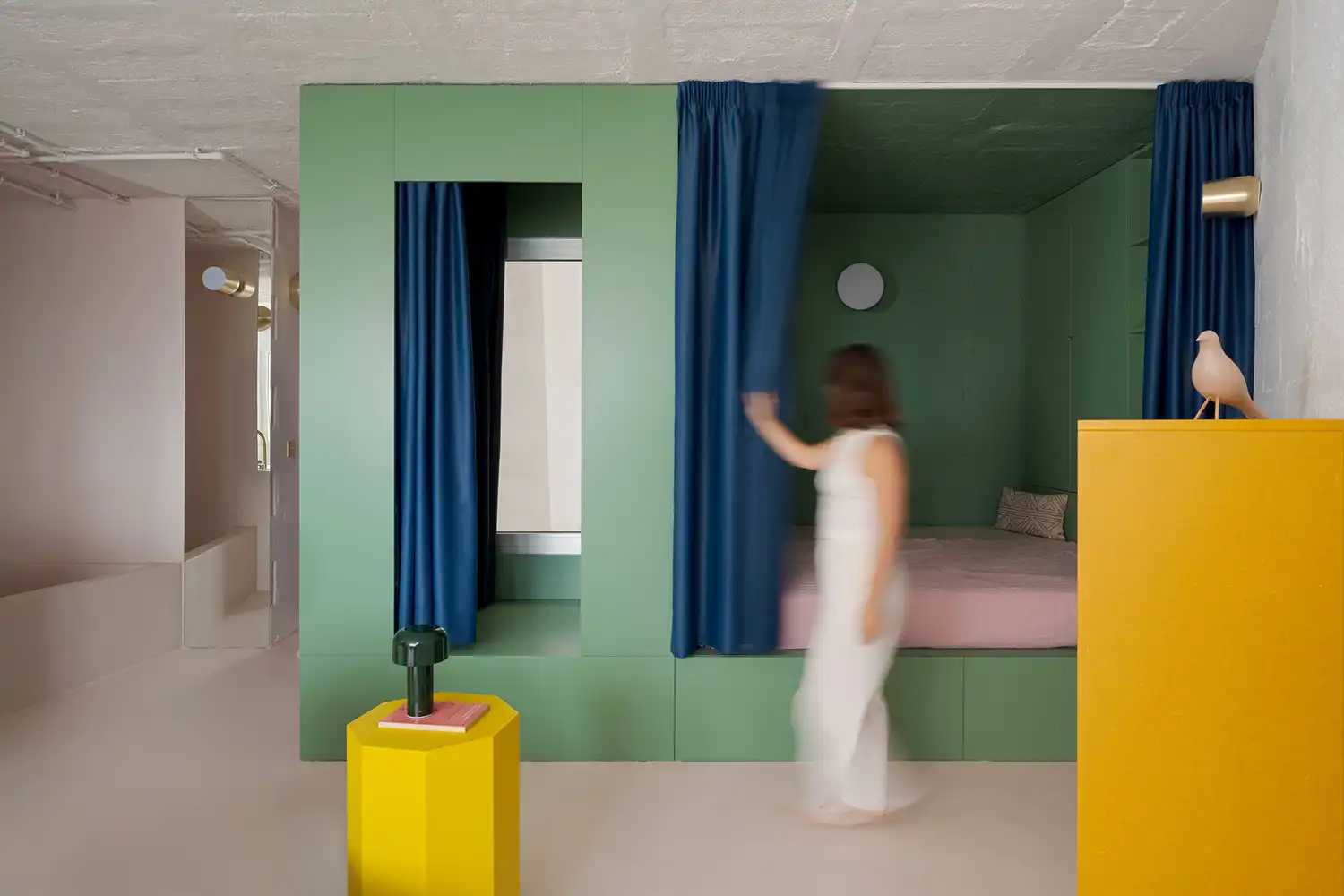
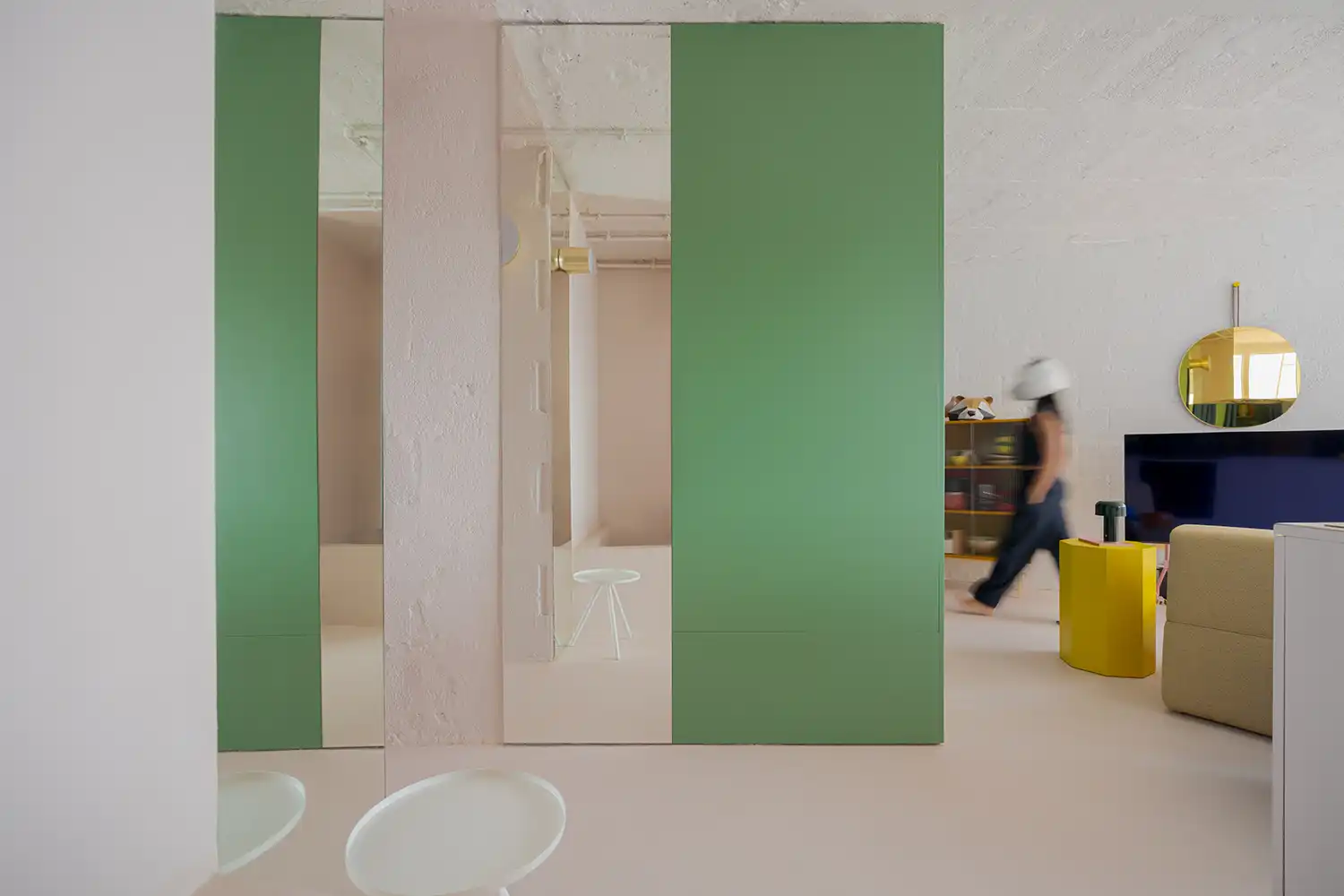
A sensory palette of light and reflection. The atmosphere of House C is dictated by a curated chromatic language that manipulates the perception of volume and temperature. A pale, dusty pink wraps the floors and walls, acting as a canvas that catches and softens the intense Canarian sunlight. This warmth is punctuated by deep Klein blue curtains, which offer a theatrical method of privacy, allowing the space to be partitioned with a single gesture of fabric. The sensory experience is further heightened by the strategic use of mirrored surfaces; these are not merely decorative but are placed to amplify the apartment’s proportions, bouncing the movement of the waves into the deepest corners of the interior.
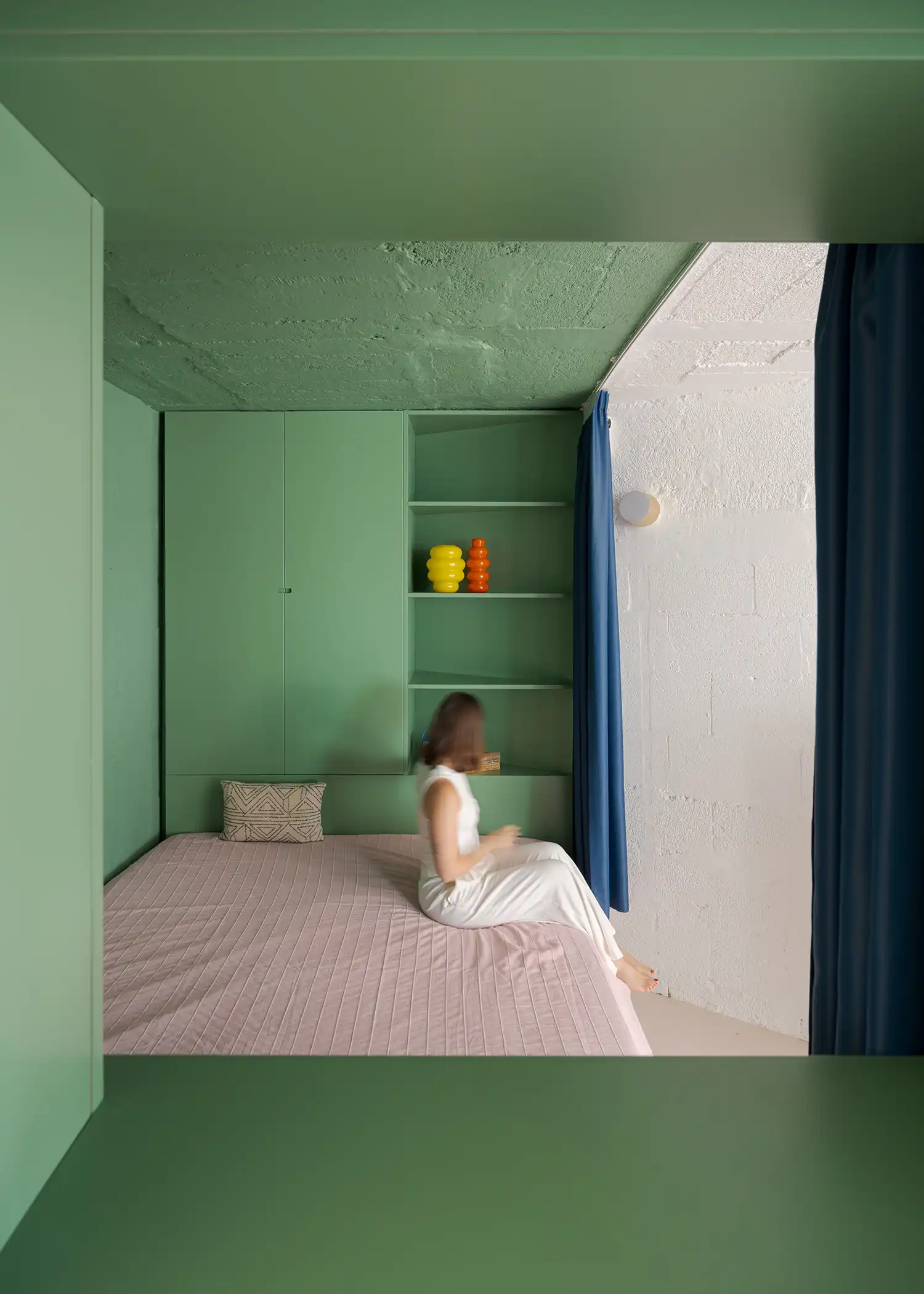
Technical precision and flexible hierarchies. Beyond the aesthetics, the success of the project lies in its rejection of rigid hierarchies. The floor plan is treated as a flexible surface where the furniture and architectural inserts allow for a variety of “everyday gestures” rather than a prescribed way of living. In Las Palmas de Gran Canaria, where the relationship with the coastline is paramount, this layout ensures that the sea is always the protagonist. The technical execution—integrating plumbing, storage, and leisure into two compact modules—frees the rest of the square footage, proving that luxury in a micro-dwelling is found in the quality of light and the freedom of movement.
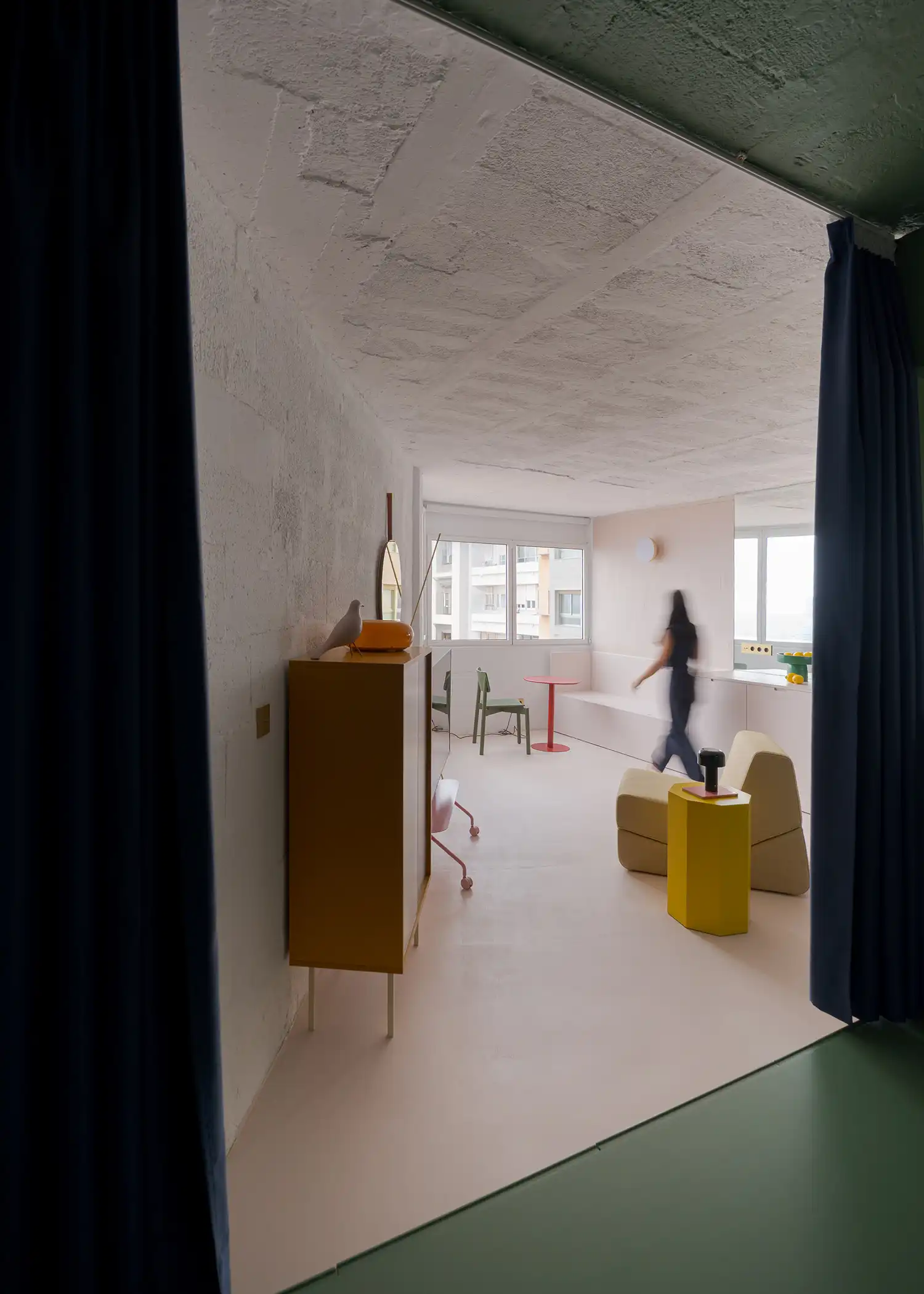
The impact of the expansive horizon. Ultimately, House C is a testament to the power of reductive design. By focusing on reflection, color, and the landscape, XSTUDIO has transformed a cramped, irregular unit into an expansive sanctuary that feels far larger than its physical boundaries. It is an architecture of subtraction that adds immense value to the quality of life, demonstrating that even the smallest urban footprint in Spain can offer a boundless connection to the natural world. Through this lens, the apartment ceases to be a 32-square-meter box and becomes a panoramic stage for the Atlantic.