


As the final echoes of the closing ceremony fade into the thin air of the Italian Alps, a familiar, haunting question begins to circulate among urbanists and architects: what becomes of the stage once the actors have left? Historically, the Olympic flame has often illuminated a path toward ruin—expensive, hollow monuments known as white elephants that drain municipal coffers and scar the landscape. Yet, as Milano-Cortina 2026 concludes, the narrative is shifting from monumental vanity to a more fragmented, tactical form of urban regeneration.
A New Blueprint for the Alps
The 2026 Games were never meant to be a singular architectural statement. Instead, they embraced the concept of the “distributed Games,” stretching across 22,000 square kilometers of Northern Italy. This conceptual vision prioritized the territory over the trophy, utilizing existing infrastructure for 85% of its venues. It is an approach that echoes the circular economy principles seen in Paris 2024, where the city itself becomes the venue, rather than a canvas for new, soon-to-be-obsolete concrete. In Milan, the transformation of the Scalo di Porta Romana serves as the project’s heartbeat, moving away from the “Olympic Park” isolation of the past and toward an integrated, lived-in piece of the city.
Related Insight: > “The intersection of artificial intelligence and urban planning is redefining how we visualize these transitions. As explored in our editorial on Filippo Mercuri’s AI-driven vision for Milano-Cortina 2026, the use of generative tools allows us to simulate the long-term impact of Olympic infrastructures before the first stone is even laid, ensuring the legacy is woven into the city’s digital and physical fabric.”
The Architecture of Necessity
At the center of this transition is the Olympic Village, designed by the firm Skidmore, Owings & Merrill (SOM). To walk through the six palazzine today is to experience a curious aesthetic tension—a certain “functional austerity” that some critics have likened to the rigid blocks of the mid-century, while others praise its sustainable efficiency.
These are buildings designed for their second life first. Within just four months of the Games’ conclusion, these rooms—still holding the faint, rhythmic pulse of international competition—will be converted into the largest student housing complex in Italy. With LEED Gold and WiredScore Platinum certifications, the technical DNA of these structures is net-zero; they are powered by 1 megawatt of photovoltaics and cooled by recovered rainwater, ensuring they do not become the metabolic burdens that Sochi’s $51 billion ruins are today.
Lessons from the Concrete Ghosts
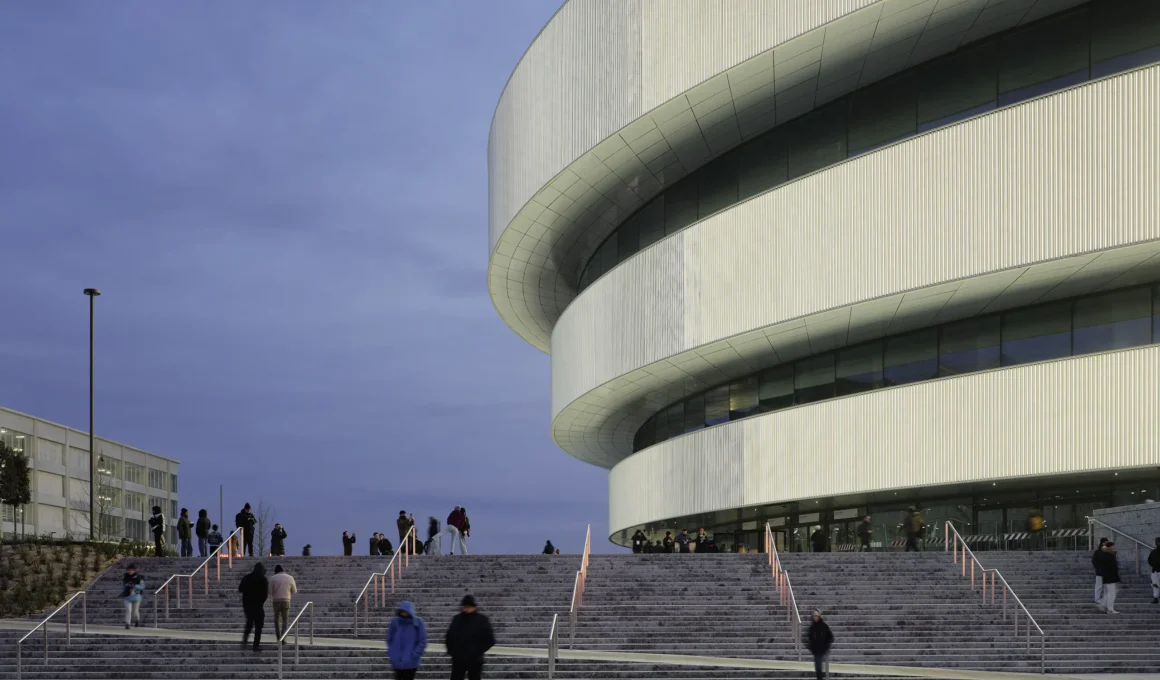
Architecture is a discipline of memory, and Italy is already haunted by the specters of Torino 2006. While the Inalpi Arena remains a vibrant urban success, hosting the ATP Finals, the mountain clusters tell a darker tale. The Cesana Pariol bobsleigh track, once a €110 million marvel of ammonia-refrigeration engineering, now stands as a rusted labyrinth of pipes.
It is a stark reminder that specialized, high-maintenance structures are the hardest to reconcile with environmental impact. This is why modular and reversible solutions have gained traction, such as the CRA-Carlo Ratti Associati alpine bivouac for Milano-Cortina 2026, which envisions a lighter, more adaptable presence in the delicate mountain ecosystem.
Global Echoes: From Success to Stagnation
Looking at the last two decades, the global map of Olympic host cities is a patchwork of urban triumphs and cautionary tales. On one end of the spectrum lies London 2012, which transformed the industrial decay of East London into the Queen Elizabeth Olympic Park—a thriving hub of 24,000 new homes and 40,000 jobs. Similarly, Vancouver 2010 is often cited as a benchmark for sustainable housing, having converted its athletes’ village into Canada’s first net-zero multi-unit residential community.
On the other hand, the specter of “white elephants” remains a haunting reality. Athens 2004 left behind a landscape of rusted kayak slaloms and crumbling pools, symbols of a debt that crippled the national economy. Rio 2016 tells an even more visceral story of abandonment: just months after the closing ceremony, the iconic Maracanã was “handed over to the cats,” plagued by power outages and looting, while the multi-million dollar Aquatics Centre became a breeding ground for mosquitoes. These global failures underscore the risk of Milano-Cortina’s “reconstruction” gamble: without a clear, day-after operational plan, even the most innovative architecture can quickly slide into obsolescence.
The Conundrum of Frozen Water
Beyond the steel and glass, the most fragile piece of the Olympic legacy is the environment itself. In the Dolomites, a UNESCO World Heritage site, the Games have had to confront a warming reality where 85% of the competition surfaces required artificial snow. This technical snow is not merely frozen water; its density and mineral additives alter the pH of the soil, delaying the spring bloom and impacting alpine biodiversity. While the production systems are now largely powered by renewable energy, the water consumption—estimated at up to 150 million cubic meters annually for the Italian ski industry—places an invisible weight on the very ecosystem the Games seek to celebrate.
Housing the Future, Not Just the Athletes
The true success of Milano-Cortina 2026 will not be measured in medals, but in its ability to mitigate the forces of gentrification. As the Olympic Village transitions into a neighborhood for 1,700 students and 2,000 residents, the social contract of the Games is under the microscope.
By dedicating 50% of the residential space to social and affordable housing, Milan is attempting to use the Olympic catalyst to solve a chronic housing crisis. The sensory experience of this new district—the clinking of coffee cups in the squares of the former railway yard, the blurred lines between high-performance sport and daily life—suggests that the most enduring legacy might not be a stadium at all, but the quiet, sustainable reintegration of the city into itself.