


Stefano Boeri Architetti has unveiled the design for the new Ambrosian Monastery, a 2,700-square-meter complex commissioned by the Milan Curia to be situated at the vital intersection of the Cardo and Decumanus within the MIND Milano Innovation District. The project reinterprets the traditional monastic cloister as a contemporary, permeable space for interreligious dialogue and spiritual research, integrating a trigonal-plan church, a public “Garden of Faiths,” and a transparent Library of Religions within the burgeoning scientific hub of the former Expo 2015 site.
A spiritual anchor in a digital age, the proposal seeks to bridge the gap between historical monastic traditions and the hyper-modernity of the MIND area. While the district is rapidly becoming a center for life sciences and technological advancement, the monastery introduces a human-centric counterpoint designed for the convergence of diverse cultures and faiths. By re-envisioning the cloister archetype, the studio has created a structure that is simultaneously introverted—offering the quietude necessary for reflection—and remarkably open to the thousands of residents, students, and professionals expected to inhabit the district by 2030.
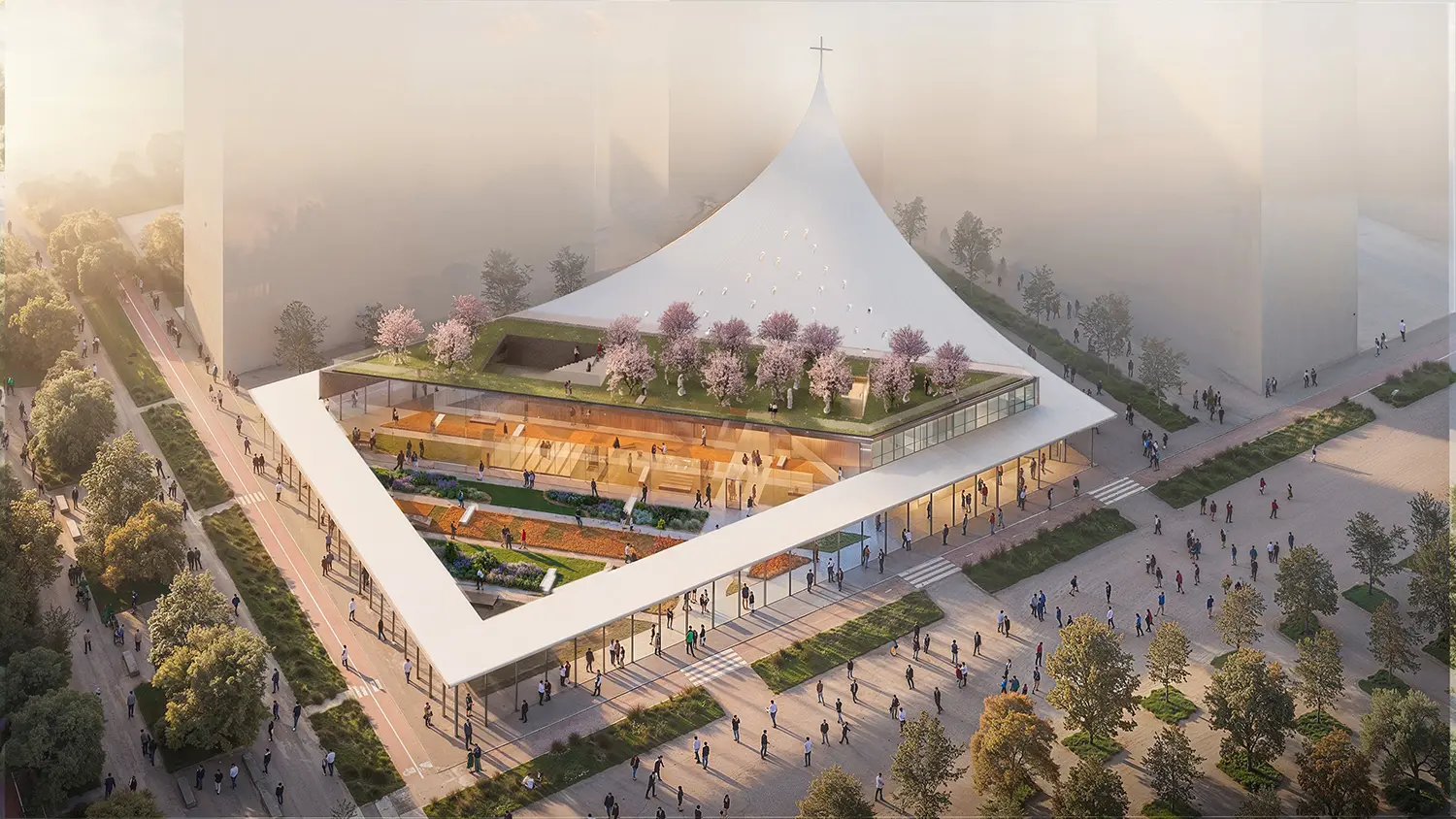
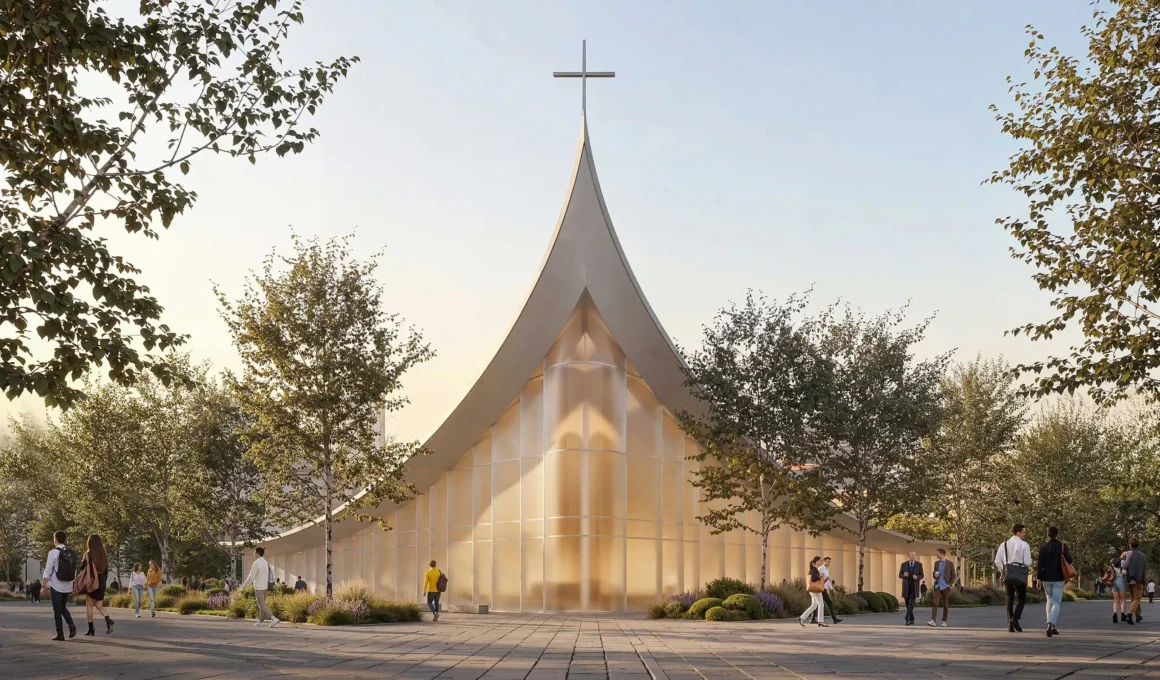
The conceptual vision is physically manifested through a singular architectural gesture: a large, ascending Sail that defines the silhouette of the complex, rising toward the north to house the central nave of the new Pastoral House. This form acts as a material continuation of the cloister’s roof, descending in sweeping lines to embrace a sheltered yet accessible colonnade that invites passersby into the Garden of Religions. Here, the sensory experience begins with the scent of diverse plant species and the tactile quality of the stone, grounding the high-tech surroundings of the innovation district in a rhythmic, organic pace.
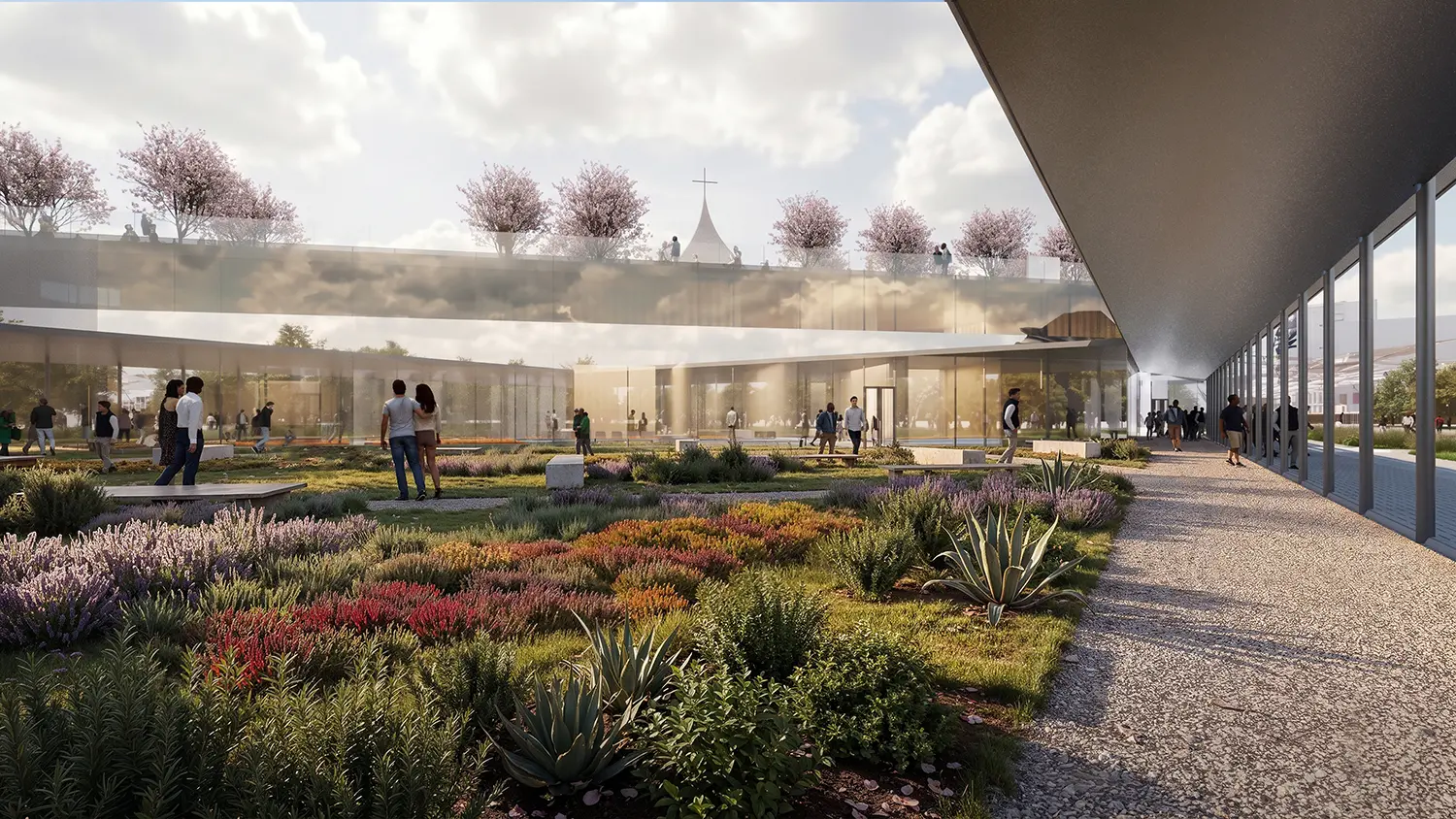
Technical precision meets symbolic geometry at the heart of the complex, where the Library of Religions stands as a transparent, trapezoidal prism dedicated to the intersection of humanistic disciplines and theological study. This glass-walled volume stands in deliberate contrast to the protective nature of the colonnade, representing the clarity of shared knowledge. On its roof, a small grove of cherry trees provides a unique setting for historic sculptures from the Veneranda Fabbrica del Duomo, bringing ancient figures typically perched on the Cathedral’s spires down to eye level, creating a profound sense of temporal continuity and public accessibility.
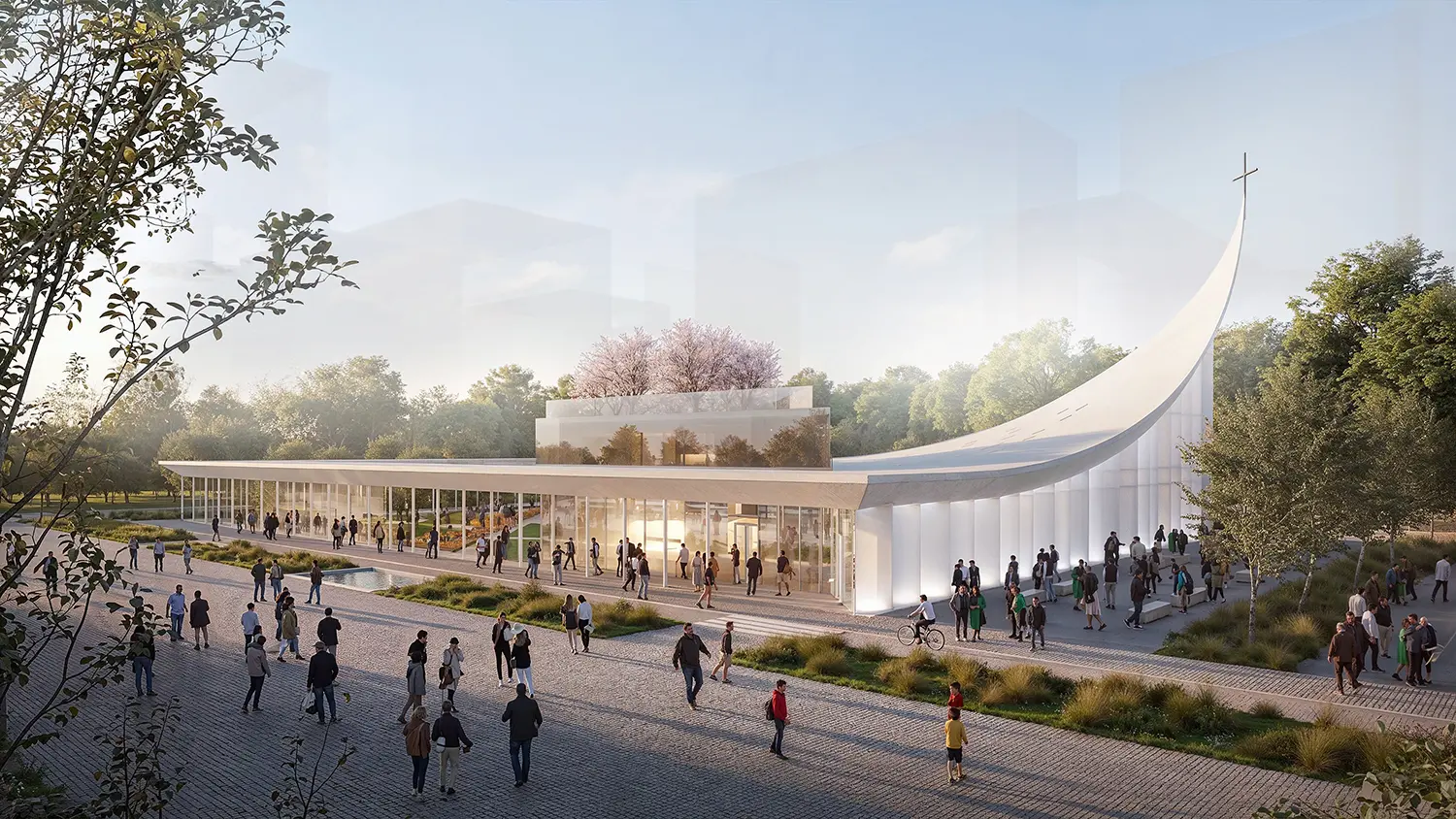
The trigonal-plan church serves as the apex of this journey, with its ascending form subtly referencing the verticality of the Milan Cathedral. The interior is characterized by a dialogue between light and volume, providing a space for both community liturgy and individual contemplation within a scientific context. This emphasis on human care reflects a growing trend in contemporary development, much like the sustainable approach seen in the Malpensa Hospital project by Zaha Hadid Architects. By placing a site of reflection at the crossroads of a district defined by research, the project ensures that innovation remains rooted in social cohesion and the collective common good.