


Café Shin Marais by Uchronia is not the third location of a Parisian café concept — it is the first one designed to remember the other two. The practice led by Julien Sebban has embedded the material DNA of both previous Café Shin venues into the architecture of 115 rue de Turenne: an unfinished concrete floor that echoes the Petites Écuries original, brickwork that quotes the Palais-Royal iteration, and a skylit room nearly four meters high that belongs to neither and synthesizes both. The result is a space that accumulates rather than resets.
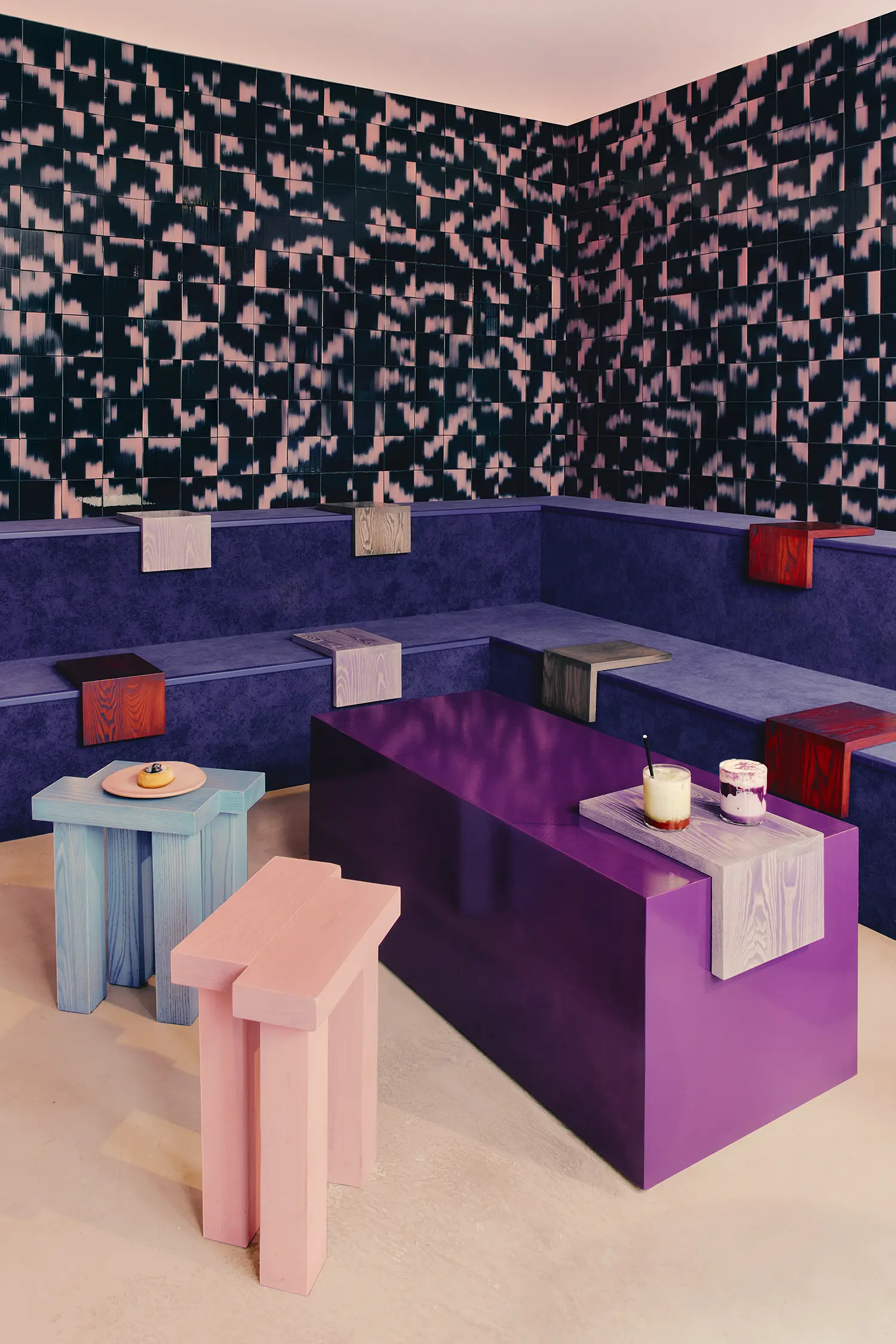
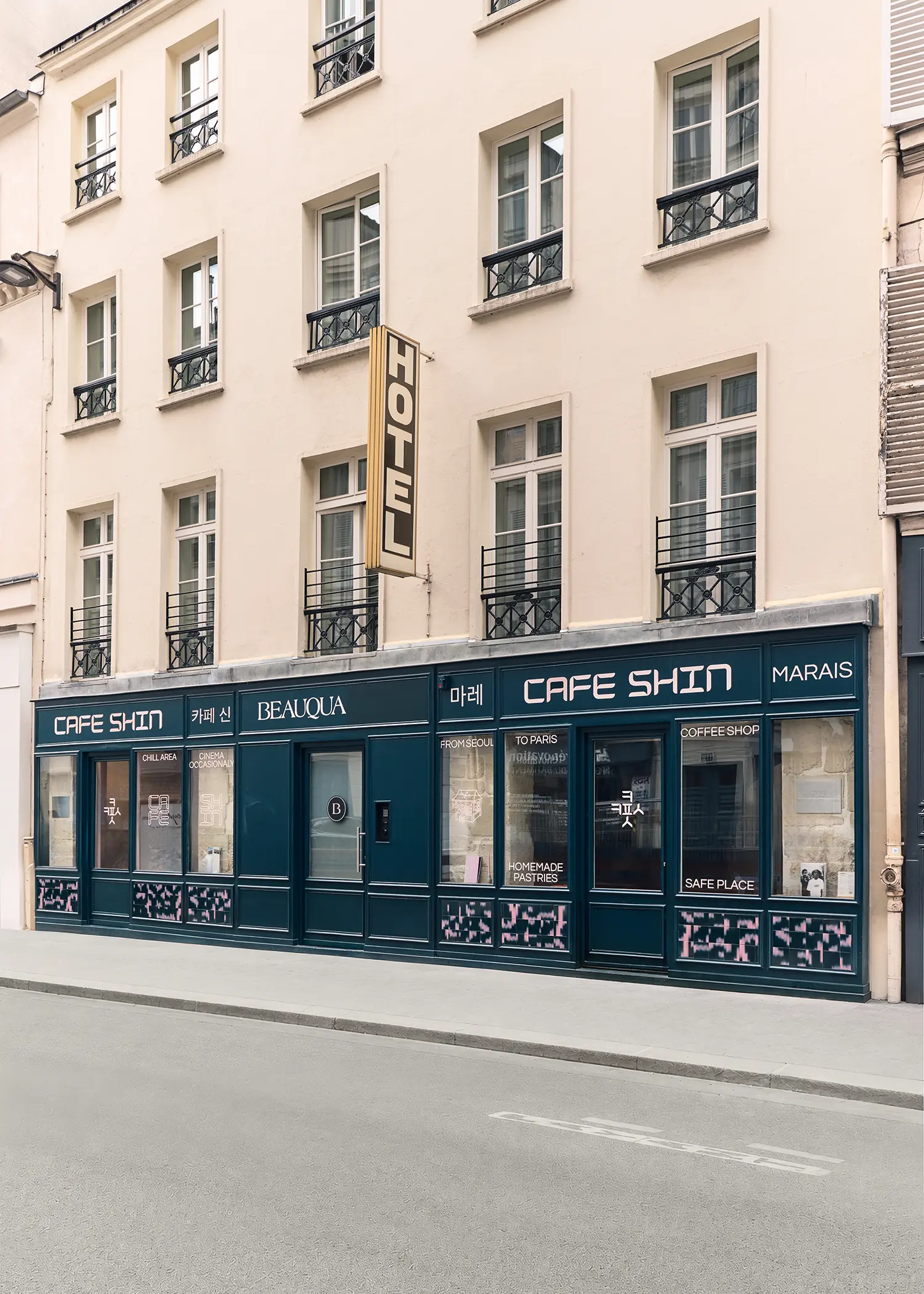
The spatial sequence begins at the facade, which is split: the residential building entrance occupies the center, Café Shin to the right, a separate screening room to the left. The division is not incidental — it establishes the Korean café interior design logic that Uchronia has developed across all three locations, where the experience is never contained in a single room but distributed across thresholds and transitions. You enter on one side, discover the main room, step outside, re-enter elsewhere. The architecture choreographs movement rather than simply accommodating it.
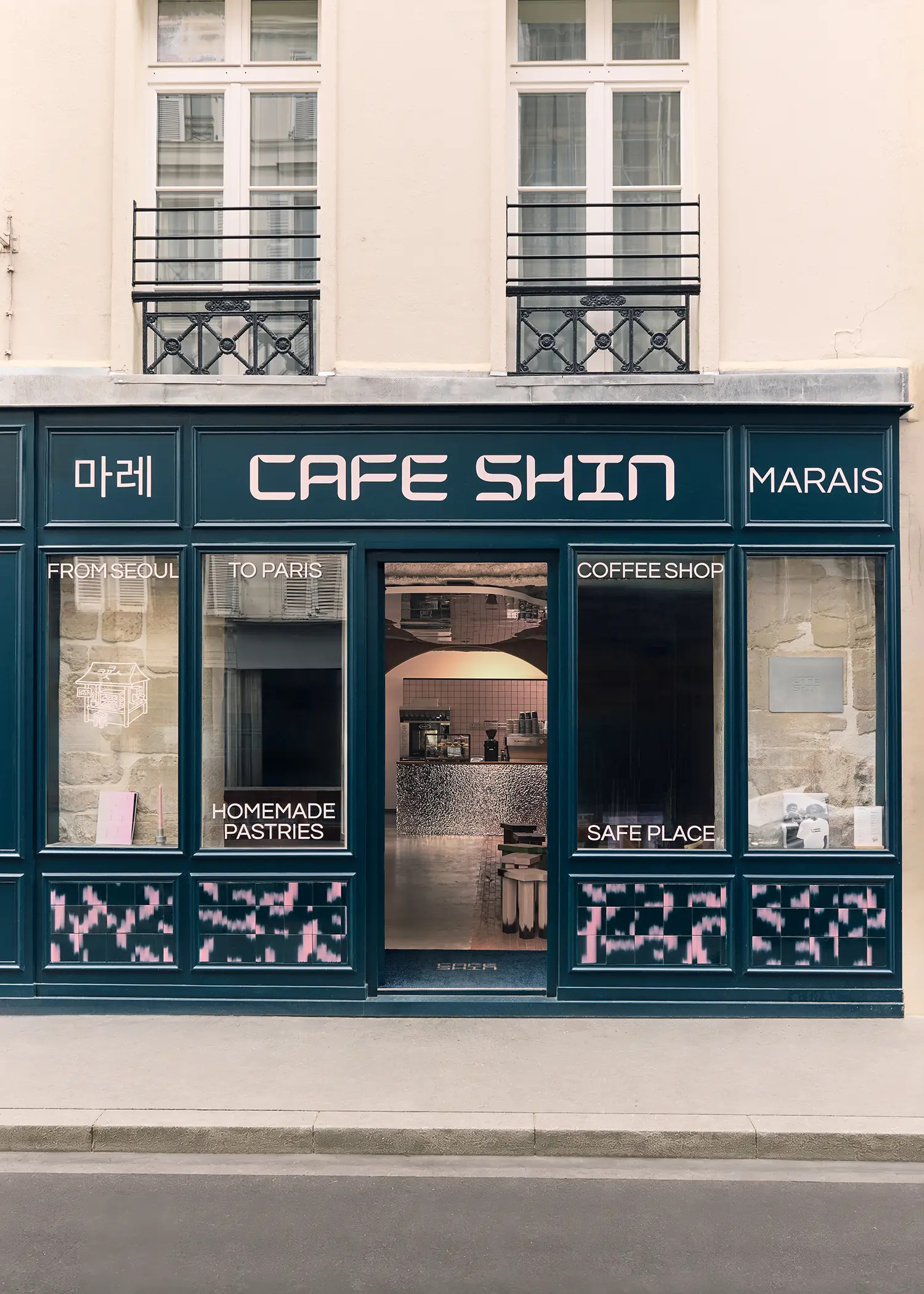
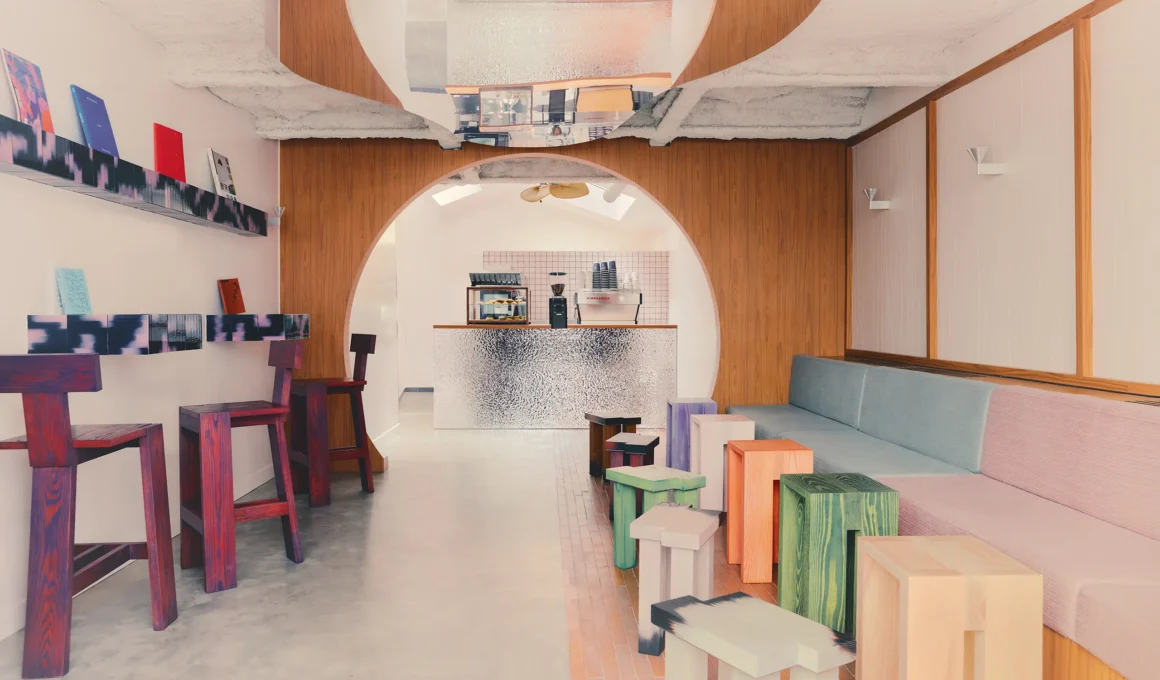
A large arch marks the threshold between the entrance corridor and the counter zone — one of Uchronia’s recurring spatial devices, used here to compress and release: the passage is tight, the room beyond it unexpectedly generous. The ceiling climbs to nearly four meters, punctuated by skylights that pull natural light down onto the counter, the high tables, and the bench seating running along the wall. In a city where café interiors typically negotiate low ceilings and narrow footprints, the volume of this room reads as a deliberate spatial argument. This approach to section and light distribution is consistent with Uchronia’s work across hospitality formats, from the Athletic Bath Club in Bordeaux to the Mandarin Oriental suite in London.
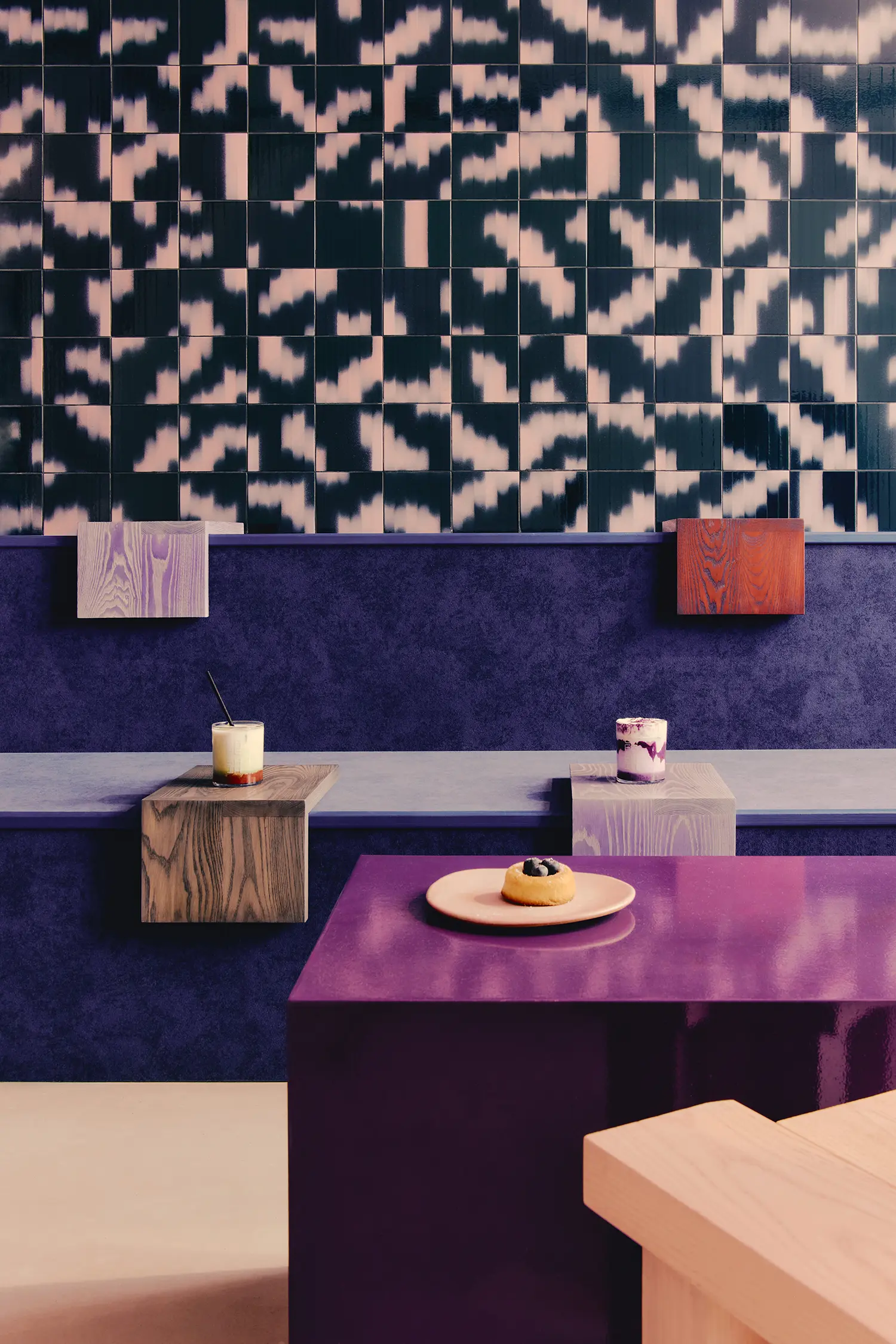
The furniture is the project’s most visually legible layer. Stools and benches in solid wood — ash and pine, stained in gradients that shift from deep burgundy to pale blush, lavender, sage, and natural grain — are scattered across the floor in a density that reads as deliberate disorder. No two pieces carry the same finish. The effect is chromatic rather than decorative: the furniture collectively functions as a color field, activating the otherwise restrained palette of concrete, pale render, and warm oak paneling. The handcrafted wooden furniture pieces are designed by Uchronia specifically for the venue, continuing the practice’s approach of treating movable objects as integral to the spatial composition rather than as afterthoughts.
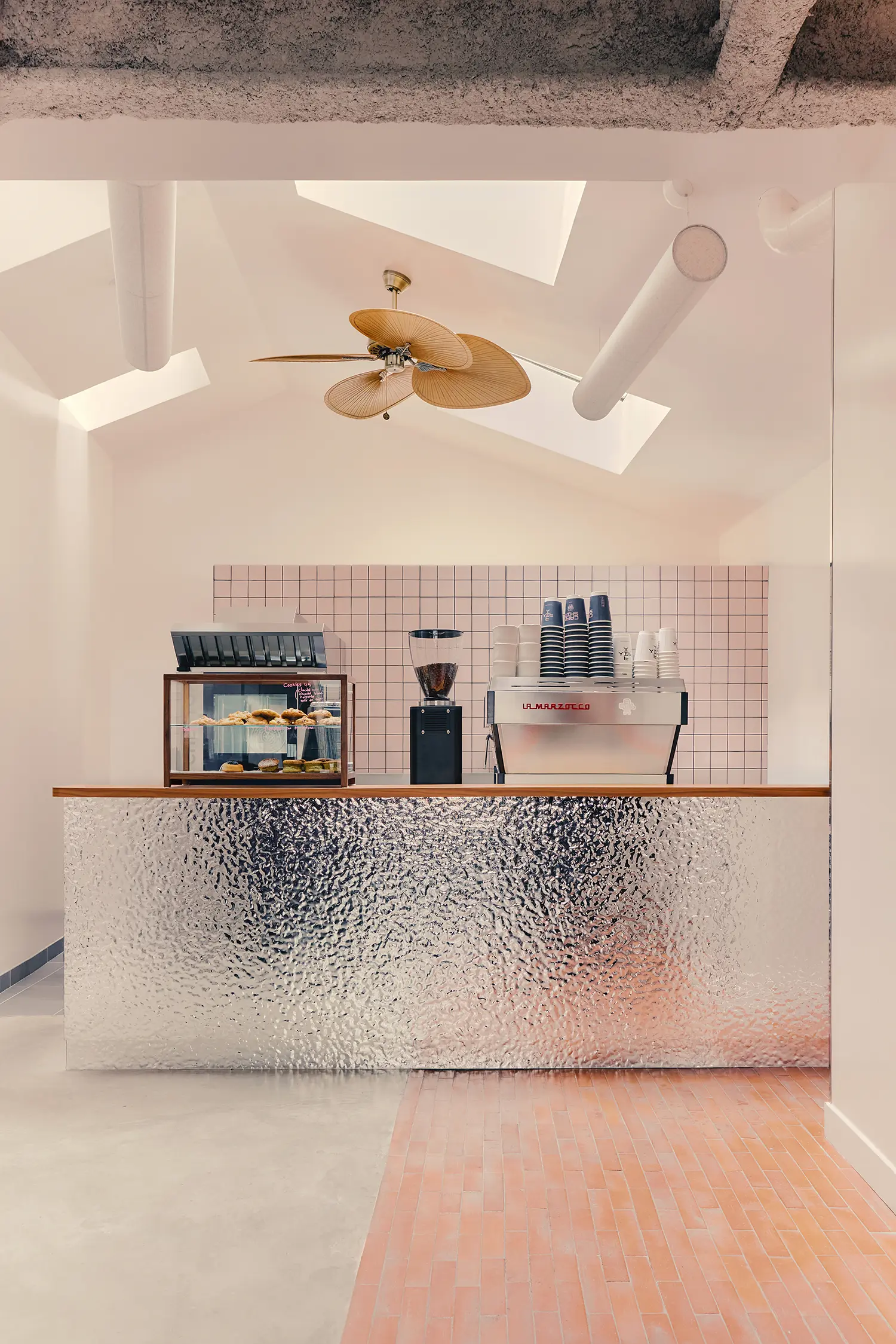
The counter is sheathed in hammered chrome-finish metal panels, their faceted surface catching and redistributing light as bodies move past — a kinetic effect achieved without any mechanical component. Behind it, pink ceramic tilesline the wall in a grid format that references both the utilitarian tiling of Korean food culture and the Haussmann-era café tradition. The material overlap is precise and deliberate: Uchronia does not resolve the Franco-Korean dialogue into a single hybrid register but keeps both references legible simultaneously. The practice deployed a comparable strategy of cultural material layering in their Padel 15 indoor court in Paris, where industrial and domestic references were held in intentional tension.
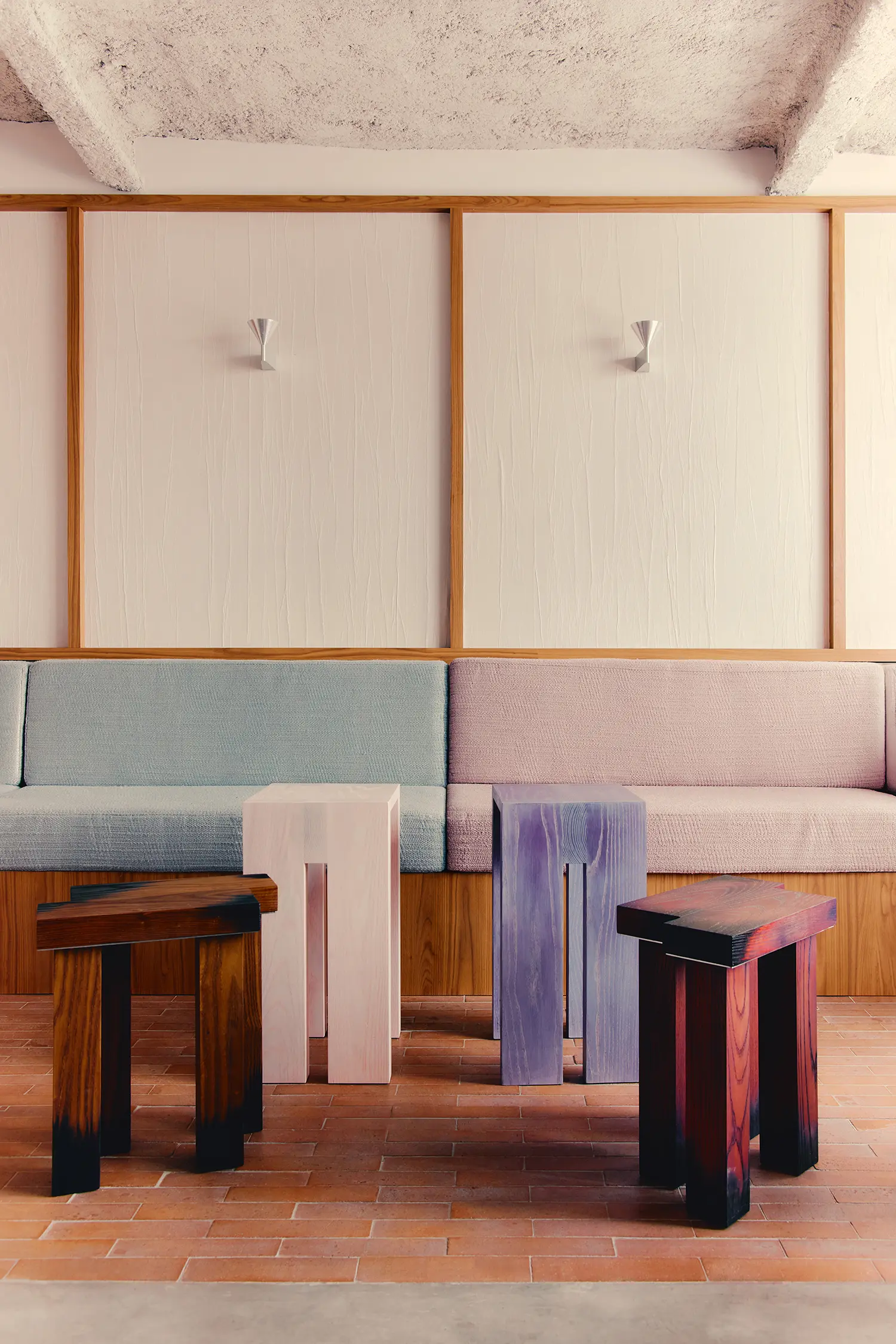
The skylight zone above the counter is the room’s architectural centrepiece. A curved mirrored pendant light hangs at the intersection of the concrete ceiling beams, capturing the zenithal light and diffusing it across the space. The exposed concrete structure — left raw, its formwork marks still visible — sits in deliberate contrast with the warmth of the oak wall paneling and the pastels of the furniture below. This vertical sectional play, between raw structure overhead and tactile softness at human scale, gives the room its specific atmospheric register: neither a polished hospitality interior nor an unfinished industrial space, but something calibrated between the two.
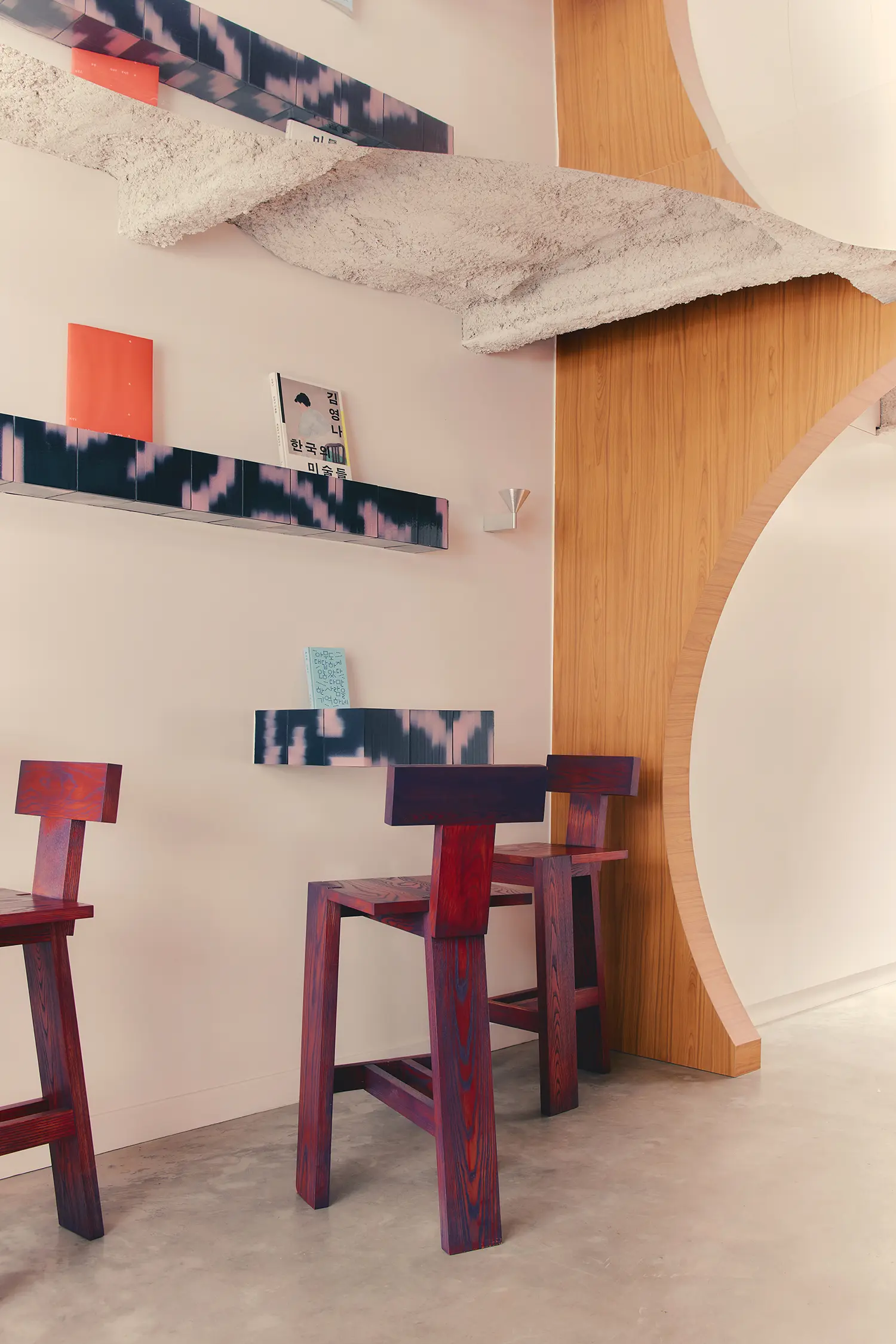
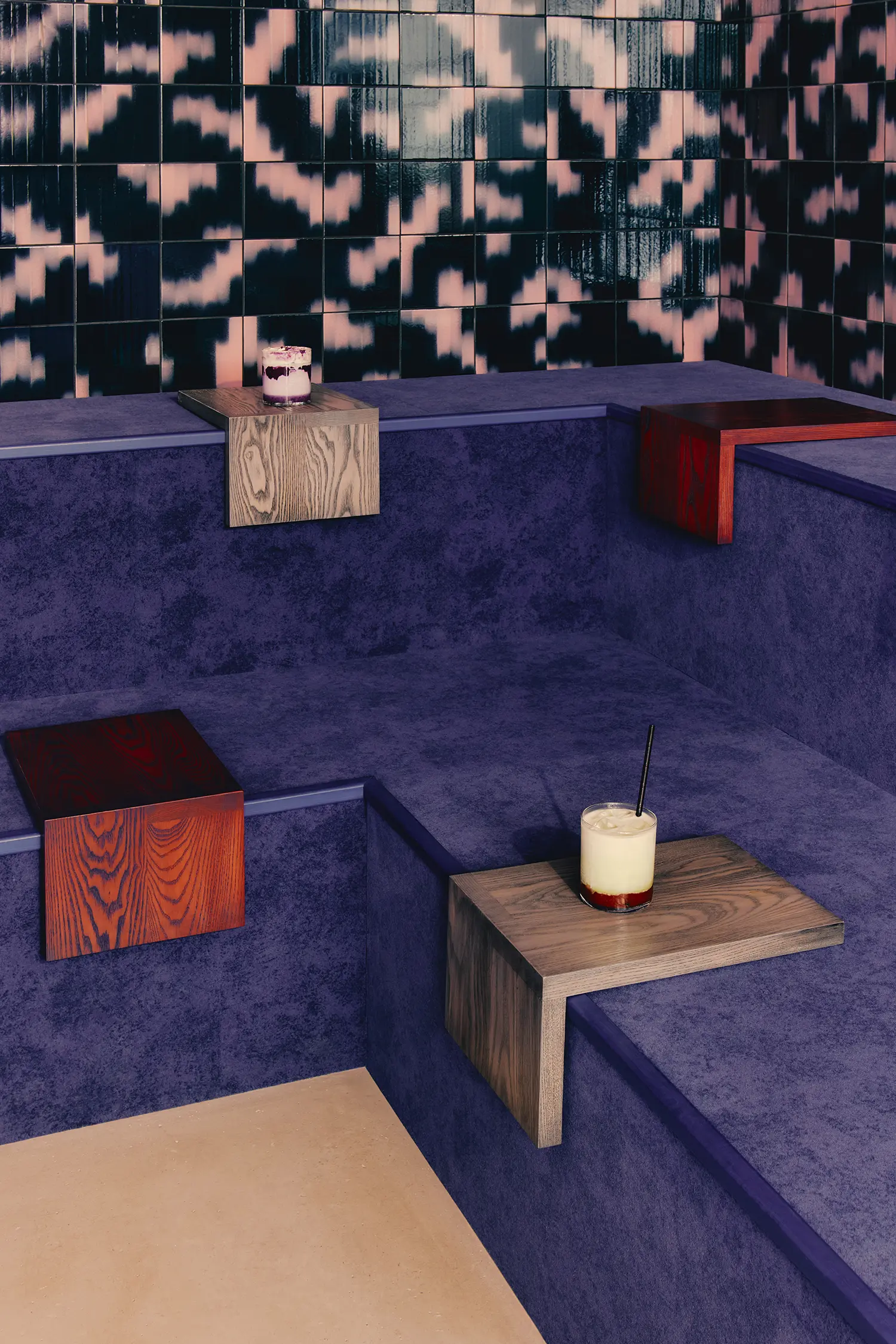
The screening room, accessed through a separate entrance to the left of the facade, operates on an entirely different spatial logic. The main café room is warm, layered, chromatic. The screening space is stripped: a large blue upholstered platform fills the floor, Palet tiles in an ikat-derived pattern — dark navy with blush pink motifs — cover the walls entirely from floor to ceiling. The programming, curated by Shin Eun Jung, runs Korean films, archival footage, and landscape sequences. The space is designed for duration: you sit, lie down, stay longer than planned. In a city where the Parisian café culture has long understood lingering as a social form, Uchronia gives it a dedicated room.
The material continuity across all three Café Shin locations is the practice’s most rigorous decision on this project. Rather than treating each venue as a fresh commission, Uchronia has constructed a cumulative spatial identity — each location adding a room, a logic, a material register to the shared archive. The Petites Écuries location gave the brand its stripped concrete character; the Palais-Royal added layered finish and a listening room; the Marais integrates both while introducing the screening space and the skylit volume. The café is not expanding — it is deepening. This long-form approach to a single client’s spatial identity is rare in the Paris hospitality interior design sector, where novelty typically overrides continuity.
The collaboration between Shin Eun Jung, Julien Sebbag, and Uchronia, now across three venues since 2023, has produced something more specific than a successful café brand: a coherent spatial language built incrementally from two cultural references — Korean café culture and Parisian street-level hospitality — that neither assimilates nor exoticizes either source. The Uchronia approach has always operated at the intersection of atmosphere and architecture; Café Shin Marais is the clearest demonstration yet that the practice works best when given time and repetition to develop an idea across multiple commissions.
Whether the accumulative model holds as the brand scales beyond three locations — and whether Uchronia’s material vocabulary remains as precise when it can no longer reference a shared history — is the question the next Café Shin will have to answer.
Café Shin Marais by Uchronia | Location: 115 rue de Turenne, Paris 3e, France — Year: 2026 — Key materials: exposed concrete, oak paneling, hammered chrome metal panels, pink ceramic tiles, Palet ikat tiles, stained solid wood furniture