

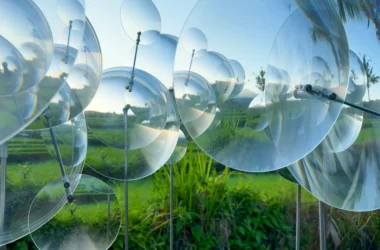
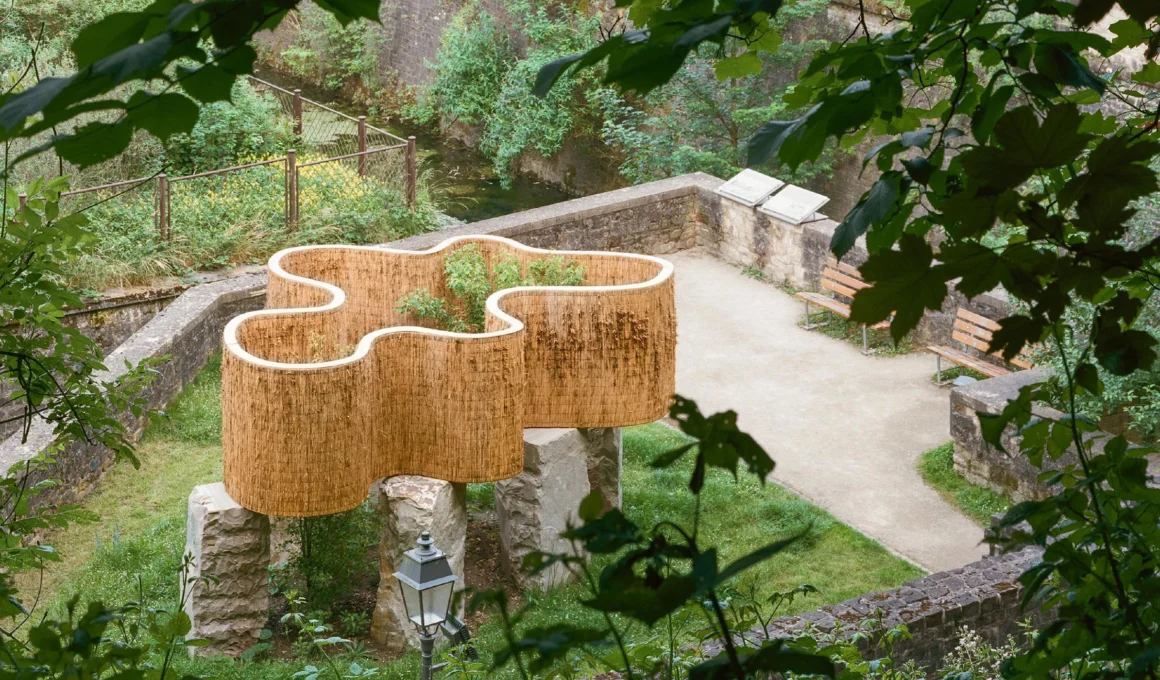
The Solum installation, a poignant work of spatial and landscaped design by the studio Atelier Faber, has emerged in Luxembourg as a powerful architectural statement on environmental urgency. Created for the LUGA international exhibition of urban gardens, the project transcends mere aesthetic appeal to tackle one of the most critical challenges facing our built environment: managing the essential relationship between earth and water.

Sited upon the grounds of an old well in Luxembourg City, the artwork directly addresses the problem of inert soil. The installation’s core purpose is to draw attention to the vital process of soil permeability, demonstrating how living organisms gradually reclaim and restore the earth’s natural porosity. This restoration is a crucial defense mechanism in the modern fight against both devastating drought and catastrophic urban flooding.

The structure itself is a study in purposeful materiality, superimposing elemental forms to create an archaic and primitive landscape. At the base, pillars of Luxembourg sandstone—the very stone that supports the region’s largest aquifer—are crowned by a dense band of reeds, which serve as a visual allegory for natural wetlands. This layering not only highlights the geological history of the site but also creates a tangible representation of the natural water cycle.

Atelier Faber’s approach is rooted in an ecological design philosophy, taking its cues directly from the environment it occupies. The project does not introduce foreign elements but rather champions the lush, existing plant life that has developed autonomously on the site. This flora, which has thrived without human assistance or watering, is by definition the most adapted and resistant vegetation to the local soil and climate, forming the foundation of the final landscape design.

The subsequent landscaping aims to support this inherent resilience. Instead of traditional gardening, the work focuses on increasing the density of the shrub layer, strategically incorporating ruderal annual perennials in nitrogen-rich soils and grasses and annual plants where the soil is drier. This low-intervention, high-impact strategy ensures long-term sustainability and provides a real-world example of effective water management through natural means.

Ultimately, Solum functions as a piece of compelling environmental Architecture—a testament to the power of natural materials like sandstone and reeds to communicate profound ecological principles. By transforming an unused urban plot into a site that celebrates the essential dynamics of porous soil, Atelier Faber has delivered a profound commentary on the necessary shift toward more conscious, responsive urban gardens and regenerative design practices.