




Architecture firm BIG – Bjarke Ingels Group has unveiled its first completed building in Los Angeles, the Robert Day Sciences Center at Claremont McKenna College. The 135,000-square-foot building, a cornerstone of a new campus masterplan also designed by BIG, is conceived as a dynamic vessel for multidisciplinary integration, where the very architecture channels the flow of people and ideas between laboratories, classrooms, and the wider campus. Its striking form, a stack of rotated volumes, creates a new eastern gateway for the college, immediately establishing a powerful architectural identity for science and innovation.
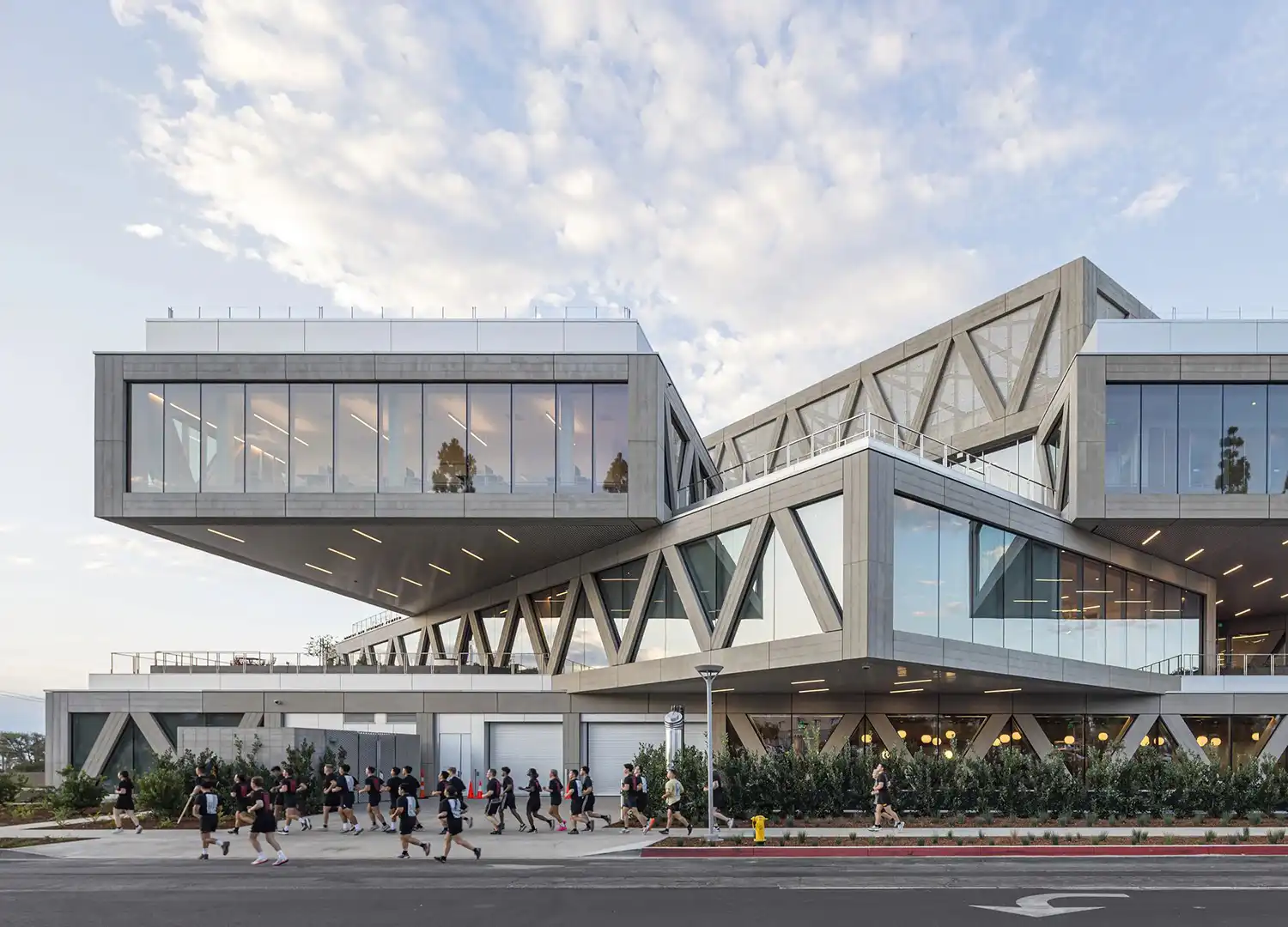
The building’s most distinctive feature is its sculptural massing, where each pair of levels is rotated 45 degrees from the floor below. This strategic rotation does more than create a visually captivating silhouette against the San Gabriel Mountains; it carves out a full-height, sky-lit atrium at the heart of the structure. This central void becomes the social and circulatory core of the center, offering direct views into classrooms and research spaces from all levels, making the process of science visibly transparent and interconnected.

A dramatic 15-foot hovering canopy draws visitors into this vibrant atrium, a space buzzing with activity and designed to foster spontaneous collaboration. Inside, the structural design is expressed through dramatic triangular steel trusses, clad in warm Douglas fir, which support the bridging levels above. The texture and rhythm of these trusses extend to the exterior, creating a seamless dialogue between inside and outside. A large, social staircase and a café anchor this space, transforming it into a lively hub for the entire college.

The material palette further emphasizes a blend of robustness and warmth. The facade incorporates board-formed panels of glass fiber reinforced concrete (GFRC), achieving a wood-like texture while meeting the stringent durability and fire-resistance requirements of a modern laboratory. This commitment to performance is matched by a drive for sustainable architecture, with 11,000 square feet of solar panels on the roof providing approximately 342 megawatt hours of energy annually, contributing to the project’s goal of achieving LEED Gold certification.

Programmatically, the center is a hive of focused activity and collaboration. The ground floor houses a large seminar forum and imaging suites, while upper floors contain flexible classrooms, advanced wet labs and dry labs, a Quantum Library, and a maker’s space. Classrooms are positioned on the perimeter to capture views, separated from the social energy of the atrium. Adding a layer of artistic inspiration, Damien Ortega’s suspended sculpture, Magnetic Field, floats within the atrium, its 1,476 glass spheres representing Earth’s magnetosphere.

Further enhancing its connection to the environment, the design incorporates eight outdoor rooftop terraces located on the corners of each rotated bar. These multifunctional spaces, landscaped with native flora, offer 360-degree views of the campus and Mount Baldy. They serve as outdoor classrooms, study areas, and social venues, extending the collaborative learning environment beyond the building’s walls. At night, the illuminated center stands as a beacon for scientific inquiry, a testament to a forward-thinking educational approach where architecture actively shapes the future of discovery.