


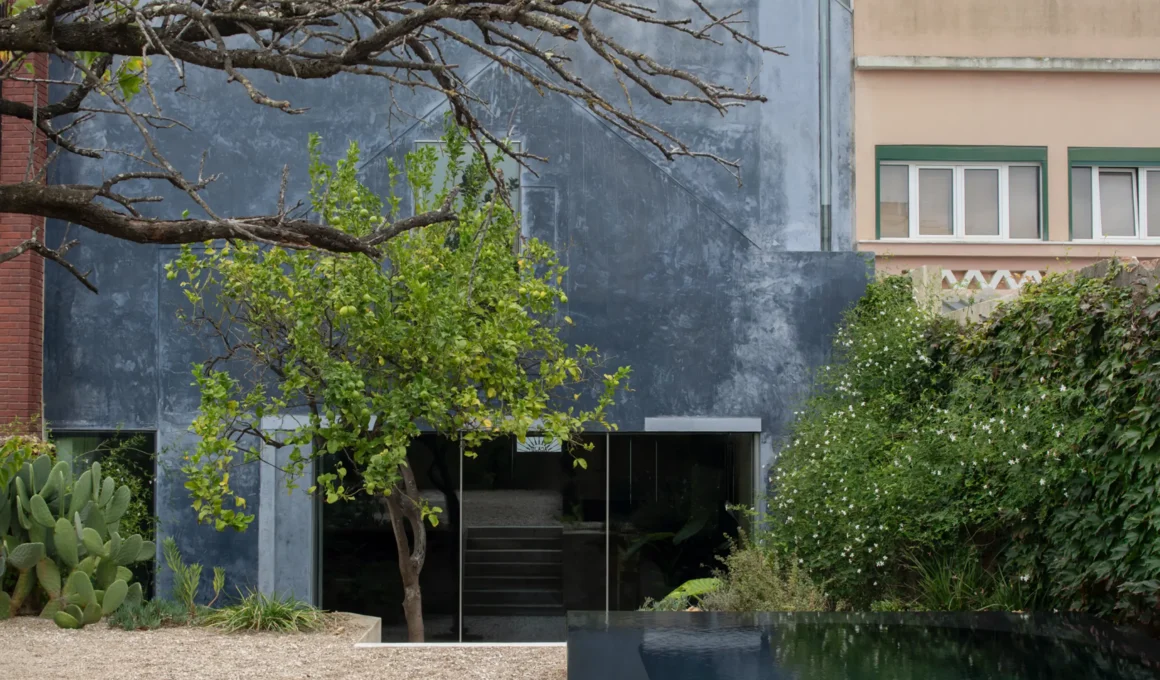
Extrastudio‘s Blue House in Marvila, Lisbon, is the first in a series the studio named casas poveras — poverty houses, stripped to essentials in a time of uncertainty — yet the material decision that defines it is one of the most technically unforgiving in Portuguese residential architecture. The ultramarine blue pigmented lime plaster covering the entire exterior volume was found not in a catalogue but in the existing building — a trace of the 1893 structure that extrastudio chose to amplify rather than erase. Blue being an unstable pigment, the studio explains, “each façade had to be finished in a single day, without seams or repairs, a Sisyphean act.” A poverty project executed with no margin for error.
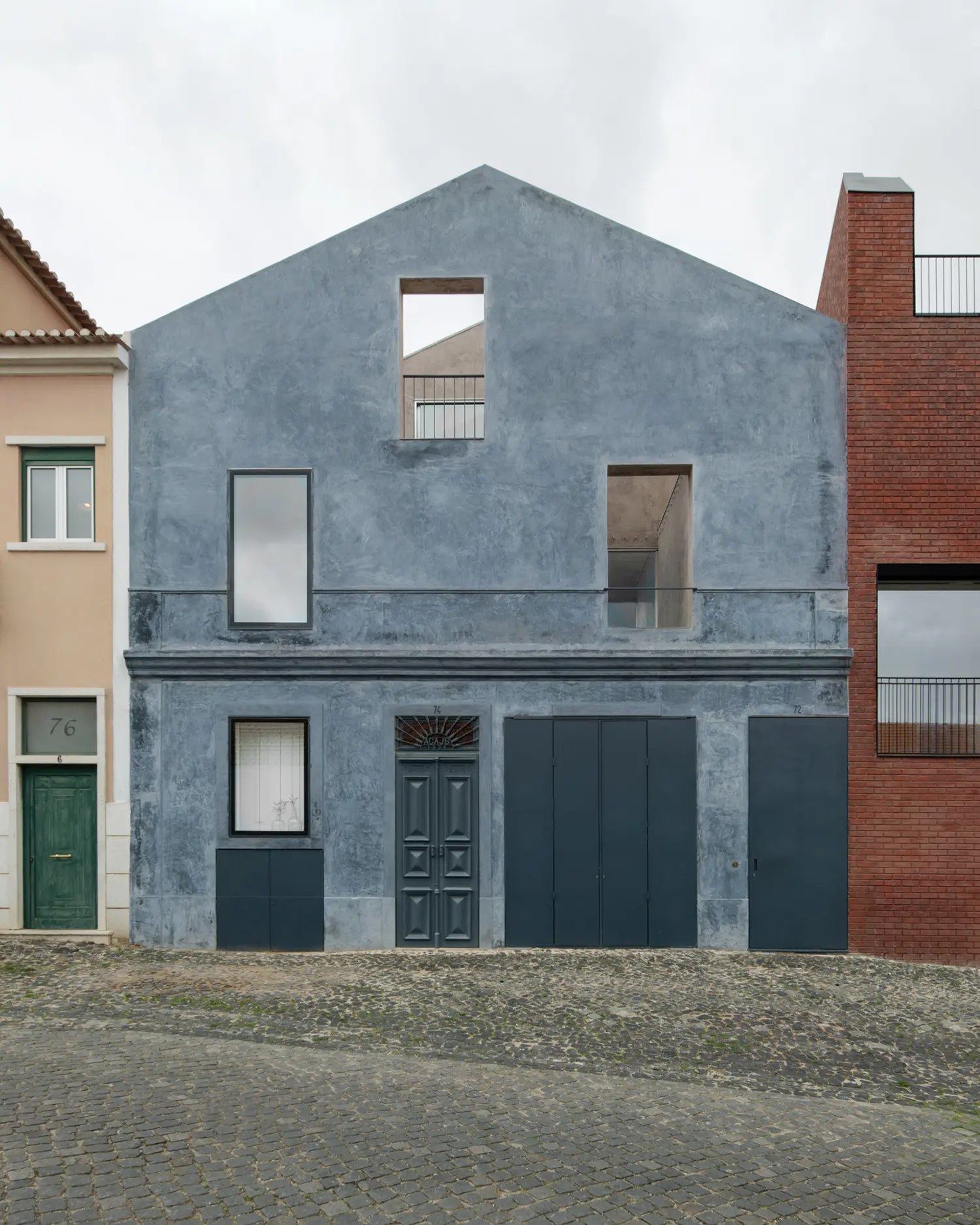
Marvila’s industrial past is the project’s unspoken context. Once a landscape of Lisbon estates and farmland, the district became the city’s main industrial zone through the twentieth century, bounded by the Tagus River and its railway lines, defined by warehouses that once housed industries still legible in street names like Rua do Açúcar and Rua da Fábrica do Material de Guerra. After decades of neglect, those same warehouses now hold studios and galleries, making Marvila the city’s most active creative district. The Blue House sits within this layered context not as a statement about gentrification or creative urbanism, but as a domestic act of preservation: the renovation and extension of a single-story house built in 1893, with the existing structure fully retained.
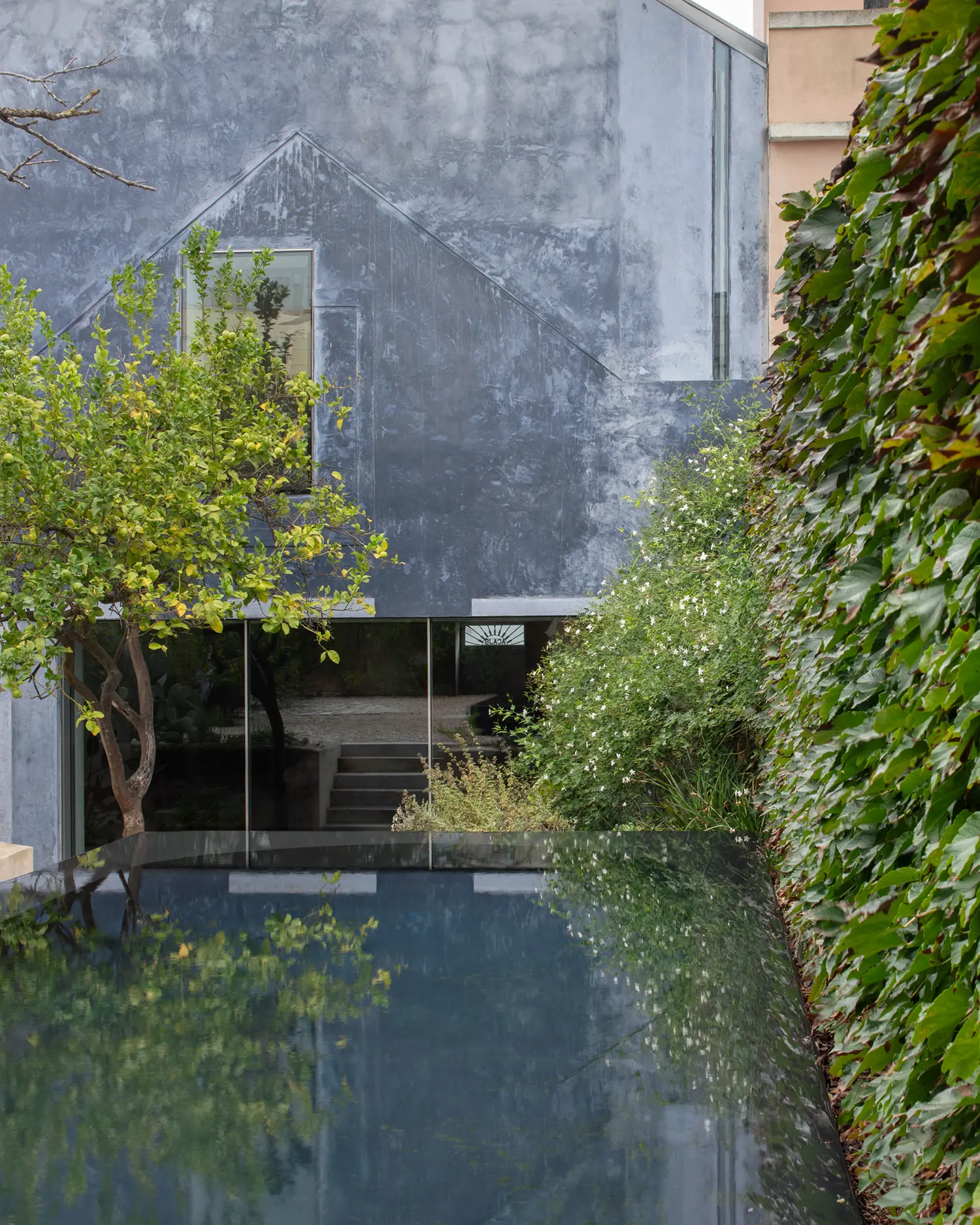
The existing building was treated as an artefact. Architectural elements from the original façades were removed, restored, and reincorporated into the new surfaces. Old and new were finished identically. The studio notes that “the different time periods are legible only in the building’s silhouette and the texture of materials” — a discipline that most residential renovation practice abandons the moment a client asks for something new to look new. Here the extension alters only the exterior form and a side passage providing access to the garden. The 1893 house underneath the blue is, structurally and spatially, still there.
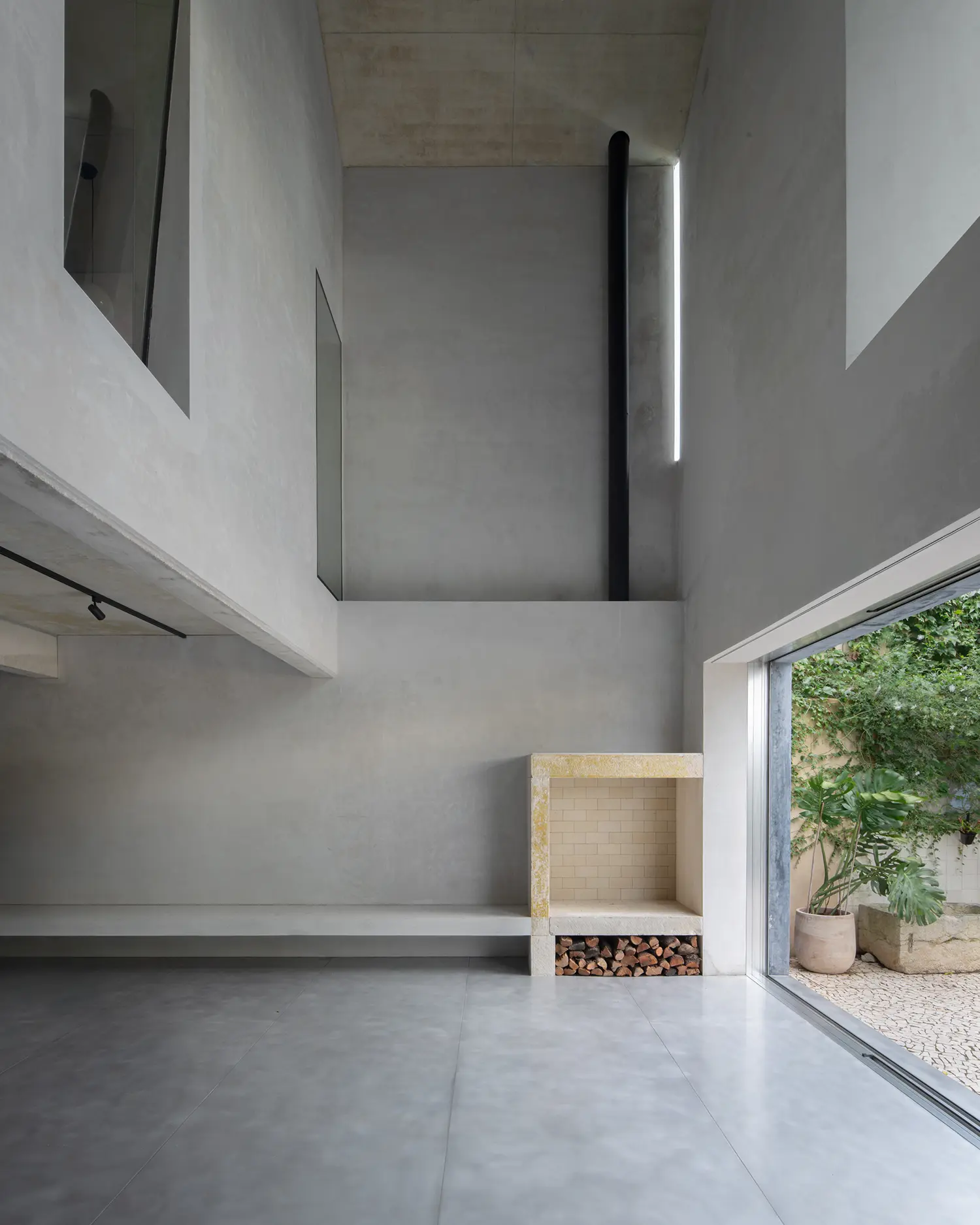
Two gestures define the spatial organization of the 251-square-metre house. A full-width cut to the front façade creates a double-height courtyard providing shade and privacy for the bedrooms; as its counterpart, a triple-height interior space faces the garden, revealing the building’s full vertical scale in a single move. The back façade carries a further complication: a vertical strip of light produced by a diagonal legal constraint that the studio chose to embrace rather than minimize. The reference is precise — as in Utzon’s Can Lis, for a few minutes at the end of each day, a ray of light enters the space and moves through it. In Lisbon’s Marvila, a planning condition becomes a sundial.

The client brief introduced the project’s most unusual programmatic element. The owners requested a garage integrated into the living room — not separated, not screened, but genuinely continuous with the daily domestic space, so that working on cars or motorbikes would not mean leaving the family. The request is treated in the project description without irony or qualification, which is itself a position: the studio accepted it as a legitimate spatial ambition, and the triple-height volume facing the garden provides the scale that makes it architecturally coherent rather than merely eccentric.

Interior finishes were deliberately left unresolved at the design stage. Once the spatial concept was fixed, all decisions concerning textures, colours, and surfaces were held open to be made on site, in collaboration with craftsmen and clients. The approach is uncommon enough to require explanation: in practice it produced an aluminium-sheeted ground floor, hand-brushed by one of the craftsmen until its surface — as the studio describes it — “resembles leather: natural, soft and luminous.” The interior walls are bare, covered only with a grey plaster scratch coat, referenced in the project notes as “Jannis Kounellis’ colour of our time.” The grey unifies every element while connecting the house, without announcement, to Marvila’s industrial past. For a comparison in how Lisbon residential architecture handles the tension between raw materiality and sensory finish, the Casa Aether by AB+AC Architects approaches similar territory through entirely different means.
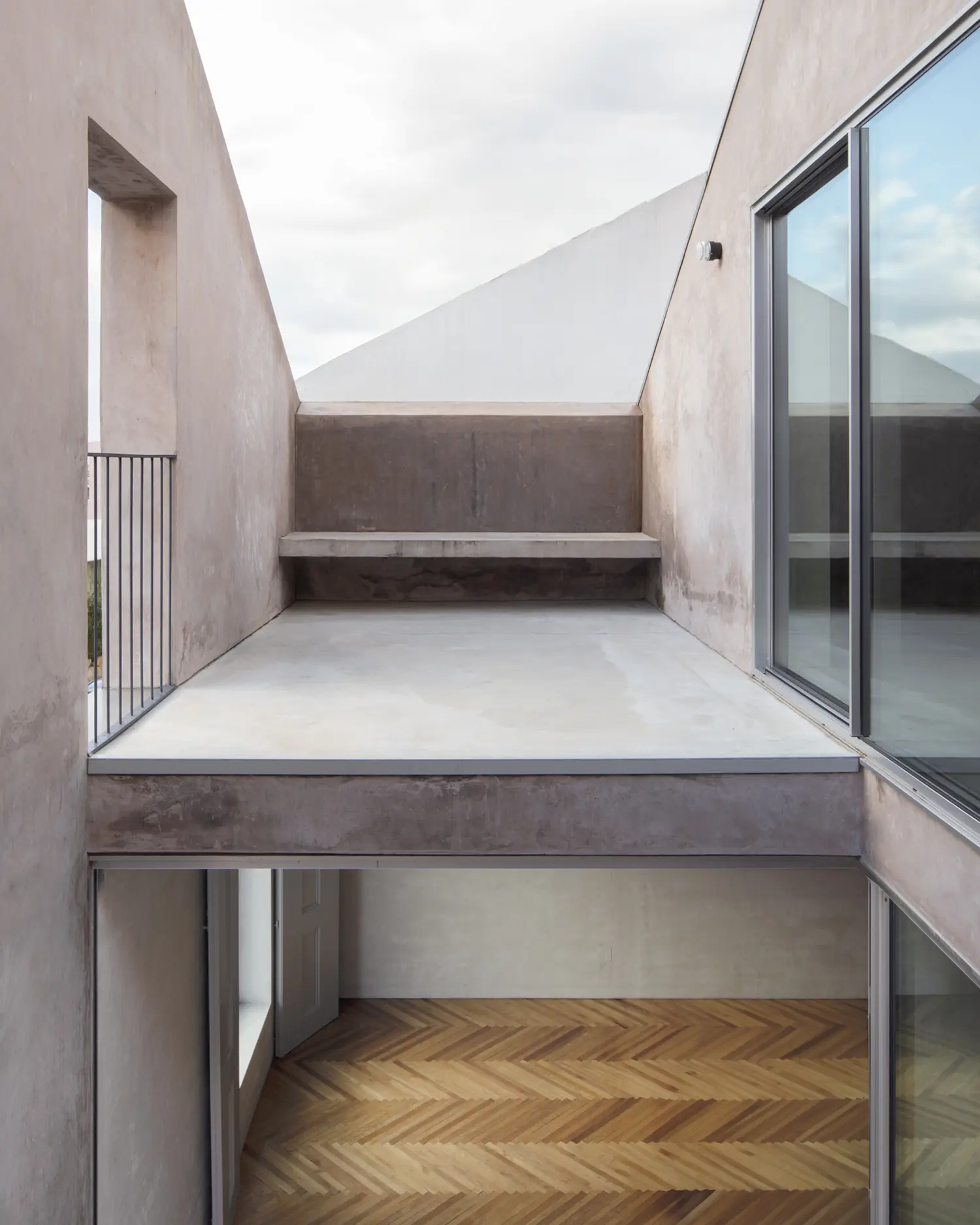
The blue is where the poverty logic breaks down — or proves itself. Ultramarine is a historical pigmented lime plaster with a specific instability: once application begins, it cannot stop. Each façade must be completed in a single continuous session, with no seams, no repairs, no second passes. On a house of any complexity, this is a significant logistical and craft constraint. On a house in Marvila where the brief explicitly called for stripped-back essentials, it is the single material decision that allowed no compromise. The result is an exterior that reads, in the studio’s own framing, as “more old than new, yet used in a way that anchors it to the present” — an ambiguity that the ultramarine shares with the district it sits in. The Barão Sabrosa apartment renovation by Aurora Arquitectos navigates a related set of questions about historic Lisbon fabric and contemporary intervention, though in a tighter urban typology.
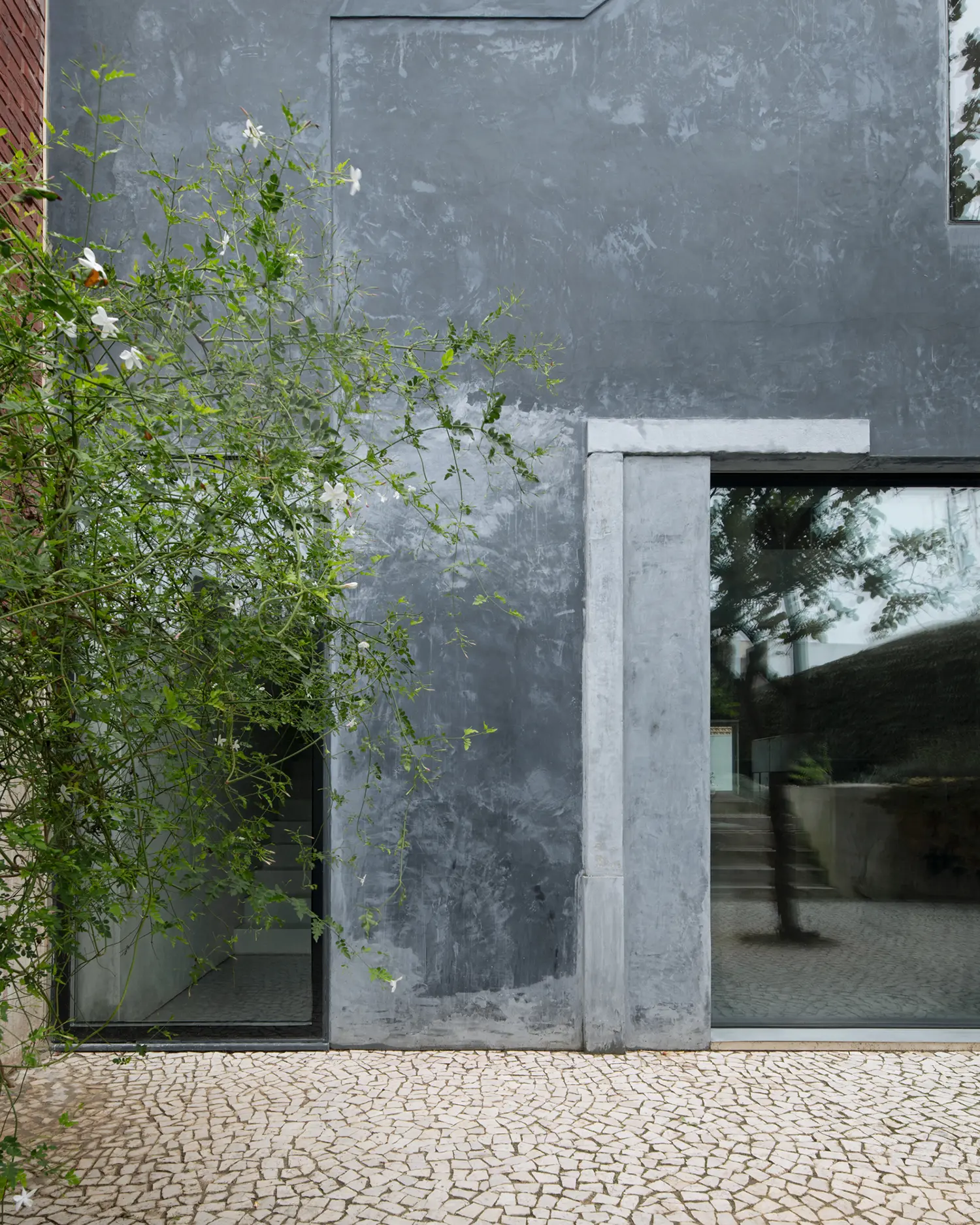
The casas poveras designation is worth taking seriously as a critical frame. The series — of which Blue House is the first — was shaped, extrastudio states, in a time of uncertainty and with a refusal to compromise on scale. Poverty in this context means absence of pretension, not absence of intention. The hand-brushed aluminium, the scratch coat grey, the on-site decision-making with craftsmen, the retained 1893 artefact below the new blue skin — none of these are cheap solutions dressed as philosophy. They are the result of a working method in which the building’s character emerges from constraint and collaboration rather than from a predetermined material palette. The musician Hermeto Pascoal is quoted in the project notes: “We did it on the spot, right there on the site. We arrived, and they were playing.” The quote is not incidental. It describes exactly how the Blue House was made.
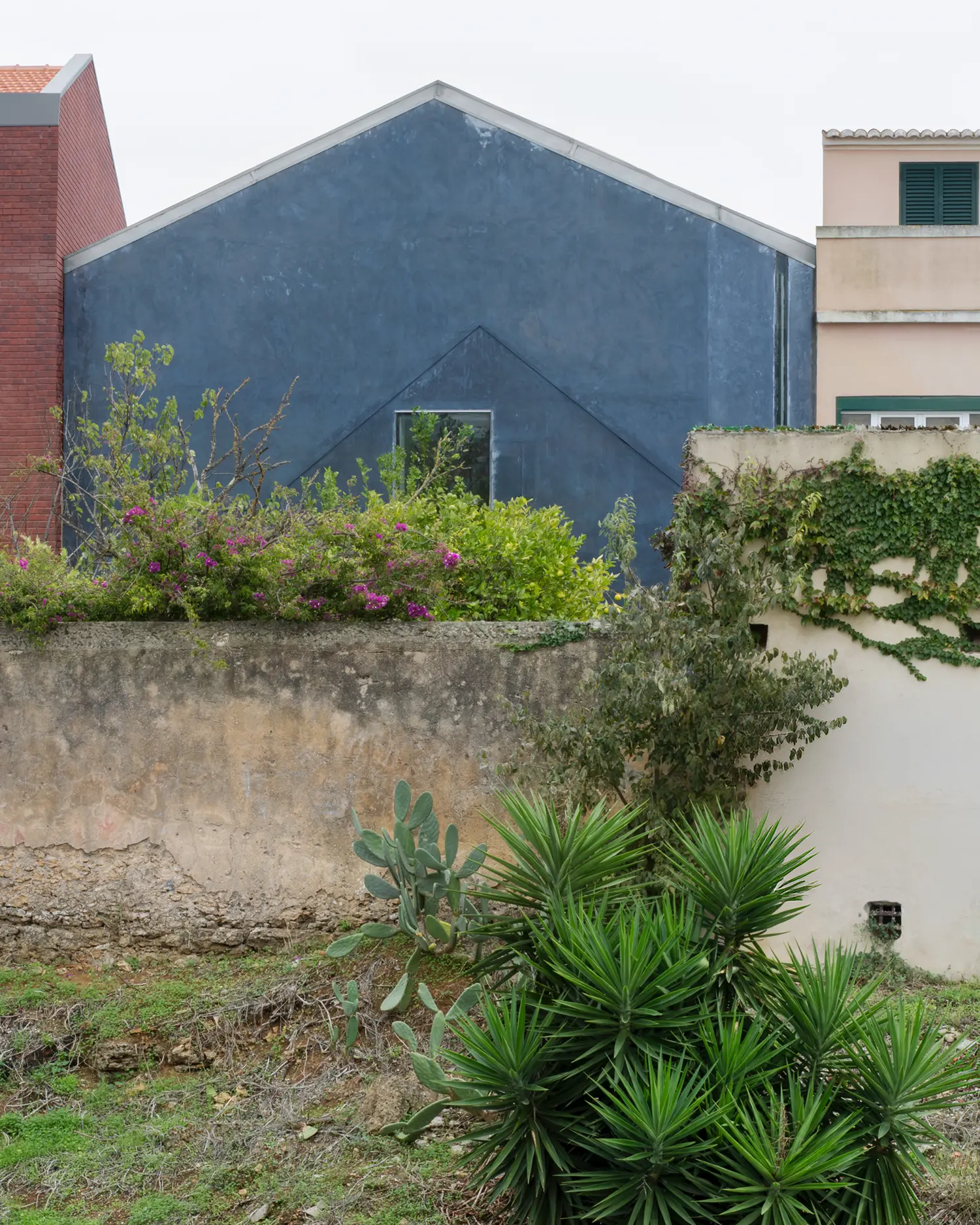
The Blue House’s most precise claim is also its most debatable one. A façade that cannot be repaired — that must succeed completely or fail completely, in a single day, in a Lisbon district where weather and logistics are not controlled variables — is not a poverty decision. It is a maximalist act disguised as restraint. The project’s character is raw and intense precisely because the blue plaster left no room for correction, and intensity produced under that kind of pressure is not the same thing as simplicity. Whether the casas poveras label accurately describes what extrastudio built in Marvila is a question the blue, on any given afternoon light, quietly refuses to settle.
Blue House by extrastudio | Location: Marvila, Lisbon, Portugal — Year: 2026 — Key materials: pigmented ultramarine lime plaster, aluminium sheeting, grey plaster scratch coat, concrete