


Rotterdam-based designer Sabine Marcelis, London architect Kyriakos Chatziparaskevas, and the Los Angeles Design Group have transformed the Empire Polo Club into a chromatic landscape for Coachella 2026, unveiling a series of immersive installations that dialogue with the desert’s shifting light and topography.
The conceptual vision for the 2026 edition sees a departure from purely decorative backdrops, favoring instead a rigorous exploration of volume and atmosphere. This year’s curation, led by the Public Art Company and Goldenvoice, centers on the idea of “generosity”—structures that serve as active participants in the festival-goer’s journey. Rather than static monuments, the works act as environmental filters, mediating the harsh Californian sun by day and radiating an internal, synthesized pulse by night.

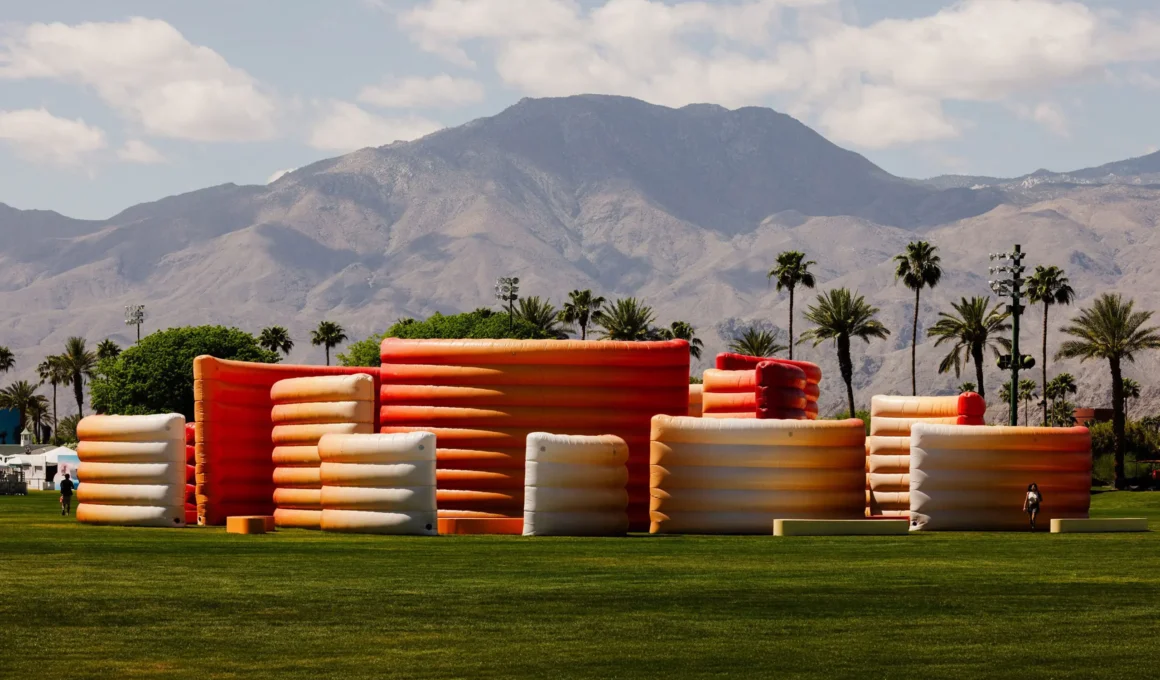
The Ombré Labyrinth created by Sabine Marcelis, titled Maze, serves as a tactile translation of the surrounding mountain ranges. Constructed from stacked, inflated PVC pipes, the work forms a series of concentric, curving walls that transition through a sunset-inspired gradient of yellow, orange, and red. Inside, the noise of the festival is muffled by the physical mass of the air-filled tubes, creating a momentary detachment from the sprawling crowds, where the chromatic density of the walls shifts as the sun moves across the sky.

Technical execution and ambition lie at the heart of this responsiveness, as Marcelis experiments with the ephemeral nature of inflatable structures. During the peak afternoon heat, the curves cast elongated, colored shadows that provide a natural cooling effect. As twilight descends, integrated light strips within the translucent material begin to breathe, transforming the solid-looking volumes into a glowing, weightless mirage that echoes the electronic rhythms of the nearby stages.

A botanical geometry defines the contribution of architect Kyriakos Chatziparaskevas, who presents Starry Eyes, a collection of pleated, orb-like volumes standing up to 40 feet tall. These structures reference the geometry of the golden barrel cactus, a staple of the Indio landscape, inviting attendees to occupy the hollow cores and look upward through star-shaped skylights. The work reframing the desert sky through a rigid, mathematical lens, creating a complex play of light and shadow across its metallic surfaces.

Brutalist totems and structural tension are introduced to the grounds by The Los Angeles Design Group (LADG) through Visage Brut, a modular tower that reimagines the concept of a landmark. Composed of warped and folded boxes, the installation appears to be on the verge of losing its structural integrity, yet it stands as a defiant, green-glowing beacon. It is an exercise in geometric distortion, challenging the viewer’s perception of stability and scale within the open expanse of the valley.

The satirical Hippo Empire returns via the collective Dedo Vabo with Network Operations, a surrealist command center managed by lifelike hippos. This sharp critique of corporate infrastructure serves as a chaotic counterpoint to the minimalist rigor of other works, while nearby, the kinetic lightness of Kites by Güvenç Özel takes to the sky. These oversized, tethered structures use the desert wind as a medium, displaying geometric graphics that bridge the gap between the monumental installations below and the vast Californian atmosphere.

A lasting contextual impact is intended for these works well beyond the two-weekend duration of the festival, emphasizing a continued effort toward sustainability and civic engagement. Several pieces are designed with a defined afterlife; following the event, the modular components are often repurposed or permanently relocated to public parks within the Coachella Valley. This circular approach ensures that the high-concept experiments eventually integrate into the permanent urban fabric of the region.

The sensory resonance of walking through the polo fields this year feels like navigating a living gallery of environmental sculpture where light, air, and scale converge. The air-filled walls of the Maze vibrate with the bass of the subwoofers, while the metallic pleats of Starry Eyes shimmer under the intense desert glare. By prioritizing human interaction over the purely “Instagrammable” moment, the 2026 installations succeed in creating a sense of wonder, offering a profound reflection on how we occupy and perceive the natural landscape.