


In the evolving landscape of Wuhan, China, where urban density increasingly seeks a dialogue with recreational landscapes, DL atelier has unveiled a structure that challenges the traditional boundaries between sculpture and shelter. Known as The Dancing Mountain, the LuxeIsland Restaurant serves as a focal point for a new children’s playground, marking the latest chapter in a long-standing collaboration between the architects and developer LUXELAKES. Rather than conforming to the rigid geometries of typical commercial pavilions, the project emerges as a playful, topographical intervention that draws inspiration from both classical Eastern poetry and Western modernism.

A conceptual synthesis of motion and memory defines the project’s origin. Lead architect Liu Yang cites the evocative, straightforward verses of Southern Song Dynasty poet Jiang Jie as a primary influence, seeking to capture a sense of “indescribable lightness” within a permanent structure. This poetic brevity is translated into a form that dances—a concept fueled by the juxtaposition of Henri Matisse’s rhythmic “Dance” and the sweeping vitality of Wang Ximeng’s “A Thousand Li of Rivers and Mountains.” The result is a spatial configuration that feels less like a static building and more like a captured moment of movement, designed to inspire “somatic intuition” in its youngest visitors.
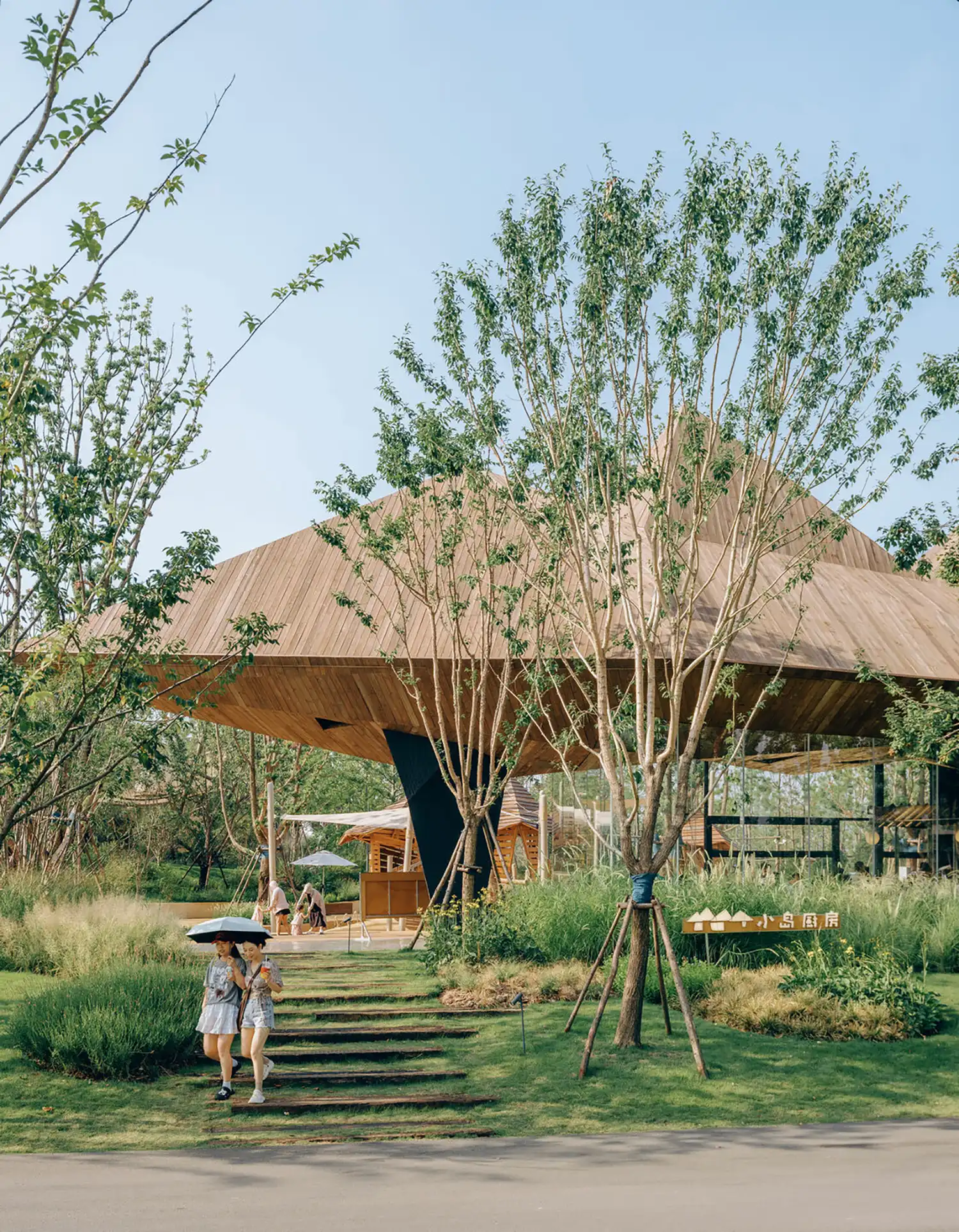
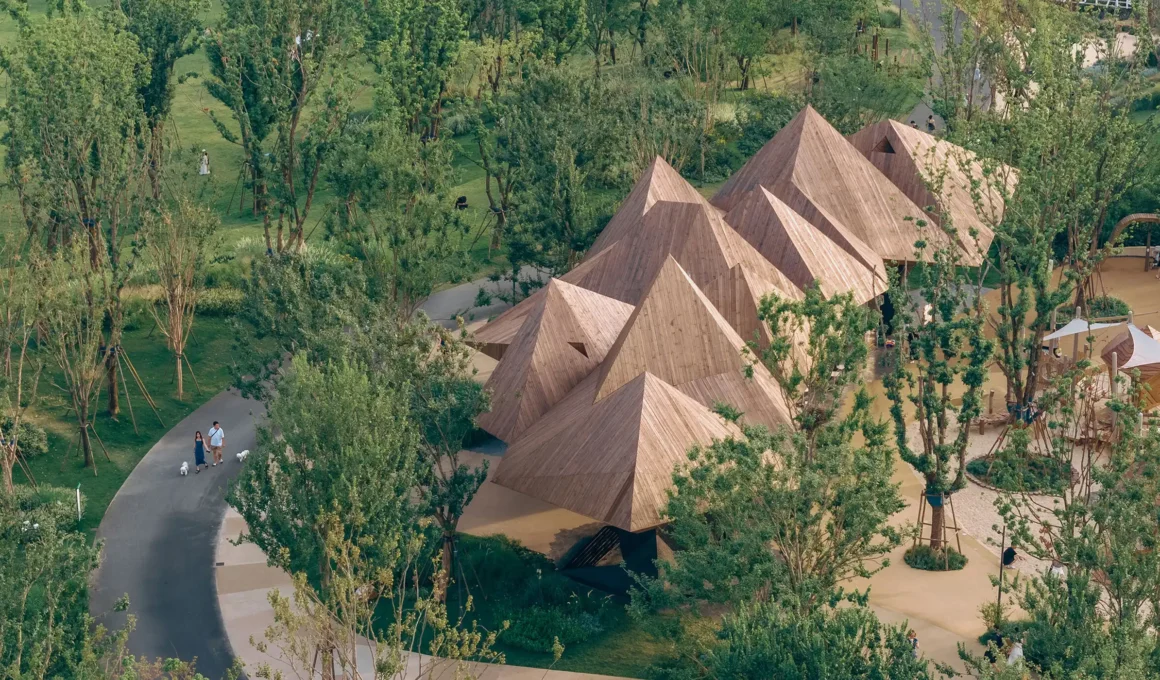
The architectural materiality and structural logic were born from a rigorous process of refinement and economic pragmatism. Originally envisioned with a skin of oxidized copper, the design evolved into a series of faceted volumes clad in solid wood strips. This shift from double-curved surfaces to flat, geometric planes did not diminish the building’s impact; instead, it sharpened the visual symbols of the structure. By utilizing a steel space frame, the architects achieved dramatic cantilevers exceeding ten meters, allowing the massive wooden “mountains” to float above the ground. These volumes are supported by four clusters of composite steel columns, artfully disguised in black stone panels that seamlessly integrate functional elements like outdoor seating and wash stations.
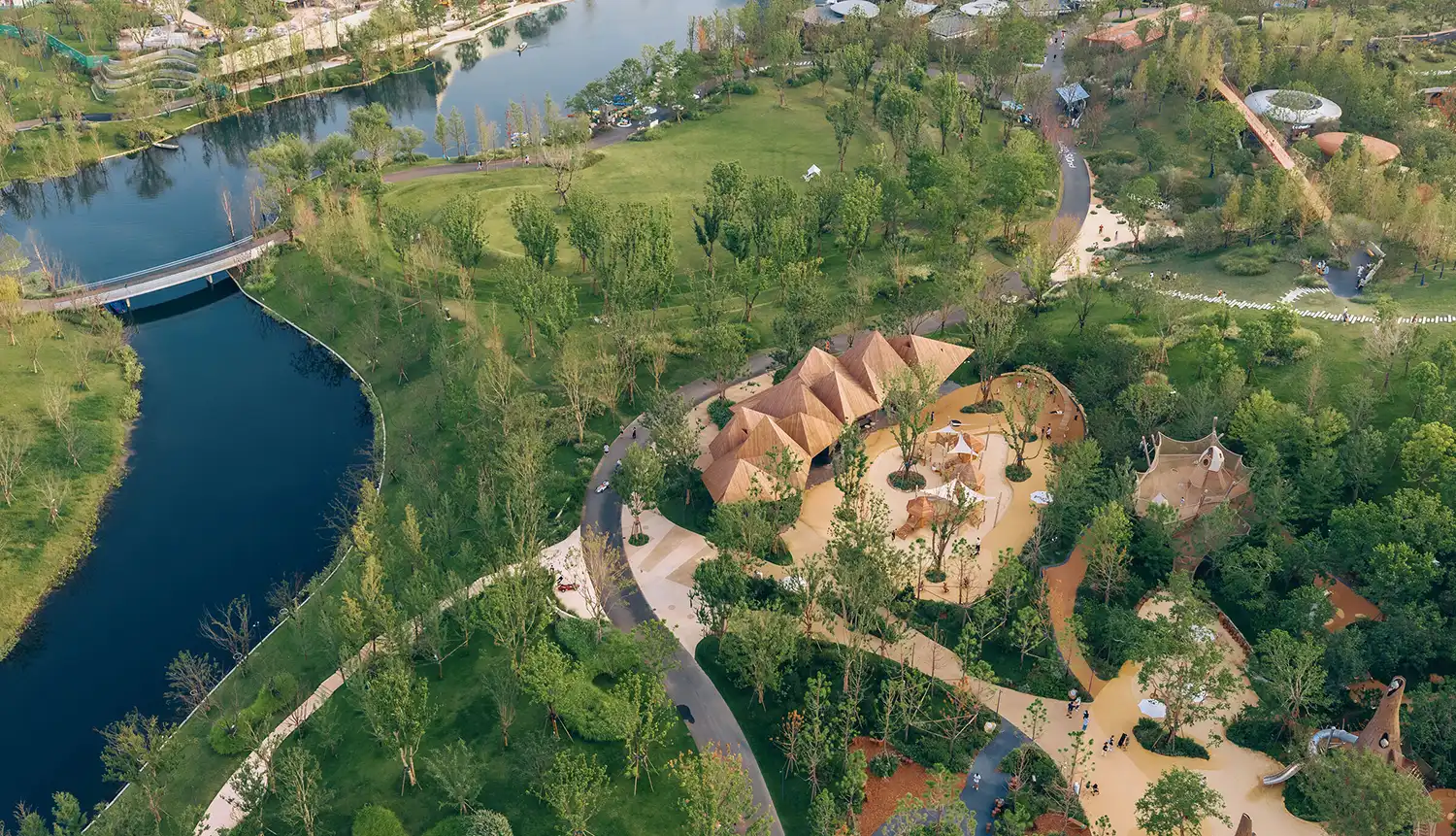
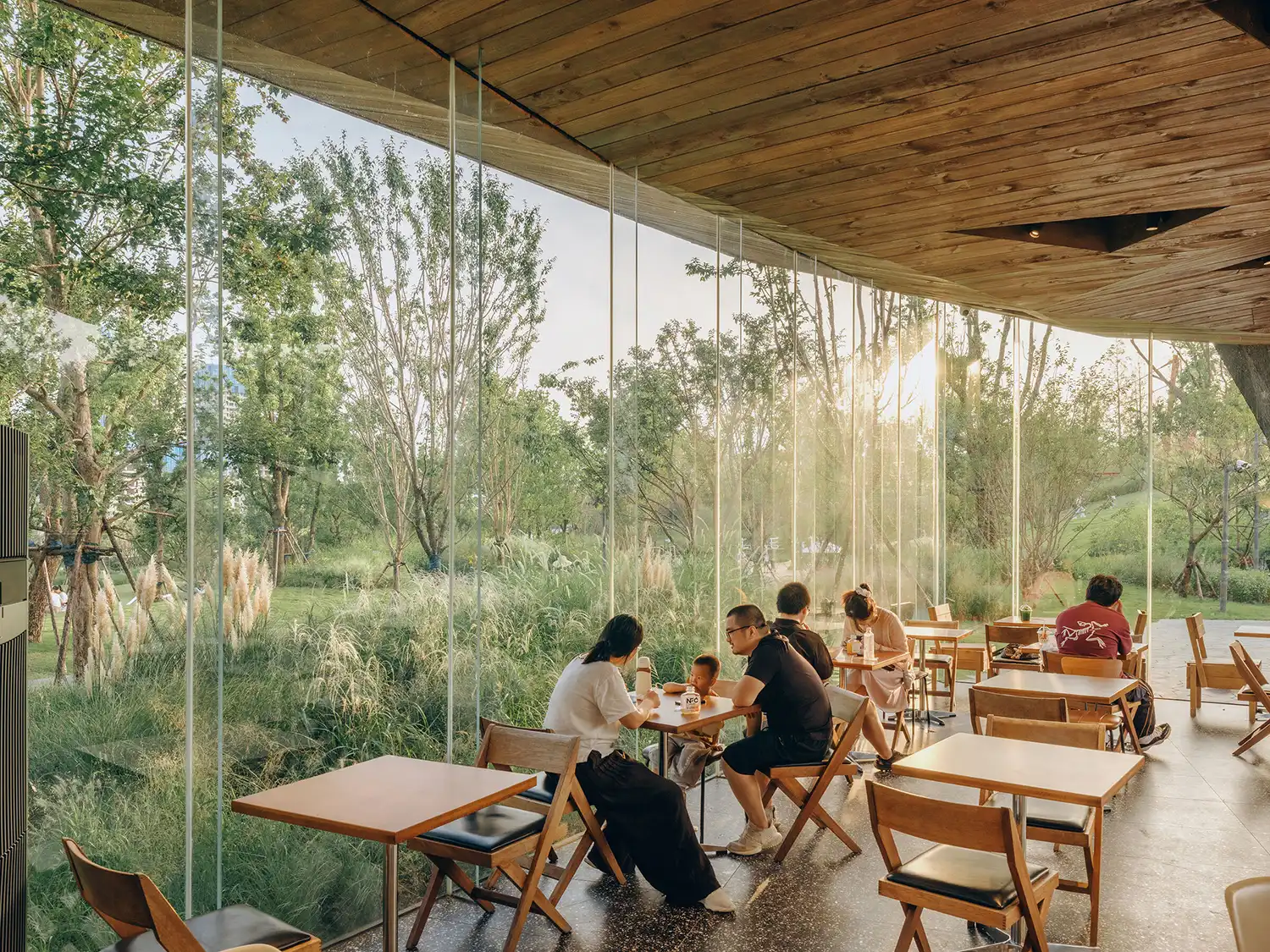
Navigating the sensory experience of the site, visitors approach the building through a curated sequence of woodland and open lawn. Situated at the gateway of the island, the restaurant acts as a beacon, its height and mass calculated to remain visible through the gaps in the foliage from across the river. As one draws closer, the scale and proportion of the floating timber pyramids become overwhelmingly physical. The cantilevered eaves stretch out like a giant canopy, providing a semi-outdoor sanctuary for parents while creating a high-energy threshold for children. The transparent glass envelope of the restaurant and water bar below provides a stark, ethereal contrast to the heavy, suspended volumes above, maintaining a constant visual link between the interior bustle and the surrounding play-scape.
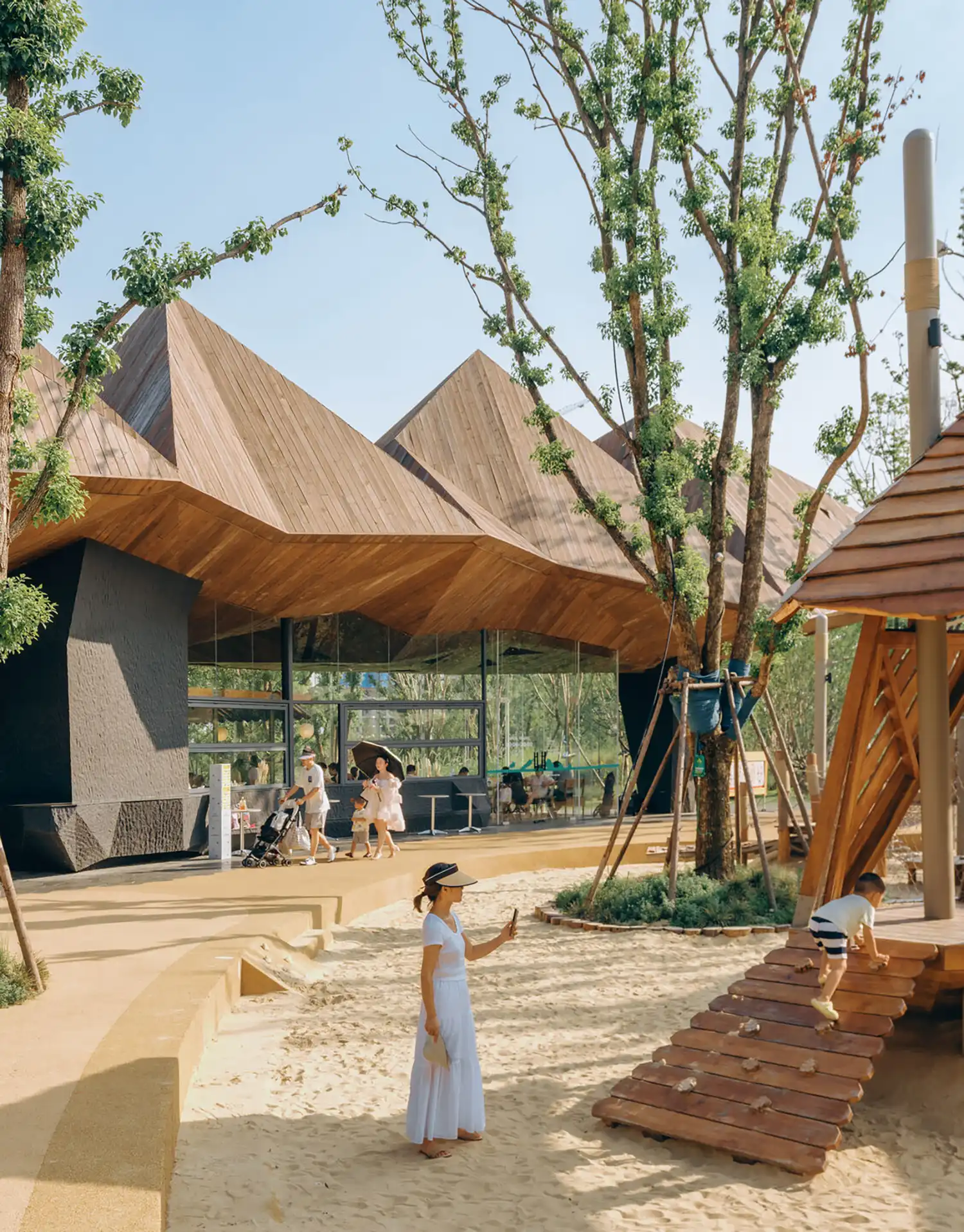
Beyond mere functionality and program, the project—originally titled “The Brave Cabin”—seeks to serve as an emotional catalyst. While the roof was initially intended as a dining terrace, it was ultimately preserved as a purely visual and atmospheric element, reinforcing the idea that architectural value is not always tied to physical accessibility. The “inner voids” of the roof structure cleverly conceal the HVAC and kitchen systems, allowing the exterior form to remain a pure, unencumbered symbol of exploration. By leaning into the “somatic intuition” of the visitor, the design encourages children to dash toward the climbing equipment with renewed courage, using the building’s dramatic posture to elevate their mood and sensory awareness.
A philosophical reflection on the human condition concludes the narrative of The Dancing Mountain. DL atelier views architecture not just as a tool for survival, but as a necessary extension of the self—much like art or music. In the context of Wuhan’s LuxeIsland, the restaurant becomes a “third-party tool” that supplements the human spirit, offering a sense of nobility and dignity to the act of play. By harmonizing the ruggedness of a mountain with the fluidity of a dance, the project stands as a testament to the power of human-centric design, proving that even a small-scale pavilion can offer a profound contribution to the wholeness of the individual.