

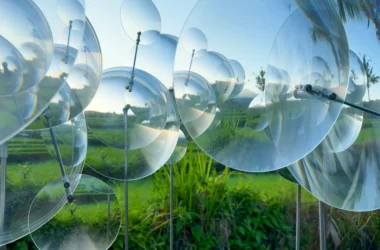

The Lucanian landscape in Policoro, Italy, an area rich with historical resonance, has received a stunning new landmark that both honours and radically reinterprets its ancient past. Belgian architecture and art duo Gijs Van Vaerenbergh have intervened on the site of an Archaic Temple with a visionary structure titled Inverse Ruin, offering an innovative artistic approach to relating to an archaeological artifact. Moving beyond traditional preservation, this project is a profound conceptual and material statement that instantly captures the attention of the architecture, design, and art world.

The Inverse Ruin challenges our ingrained perception of architectural decay. Where natural processes see structures crumble from the roof down to the foundations, Gijs Van Vaerenbergh inverts this trajectory entirely. Their artwork presents a suspended glimpse of the temple’s upper part, held aloft by a dynamic reticular support structure. This creative intervention allows visitors to perceive the monumental scale of the ancient building, even though only a few original traces remain at ground level. The artists’ reinterpretation of the ruin’s jagged forms creates an explicit theatrical narrative that manipulates the visitor’s physical and perceptual expectations.

As the Greek temple stands as the quintessential architectural form at the root of Western culture, capable of unleashing a universal evocative power, the Inverse Ruin serves as a conceptual interpretation of this powerful archetype. It exists as an artistic reading of the vanished monument, finding a captivating balance between image and matter. The project is designed to be a significant cultural attractor, leveraging the third dimension—the evocation of the architectural elevation—to harmoniously unite the preservation, communication, and enhancement of this significant heritage.

Standing at an impressive height of around twelve meters, the installation meticulously recalls the original proportions and formal values of the temple through a decidedly contemporary intervention. It boldly employs experimental construction techniques and materials drawn from the industrial world. Metal elements form the essential supporting structure, while mortar is ingeniously used to craft the gravity-defying, suspended sculpture. This thoughtful material contrast highlights the work’s inherent tension, positioning itself compellingly between reality and illusion, materiality and abstraction, container and content.

Gijs Van Vaerenbergh deliberately questions the contemporary meaning of the ruin, often a complex result of profound historical and architectural processes. The artists manipulate the conventional architectural grammar of decay to enhance the illusion, achieving this through meticulous compositional strategies. They skillfully remove some elements while inserting others, simulating authentic stone fractures with modern joints, and heightening the volumetric complexity via broken rhythms, carefully calibrated balances, and powerful dramatic detailing. The result is a work driven by a visible internal tension that encourages deeper reflection.

In essence, the iconic temple is overturned, deconstructed, and fragmented. Architectural drawing, material presence, and chromatic elements are expertly balanced into a new spatial poetics. This generates unexpected broken sightlines and silhouettes against the sky, engaging in a dynamic dialogue with the wider Park’s landscape that subtly shifts with every change in the visitor’s point of view. Gijs Van Vaerenbergh does more than just reconstruct a monument according to altered physical rules; they challenge our cultural perception, reflecting on the very logic and aesthetics of the contemporary ruin in a way that is profoundly memorable and design focused.